
What Is an Advent Calendar? History, Types, and How to Choose One
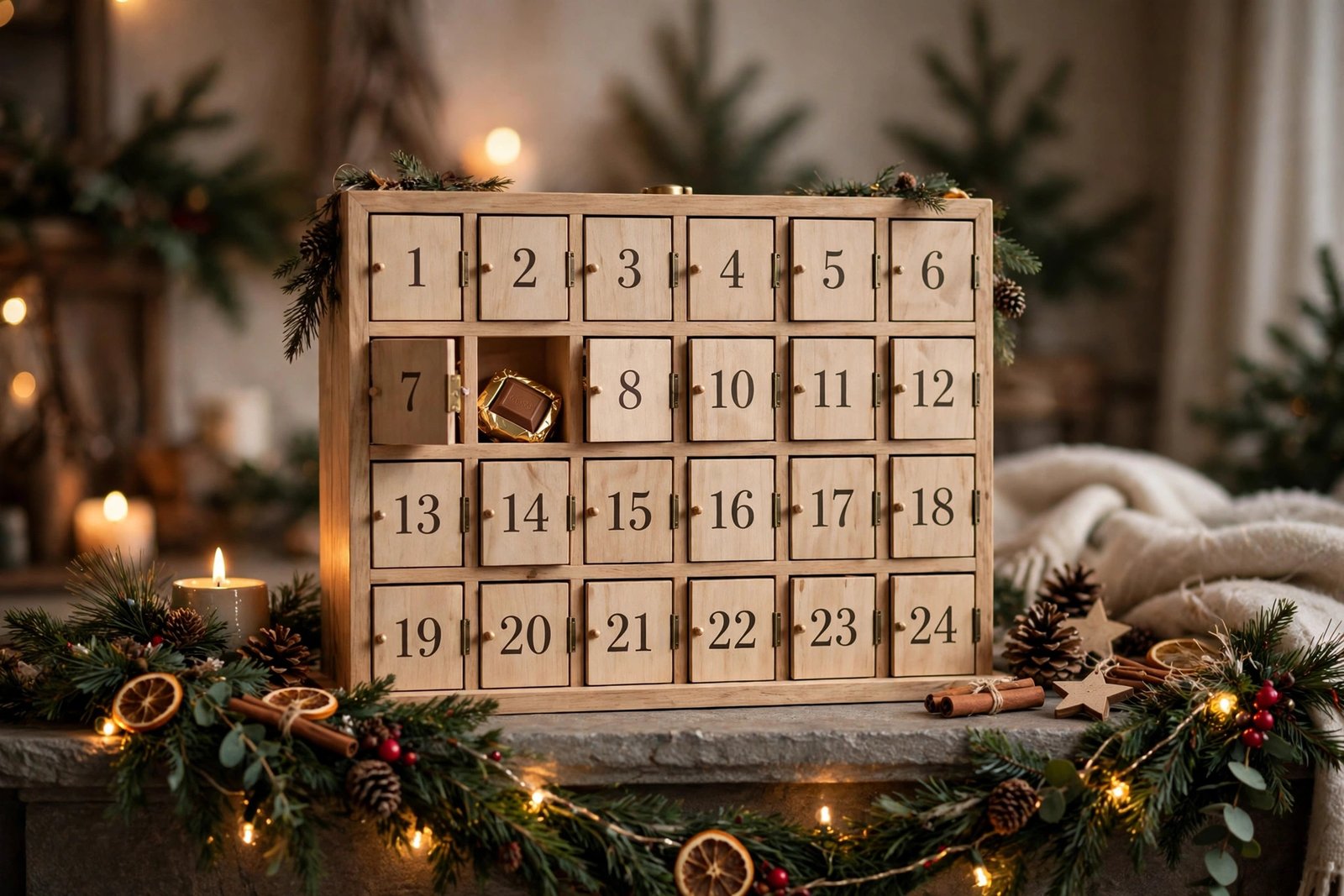
Every December, the same small ritual plays out in millions of homes: a child races to the calendar on the wall, opens one tiny numbered door, and fishes out the treat hiding behind it. But what is an advent calendar, exactly — and where did the idea come from?
At its simplest, it is a countdown to Christmas. Behind each numbered door, from December 1 to December 24, waits a small surprise: a chocolate, a picture, a miniature bottle of perfume, a tiny toy. One door a day, no peeking ahead, and Christmas morning arrives before you know it.
What Is an Advent Calendar? A Definition That Covers Them All
An Advent calendar is a special calendar used to count down the days of Advent, the season leading up to Christmas. Most have 24 numbered doors or drawers, one for each day from December 1 to Christmas Eve. Each morning you open the door that matches the date and find a small surprise inside.
Ask a five-year-old what is an advent calendar and you will get the best definition there is: a box that makes waiting for Christmas bearable. That is the whole point — 24 small daily events instead of one long, impatient month.
The classic version is a flat cardboard calendar with a festive scene printed on the front — a snowy village, a nativity scene, Santa’s workshop — and perforated doors you push open. Behind each door sits a picture or a small chocolate.
Modern versions stretch the idea in every direction. There are calendars filled with beauty products, craft beer, cheese, candles, LEGO bricks, and tea. Some are reusable wooden boxes with drawers you fill yourself. Others are digital, with a new video or puzzle unlocked each day. The wrapping changes; the ritual does not.
One thing worth knowing: not every Advent calendar has 24 doors. Some have 25, with a final door for Christmas Day itself. A few religious calendars follow the church season instead of the month, starting on the first Sunday of Advent.
The Meaning of Advent: Where the Word Comes From
To understand the calendar, you need the season it counts down. The word Advent comes from the Latin adventus, meaning “coming” or “arrival.” In the Christian church calendar, Advent is the season of preparation for Christmas. Britannica’s entry on Advent traces the season back to the early church, when it began as a period of fasting and reflection before Christmas.
Advent begins on the fourth Sunday before Christmas Day and ends on Christmas Eve. Because Christmas falls on a different day of the week each year, the season lasts anywhere from 22 to 28 days. Each of the four Sundays has a traditional theme — hope, peace, joy, and love — which Christianity.com’s guide to Advent explains in detail.
In 2026, Advent begins on Sunday, November 29, and runs through Christmas Eve, Thursday, December 24. The four Sundays fall on November 29, December 6, December 13, and December 20. That is why commercial calendars start on December 1.
None of this means you need to be religious to enjoy an Advent calendar. For most people today it is simply a December ritual — a small daily pleasure that marks the run-up to Christmas, much like putting up the tree or baking the first batch of Christmas cookies.
A Short History of the Advent Calendar
The Advent calendar was born in 19th-century Germany, among Lutheran families looking for a way to help their children through the long wait for Christmas. The earliest methods were wonderfully simple: parents drew 24 chalk marks on a door, and the children wiped one away each morning. Others lit a candle and let it burn down a notch each day. The German word for the calendar, Adventskalender, captures that plain, homemade origin.
The idea of a printed calendar came from a childhood memory. German printer Gerhard Lang grew up with a calendar his mother had made him: 24 small sweets stuck onto a piece of cardboard, one to eat each day. As an adult working in printing, he turned that memory into a product. In 1908, his firm Reichhold & Lang produced what is widely regarded as the first printed Advent calendar: 24 small pictures to cut out and paste onto a numbered sheet. A few years later, Lang added the little doors that are now the defining feature. Christianity.com’s history of the Advent calendar traces the same path from homemade countdown to printed product.
Production stopped during the Second World War, when paper and cardboard were rationed and the Nazi regime banned illustrated calendars. After the war, Stuttgart printer Richard Sellmer obtained a printing licence from the American occupation authorities and reintroduced the Advent calendar in 1946, with a snowy village scene called “The Little Town” that is still sold today.
The moment that made the calendar famous in the United States came in 1953, when President Dwight D. Eisenhower was photographed opening an Advent calendar with his grandchildren. The photographs were part of a fundraising appeal by the National Epilepsy League, which was selling German-made calendars, and they ran in newspapers and magazines across the country. National Geographic’s history of Advent records the same turning point: a presidential photo op turned a German custom into an American December habit.
Chocolate arrived behind the little doors in the 1950s, and Cadbury began producing chocolate Advent calendars commercially in 1971. It took another couple of decades for the chocolate version to dominate the market. The picture calendar still exists, but for most children today, an Advent calendar means chocolate — one small piece a day, eaten the moment the door opens.

| Year | Milestone | What changed |
|---|---|---|
| 1850s | Chalk marks on doors | German Lutheran families count down December with chalk lines, candles, and pictures |
| 1908 | Gerhard Lang’s first printed calendar | Lang turns his mother’s homemade cardboard countdown into a commercial product |
| 1946 | Richard Sellmer reintroduces calendars | Post-war printing resumes with “The Little Town”; soldiers carry calendars home |
| 1953 | Eisenhower photographed with grandchildren | The presidential photo popularizes Advent calendars across the United States |
How an Advent Calendar Works
Using one is simple, but a few conventions keep the ritual intact. Start on December 1, open the door numbered for that day, and take out what is inside. Repeat daily until Christmas Eve, when the last door opens.
The one rule that matters is: one door per day, in order. Opening them all at once defeats the purpose, and every family with children knows the temptation is real.
Timing is worth planning. Calendars go on sale from late September, and the popular ones — the beauty boxes, the LEGO sets, the well-known chocolate brands — regularly sell out by mid-November. If you want a specific calendar, buy it in October.
The Main Types of Advent Calendar in 2026
Walk into any shop in November and the choice is bewildering. The short version of what is an advent calendar in 2026 is that it is no longer one product but a whole category.
| Type | Typical price | Best for | Reusable? |
|---|---|---|---|
| Chocolate | Roughly $5–$15 | Children and traditionalists | No — single use |
| Beauty | Roughly $30–$150+ | Adults who love skincare and makeup | No — single use |
| Toy | Roughly $25–$60 | Children aged 4–10 | No — single use |
| Wine | Roughly $75–$200+ | Adults, wine lovers, gifts | No — single use |
| DIY fill-your-own | Roughly $20–$60 to fill | Families, personal gifts | Yes — refill every year |
Chocolate Advent Calendars
The original, and still the bestseller. A flat cardboard calendar with a milk chocolate behind each door, usually shaped like a star, a bell, or a tiny Santa. The chocolate is rarely remarkable — thin, sweet, and gone in two bites — but that is not the point. The point is the ritual, and for children the ritual is perfect.
Beauty Advent Calendars
The biggest growth category of the past decade. Beauty calendars hide miniature skincare, makeup, and fragrance behind each door: serums, lipsticks, hand creams, and nail polish. Prices range widely, from roughly $30 for a high-street version to well over $150 for a luxury one. Check the value of the contents against the price — reputable brands usually print the total value on the box.

Toy Advent Calendars
Toy calendars give a small figure or accessory each day, building toward a little set by Christmas Eve. LEGO is the best-known example, with a mini build behind each door, but there are versions with dinosaurs, dolls, cars, and collectible figures. They cost more than chocolate calendars, roughly $25–$60, but the contents last long after December.
Wine and Spirits Advent Calendars
The adult answer to the chocolate calendar: 24 miniature bottles of wine, whisky, gin, or craft beer, one per day. Wine calendars typically run roughly $75–$200 or more. They make an excellent gift, but buy from a reputable seller and check the bottle sizes.
DIY Fill-Your-Own Advent Calendars
The most personal option, and the one that lasts. A reusable wooden box, fabric hanging, or set of numbered bags that you fill yourself each year. You choose every surprise, so it fits the recipient exactly — and it costs whatever you decide to spend filling it.
How to Choose the Right Advent Calendar
Choosing well comes down to four questions. First, who is it for? A calendar for a six-year-old and a calendar for a colleague are different products. Second, what is your budget? Decide the number before you browse, because prices run from a few dollars to several hundred.
Third, what is actually inside? Read the contents list on the back of the box before you buy. For chocolate, check the allergy warnings. For beauty, check whether the products suit the recipient’s skin type. For toys, check the age guidance and whether the pieces need batteries.
Fourth, how long should it last? A paper calendar is used once and recycled. A wooden or fabric calendar is a keepsake that comes back every December, and over five or six years it works out cheaper than buying a new one annually.
A practical tip: buy early, and buy from a shop you trust. The calendars that sell out first are the ones everyone talks about in November, and resellers mark them up sharply. If you miss the one you wanted, a DIY calendar filled with treats from your own kitchen is a better fallback than an overpriced resale.
How to Make a DIY Fill-Your-Own Advent Calendar
Making your own is simpler than it looks, and it is the version children remember longest. You need a container with 24 compartments and 24 small fillers: a wooden drawer box, a fabric wall hanging with pockets, or 24 small paper bags pegged to a string.
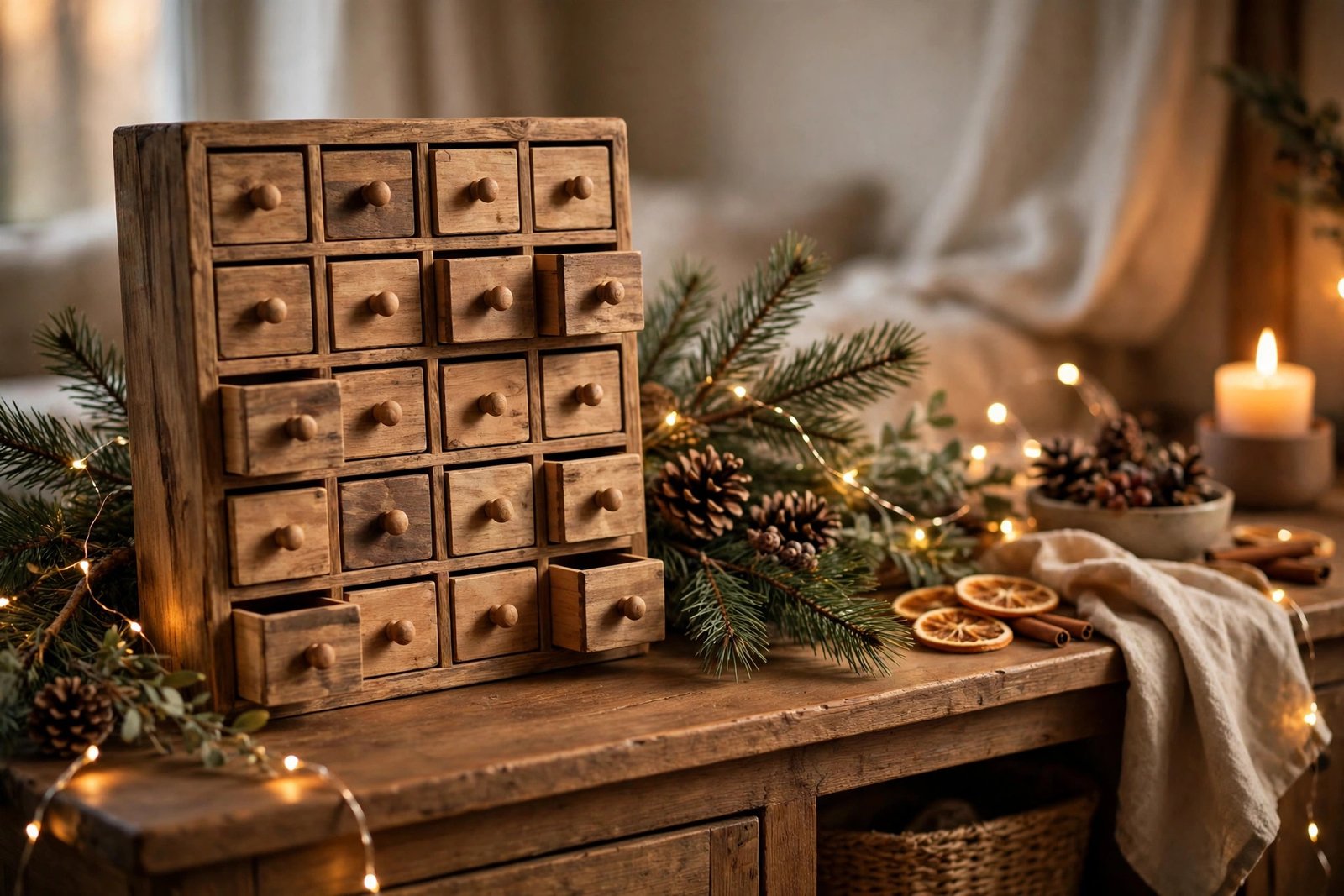
Start by deciding a theme, because 24 random items feel like a lucky dip. For children, a mix works well: small chocolates, stickers, a tiny toy every few days, and a joke on a folded slip of paper. For an adult, try a tea calendar with a different tea bag each day, or a self-care calendar with bath salts and a candle.
Keep the fillers small and flat. Drawers and pockets are smaller than you think. Wrap each item in tissue paper so the contents stay hidden, and number the compartments clearly.
Fill the calendar together if you can. Letting children choose some of the fillers for a sibling’s calendar teaches them the giving side of the ritual. And if you are making one for a partner, slip in a few personal touches: a photo, a voucher for breakfast in bed, or a note that says what you love about them.
A DIY calendar also makes a thoughtful gift in itself. Fill it, wrap it, and give it at the end of November — it is more personal than anything on a shop shelf. If you need inspiration for what to put inside, our guide to the best gifts for kids in 2026 is a good place to start.
Frequently Asked Questions
When do you start an Advent calendar?
On December 1. Open the door numbered 1 that morning, then one door a day until December 24. If your calendar has a 25th door, save it for Christmas morning.
Do Advent calendars always have 24 doors?
Most do, covering December 1 to 24. Some have 25 doors, adding Christmas Day. A few have 12 doors, for the twelve days of Christmas, and religious versions can run 22 to 28 days, matching the length of Advent in a given year.
Are Advent calendars religious?
They started that way — the calendar grew out of German Lutheran family customs for counting down to Christmas. Today, most are secular: chocolate, beauty products, and toys have nothing to do with church. But religious versions still exist, with Bible verses or nativity pictures behind each door.
When should I buy an Advent calendar?
As early as you can. The most popular calendars go on sale in late September or October and regularly sell out by mid-November.
What do you put in a DIY Advent calendar?
Small, flat things: chocolates, tea bags, stickers, hair clips, miniature toiletries, and jokes on folded paper. Avoid anything bulky or breakable, and check the size of your compartments before you buy the fillers.
Can adults use an Advent calendar?
Absolutely — what is an advent calendar today is as much an adult ritual as a children’s one. Beauty, wine, coffee, cheese, and book calendars are made for grown-ups, and plenty of adults buy the chocolate version for themselves too.
Conclusion
So what is an advent calendar, once you strip away the marketing? It is a German invention from the 1850s that turned waiting into a daily pleasure: 24 small doors, one opened each morning, each hiding a little surprise. It survived two world wars, crossed the Atlantic on a presidential photograph, and grew from chalk marks on a door into a whole shelf of chocolate, beauty, toys, and wine.
Pick the one that fits the person it is for, buy it before the popular ones sell out, and open the first door on December 1. Or make your own — a wooden box, 24 small surprises, and an evening spent filling it. Either way, the calendar does its quiet job: it makes December feel shorter and sweeter, one door at a time. And when the countdown ends, our guide to how to host Christmas dinner covers the big day itself.
And if you are still deciding, start simple. A classic chocolate calendar costs only a few dollars, and it is the version that started it all. Open door one on December 1, and see how the month feels. By Christmas Eve, you will understand why this small German tradition conquered December — and why, after Boxing Day has come and gone, you will already be thinking about next year’s calendar.



