

If your car insurance renewal just landed like a punch, you’re not imagining it. For several years running, auto insurance has been one of the fastest-rising costs in the American household budget — outpacing groceries, rent, and even medical care at times. Understanding why car insurance is so expensive right now takes a little more than “everything got pricier.” There are specific, measurable forces pushing your bill up: repair shops billing for sensor calibrations that didn’t exist five years ago, hurricane seasons priced into your zip code, state laws rewriting coverage minimums, and a quiet industry habit of charging loyal customers more than newcomers.
Here’s the good news buried in the data: the worst of the surge is over. The national numbers peaked and have actually started to fall. But “national” is doing a lot of heavy lifting — your renewal depends on your state, your car, and whether you’ve shopped around lately.
The data behind why car insurance is so expensive
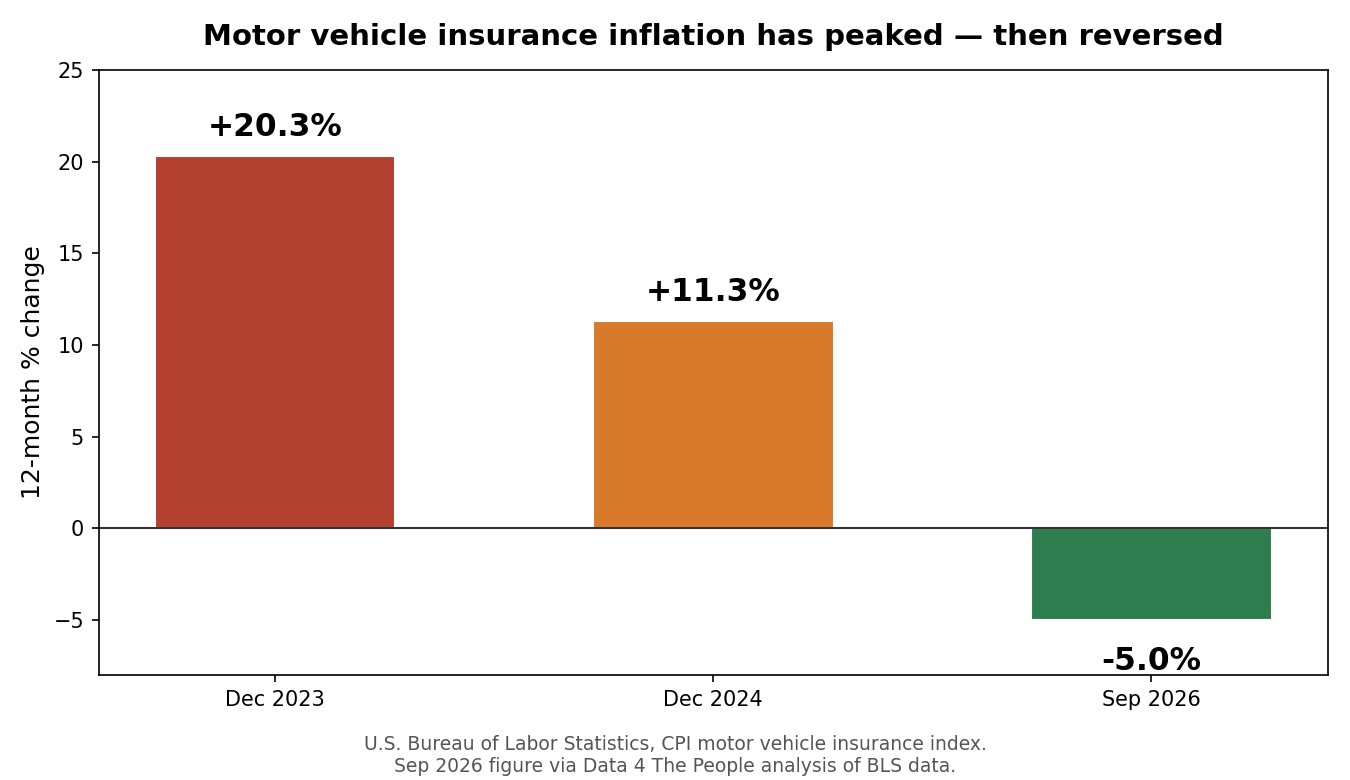
The Bureau of Labor Statistics tracks what it calls the motor vehicle insurance index, which covers liability, collision, comprehensive, medical payments, and uninsured-motorist coverage for private passenger vehicles. It’s the closest thing to an official scoreboard for premiums, and its recent history is startling: the index rose 20.3 percent in the 12 months ending December 2023, then another 11.3 percent in the 12 months ending December 2024. That’s roughly a one-third increase in two years — for something most states legally require you to buy.
Then the curve bent. By January 2025 the year-over-year increase had cooled to 11.8 percent, and during 2026 the index actually started declining — an analysis of BLS data found motor vehicle insurance prices fell 5.0 percent in the 12 months through September 2026, one of the largest drags on headline inflation that month.
So why does your bill still feel enormous? Three reasons. First, premiums are priced off paid claims, which run with a lag — insurers spent years catching up to costs that had already exploded, and the relief is reaching customers unevenly. Second, the index is national, and insurance is brutally local. Insurance.com’s 2026 state data shows the national average for full coverage at about $2,578 a year, but a driver in Vermont pays around $1,660 while the same profile in Louisiana pays $3,999 — a state-by-state spread of more than two-to-one. Third, the averages hide timing: declines flow to new customers first, while loyal renewers often keep the old price.
The 8 real reasons your car insurance premium is so high
1. Fender benders now come with a technology surcharge
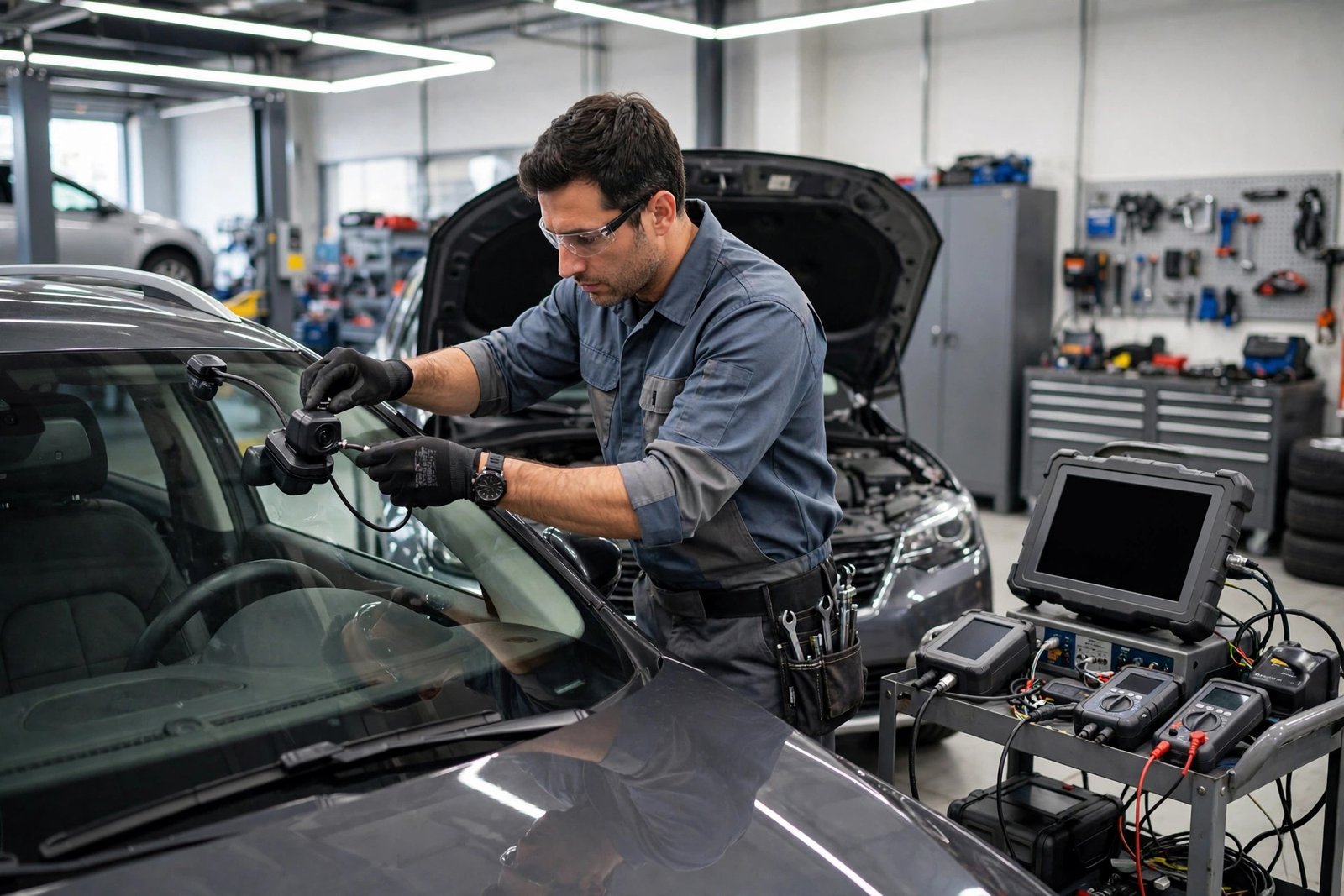
This is the single biggest structural change in auto insurance, and almost nobody outside the industry saw it coming. Modern cars are rolling sensor platforms: radar behind the bumper, cameras in the windshield, ultrasonic sensors in the mirrors. After even a minor collision, those systems must be recalibrated by a trained technician — and that work bills separately.
According to Enlyte’s 2026 Envision Trends report, which draws on Mitchell estimating data, ADAS calibration appeared on nearly 35 percent of repair estimates in 2025, up from just 12 percent in 2022, adding roughly $688 to the cost of a repair when it’s present. CCC Intelligent Solutions’ 2026 Crash Course report put the average overall repair cost at $4,818 in the fourth quarter of 2025, with calibrations on 28.3 percent of repairable estimates, up from 21.8 percent a year earlier. An analysis of repair-cost data cites joint IIHS-HLDI research finding that vehicles with a bundle of driver-assistance features run about 10 percent higher in collision claim severity than otherwise identical vehicles without them — precisely because of these added repair steps.
The irony: the technology prevents crashes, so frequency is down while severity per claim is way up. You’re paying less often but much more each time — and premiums are priced on the “how much,” not the “how often.”
2. Parts and labor inflation hit the repair shop harder than anywhere else
A September 2026 white paper from the American Property Casualty Insurance Association (APCIA) put hard numbers on this: the severity of paid vehicle-damage claims climbed 42.3 percent between 2020 and the third quarter of 2025, while claim frequency rose only 1.4 percent. Tracking BLS producer-price data from June 2021 to June 2026, APCIA found the index for vehicle repair and maintenance up 34.4 percent, and the index for auto parts, accessories, and tires up 55.6 percent — against a 24.4 percent rise in the producer price index for personal auto insurance over the same stretch, as detailed in coverage of the industry analysis.
Read that gap carefully: repair and parts costs rose roughly twice as fast as what insurers were collecting in premiums. When the economics run that far against insurers for that long, rate filings eventually follow — and they did, in force.
3. Tariffs quietly made replacement parts more expensive
Layered on top of the repair-complexity problem, trade policy added a direct surcharge. In 2025 the U.S. Commerce Department expanded steel and aluminum tariffs to more than 400 additional product categories, including auto exhaust components and EV-related steel, adding a 50 percent duty on the metal content of those imports. For insurers paying millions of collision and comprehensive claims a year, pricier imported parts flow straight into claim severity — and eventually into premiums. It won’t show up as a line item on your bill, but it’s baked into the average.
4. Every crash costs more in medical bills and legal fees
Auto insurance doesn’t just fix cars — it pays for people. Bodily injury claims have been inflated by rising medical costs and by what the industry calls “social inflation”: bigger jury awards, more attorney involvement in claims, and aggressive advertising from personal-injury firms. Insurance.com’s state-by-state analysis names litigation and uninsured motorists among the explicit reasons the most expensive states are expensive: Louisiana ($3,999 average full coverage) cites “severe weather, litigation, many uninsured motorists,” Florida ($3,916) cites “severe weather, litigation, no-fault insurance, many uninsured motorists,” and Michigan ($3,964) points to its high no-fault coverage limits.
You don’t have to live in a lawsuit hotspot to feel it. When your state is one where a meaningful share of drivers carry no insurance at all, your uninsured-motorist coverage — and your premium — picks up the slack.
5. Weather disasters are being priced into your zip code
Hail, hurricanes, floods, and wildfires don’t just destroy homes. Comprehensive coverage pays for the cars caught in them, and insurers have spent the last several years repricing that risk down to the zip-code level. The states topping the expensive list read like a severe-weather map: Florida and Louisiana face repeated hurricane seasons; Colorado and Texas absorb punishing hail. A driver in Vermont, with low population density, little severe weather, and few uninsured motorists, pays $1,660 a year for the same full coverage that costs $3,999 in Louisiana — a gap driven almost entirely by geography, not driving skill.

6. Your state may have just raised what you’re required to buy
Six states raised their minimum liability limits in 2025 and 2026: California, Massachusetts, North Carolina, Utah, Virginia, and New Jersey. If you live in one of them and carry minimum coverage, your insurer raised your limits at renewal — and your bill went up with them, according to CarInsurance.com’s 2026 rate analysis. This one stings because it’s invisible: nothing about your driving changed, no surcharge was added, but the product you were forced to buy got more expensive by law. State minimums now range from about $326 a year in Wyoming to $2,546 in New York — an eight-to-one spread for the thinnest legal coverage.
7. Loyal customers are the last to get the discount
Here’s the uncomfortable one. When rates fall, insurers compete for new customers with lower quotes. Long-time policyholders often renew at the old price — or get a smaller cut — unless they push back. Reporting on 2026 quote data found that Texas has banned the practice of charging loyal customers more based on models predicting they won’t shop around, while 30 states have not acted, per coverage of the 2026 rate data. Quote-tracking firm Insurify found premiums fell in the first half of 2026 in Washington, D.C. (down 7 percent), New Mexico (down 6 percent), and New Jersey, New York, and Massachusetts (down 5 percent each) — while Connecticut rose 10 percent and Kentucky 6 percent. Same national index, wildly different renewals.
The takeaway is blunt: in a softening market, the discount exists — but you usually have to leave to find it.

8. Insurers price the past, so the pain arrives late — in both directions
Insurance rates are set from paid-claims history, which means premiums respond to reality with a delay. When repair severity surged from 2021 onward, rate filings took years to catch up — that’s the 2023–2024 spike you lived through. Now the reverse is happening: costs are cooling, and the 2026 declines in the national index haven’t fully reached renewal notices yet. Your bill peaked after the cost crisis did, and it will ease after the cost crisis has — whether your insurer passes the relief to you promptly is, once again, mostly a function of whether you shop.
What actually lowers your car insurance bill
Here’s what actually moves the number:
Compare at least three quotes at every renewal. This is the single highest-leverage move, especially now that markets are diverging state by state. Quote data shows double-digit swings in opposite directions across states in the same six-month window — your current insurer’s renewal is a guess; the market’s answer is usually cheaper. Treat it like comparing insurance before any big trip: the product looks identical until you read the prices.
Raise your deductible. Moving collision and comprehensive deductibles from $500 to $1,000 typically cuts that portion of the premium by 15 to 30 percent. Only do it if you can comfortably cover the deductible from savings.
Try telematics or usage-based insurance. If you drive little and drive gently, pay-how-you-drive programs can offer some of the largest available discounts. Low annual mileage alone can qualify you for discounts with most major carriers.
Bundle and audit the household. Bundling home and auto with one carrier remains one of the biggest reliable discounts — worth factoring into what home really costs each month if you’re buying. Then audit annually: drop collision and comprehensive when your car’s value falls below roughly ten times the premium for those coverages, remove drivers who moved out, and update your mileage.
Fix the factors you control. A defensive-driving course can earn a discount in many states; improving your credit-based insurance score helps where it’s legal to use; and avoiding small claims keeps your record clean for the quotes that matter. With household budgets already squeezed by higher interest rates and years of inflation, the insurance line item is one of the few you can renegotiate from your couch.
Frequently asked questions
Will car insurance get cheaper in 2026?
Nationally, the trend has turned: the BLS motor vehicle insurance index fell 5.0 percent in the 12 months through September 2026. But your state may be moving the other way — Connecticut quotes rose about 10 percent in the first half of 2026 while Washington, D.C. fell 7 percent. Expect modest relief, unevenly distributed, going mostly to shoppers.
Why did my premium go up when I had no tickets, no claims, and the same car?
Your personal record is only one input. Zip-code repricing after weather losses, state-mandated coverage increases, repair-cost inflation flowing through with a lag, and loyalty pricing (existing customers renewing at old rates while newcomers get discounts) can all raise your bill with zero change in your driving.
How much does car insurance cost on average in 2026?
Insurance.com’s 2026 data puts the national average for full coverage at about $2,578 a year. The state spread is enormous: roughly $1,660 in Vermont up to $3,999 in Louisiana. State-minimum coverage averages far less — around $671 nationally — but minimums leave you exposed in any serious crash.
Is state-minimum coverage enough?
Usually not. Minimum liability limits can be exhausted by a single moderate injury claim, leaving your assets on the hook. Financially, minimum coverage makes sense only for very low-value cars you could afford to replace outright — and even then, the liability side is the real risk, not the car.
Why is my neighbor’s insurance cheaper for the same car?
Premiums are priced on dozens of factors beyond the vehicle: exact zip code, annual mileage, driving and claims history, coverage limits, deductible, and — critically — how recently they shopped. Two identical cars in adjacent zip codes can easily differ by hundreds of dollars a year.
Does a more expensive car always cost more to insure?
Not always, but usually — and it’s about repair costs, not the sticker price. A mid-priced car loaded with radar, cameras, and sensors can cost more to insure than a pricier but simpler one, because insurers price the claim: calibration on a bumper repair can add nearly $700.
The bottom line
Car insurance got so expensive because fixing cars — and fixing people — got dramatically more expensive, while weather, litigation, state mandates, and loyalty pricing piled on. The 20.3 percent surge of 2023 and the 11.3 percent of 2024 were real, measured, and miserable. But the cycle has turned: costs are cooling, the national index is falling, and the savings are sitting with the shoppers, not the loyalists. Get three quotes at your next renewal and treat your policy like any other subscription you’ve been overpaying — because you probably have been.