

Imagine paying zero taxes on decades of investment growth — legally. That’s the entire pitch of a Roth IRA, and it’s why financial planners bring it up in almost every retirement conversation. If you’ve been wondering how to start a Roth IRA, the good news is that it’s one of the simplest accounts in all of personal finance to open. You can go from reading this article to having a funded account in under an hour.
This guide covers everything a beginner needs: what a Roth IRA actually is, the 2026 contribution and income limits (they changed — make sure you’re using this year’s numbers), how to choose where to open one, what to invest in once the money is there, and the mistakes that trip up first-timers. Let’s get into it.
What Is a Roth IRA, Exactly?
A Roth IRA is an individual retirement account with a special tax deal: you contribute after-tax dollars today, and in exchange, your investments grow tax-free and you pay no tax on qualified withdrawals in retirement. Contrast that with a traditional IRA or 401(k), where you get a tax break now but pay income tax on everything you withdraw later.
The trade-off is straightforward. A Roth IRA makes the most sense when you expect to be in a higher tax bracket in retirement than you are today — which describes most young earners, since they’re typically in their lowest-earning (and lowest-taxed) years. Pay taxes at today’s lower rate, and never pay on the growth. The IRS’s official Roth IRA page lays out the core rules if you want to read them straight from the source.
One underappreciated feature: unlike traditional retirement accounts, Roth IRAs have no required minimum distributions (RMDs) during your lifetime. You can let the money compound untouched for as long as you want — a powerful option for legacy planning.
Roth IRA Contribution and Income Limits for 2026
Before you open anything, check the numbers. The IRS adjusts these annually for inflation, and using last year’s figures is one of the most common beginner mistakes.
For 2026, the maximum annual contribution is $7,500 if you’re under 50. If you’re 50 or older, you can add a $1,100 catch-up contribution for a total of $8,600. These caps apply across all your IRAs combined — so if you put $4,000 in a traditional IRA, you can only put $3,500 in a Roth the same year. You also can’t contribute more than you earned: no earned income, no contribution.
Your income determines whether you can contribute the full amount. Here are the 2026 phase-out ranges, per the IRS announcement from November 2025 (summarized clearly on Fidelity’s Roth IRA limits page and NerdWallet’s 2026 limits guide):
| Filing Status | Full Contribution | Partial (Phase-Out) | Not Eligible |
|---|---|---|---|
| Single / Head of household | MAGI under $153,000 | $153,000 – $168,000 | $168,000+ |
| Married filing jointly | MAGI under $242,000 | $242,000 – $252,000 | $252,000+ |
| Married filing separately | Partial only under $10,000 | Under $10,000 | $10,000+ |
MAGI means modified adjusted gross income — roughly your adjusted gross income with certain deductions added back. If you’re over the limit, don’t give up: the “backdoor Roth” strategy (contributing to a traditional IRA and converting it) is a legitimate workaround, though it has tax nuances worth discussing with a professional if you have existing pre-tax IRA balances.

How to Start a Roth IRA in 5 Steps
Step 1: Confirm You’re Eligible
Check two things: you have earned income (wages, salary, freelance income — not investment gains or gifts), and your MAGI falls within the limits above. If both check out, you’re clear to proceed. Teens with part-time jobs can open custodial Roth IRAs — one of the best financial head starts a parent can give.
Step 2: Choose a Brokerage
You open a Roth IRA through a brokerage firm — the big names are Fidelity, Vanguard, and Charles Schwab, all of which offer commission-free trading and no account minimums for IRAs. What matters most for beginners: low (ideally zero) fees, a decent mobile app, and access to low-cost index funds. Avoid brokers that charge annual account fees or push you toward expensive actively managed funds. If you’re still building your financial foundation, our guide on how to start investing with little money pairs well with this one.
Step 3: Open the Account Online
This takes about 15 minutes. You’ll provide your Social Security number, employment information, and a beneficiary designation (who gets the account if something happens to you — don’t skip this). Fund it by linking your bank account; you can start with any amount, even $50. You have until the tax filing deadline (typically mid-April) to make contributions for the prior tax year, so there’s no need to rush a December panic deposit.
Step 4: Actually Invest the Money
This is the step most beginners miss. Opening and funding a Roth IRA does not invest the money — your contributions will sit in a cash settlement fund earning next to nothing until you buy investments. Log in after funding and purchase your chosen investments.
What should you buy? For most beginners, a low-cost total U.S. stock market index fund or target-date fund is a sensible default. Index funds give you instant diversification across hundreds of companies for fees as low as 0.03% per year. Target-date funds go a step further and automatically shift from stocks to bonds as you age. What’s important is keeping costs low and staying invested for decades — not picking the perfect fund on day one.
Step 5: Automate Contributions
Set up automatic monthly transfers — $625/month hits the $7,500 annual max for 2026. Automation is the closest thing to a cheat code in investing: it removes willpower from the equation and enforces dollar-cost averaging, buying more shares when prices dip and fewer when they rise. If $625 feels steep, start with what fits your budget and increase it with every raise. Consistency beats amount in the early years.

Roth IRA vs. Traditional IRA: Which Should You Pick?
The choice comes down to one question: will your tax rate be higher now or in retirement?
| Filing Status | Full Contribution | Partial (Phase-Out) | Not Eligible |
|---|---|---|---|
| Tax break | None now; tax-free withdrawals later | Possible deduction now; taxed on withdrawal | |
| Best for | Lower earners, young investors | High earners wanting a current deduction | |
| Withdrawal rules | Contributions withdrawable anytime, penalty-free | 10% penalty before 59½ (with exceptions) | |
| Required withdrawals | None during your lifetime | RMDs starting at age 73 | |
| Income limits | Phase-outs apply (see 2026 table above) | Anyone can contribute; deduction phases out |
A useful rule of thumb: if you’re early in your career or in a low tax bracket, the Roth usually wins. If you’re a peak earner in a high bracket, the traditional IRA’s upfront deduction may be worth more. Many people end up with both over their lifetimes — and that’s perfectly fine, since the $7,500/$8,600 cap applies to your combined IRA contributions.
Why Starting Early Matters More Than Starting Big
Here’s the math that convinces skeptics. Contribute the 2026 maximum of $7,500 every year and earn a 7% average annual return — below the stock market’s long-term historical average. After 30 years, you’d have about $708,000, despite only contributing $225,000. Wait just 10 years to start, and the same annual contribution over 20 years grows to only about $307,000. That decade of delay costs over $400,000.
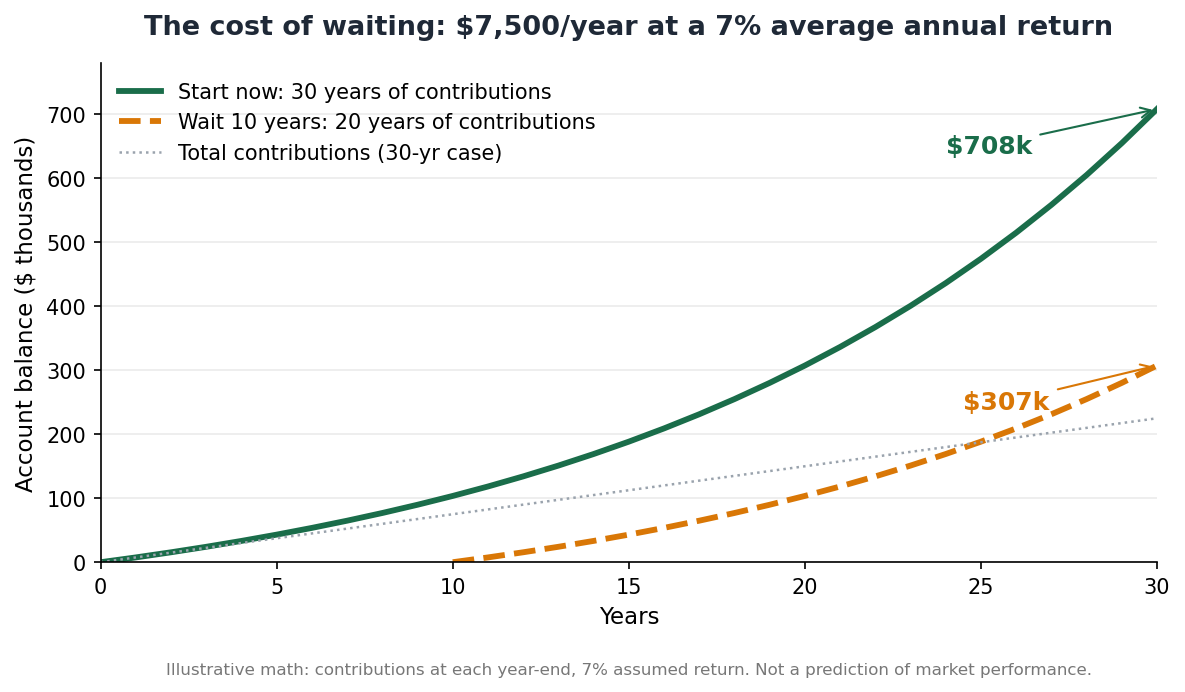
The gap comes from compounding: returns earning returns, year after year. Time in the market does the heavy lifting — which is why opening the account this week matters more than finding the perfect investment. (These figures are illustrative math at an assumed return, not a market prediction.)
5 Roth IRA Mistakes Beginners Make
- Never investing the cash. Worth repeating: contributions sitting in the settlement fund earn essentially nothing. Buy investments after every deposit.
- Overcontributing. Exceeding the annual limit triggers a 6% penalty on the excess every year until corrected. Track contributions across all your IRAs — the limit is combined.
- Ignoring the income limits. Earn above the phase-out and contribute anyway, and you’ve created an excess contribution problem. Check your MAGI before contributing each year.
- Raiding earnings early. You can withdraw contributions anytime tax- and penalty-free, but earnings withdrawn before 59½ (and before the 5-year rule is satisfied) generally face taxes plus a 10% penalty. Treat the account as untouchable.
- Paying high fees. A 1% annual fee versus a 0.03% index fund fee can cost you six figures over a career. Keep expenses minimal — it’s one of the few investment outcomes you fully control.
One more priority note: if you’re carrying high-interest credit card debt, paying off debt fast usually beats investing, since few investments reliably outpace 20%+ APRs. And before investing at all, make sure your basic financial safety net is in place — building credit from scratch and keeping an emergency buffer should come first for most beginners.

Frequently Asked Questions
How much money do I need to start a Roth IRA?
There’s no IRS minimum — you can open an account with $0 and many brokerages have no account minimums. You can start contributing with as little as $50. What matters is starting; you can ramp up to the $7,500 annual maximum over time.
Can I have a Roth IRA if I already have a 401(k)?
Absolutely. A workplace 401(k) doesn’t affect Roth IRA eligibility at all — only your income does. Many people max out an employer 401(k) match first, then fund a Roth IRA, then return to the 401(k). They work beautifully together.
What happens if I contribute too much to my Roth IRA?
You’ll owe a 6% excise tax on the excess amount for each year it remains in the account. Fix it by withdrawing the excess (plus any earnings on it) before the tax filing deadline, or recharacterize it. When in doubt, contribute conservatively and top up later in the year once your income is clearer.
Can I withdraw money from my Roth IRA before retirement?
Your contributions — the money you put in — can be withdrawn anytime, tax- and penalty-free, since you already paid tax on them. Earnings are a different story: withdraw them before age 59½ without a qualifying exception and you’ll generally owe income tax plus a 10% penalty. That’s why the account works best as a true retirement vehicle.
Is a Roth IRA better than just investing in a regular brokerage account?
For retirement savings, yes — the tax-free growth is a massive advantage over decades. A taxable brokerage account makes sense for goals before retirement (a house down payment, for example) since Roth earnings are penalized if tapped early. Use each account for what it’s designed for.
Do I need to file anything special on my taxes for a Roth IRA?
Roth contributions aren’t deductible, so there’s nothing to claim — but keep records. You’ll report contributions on Form 8606 in certain situations (like conversions), and your brokerage will send you Form 5498 showing annual contributions. Simple, but don’t throw the paperwork away.
Conclusion
Starting a Roth IRA is one of the highest-leverage financial moves a beginner can make: fifteen minutes of paperwork buys you decades of tax-free compounding. Confirm your eligibility, pick a low-cost brokerage, fund the account, invest the money (don’t let it sit in cash), and automate your contributions.
The investors who build real wealth aren’t the ones with the cleverest strategies — they’re the ones who started early and never stopped. Open the account this week. Future you, withdrawing tax-free income in retirement, will be glad you did.
This article is for educational purposes only and is not financial advice. Tax rules change; consider consulting a qualified tax professional for your specific situation.