
Monday, October 19, 2026 — Wall Street’s most crowded trade finally caught a breath. The Nasdaq Composite jumped 1.11%, gaining 290.85 points to close at 26,430.89, as investors tiptoed back into chip and artificial-intelligence stocks after a punishing selloff, according to Reuters’ coverage of the AI stock market rebound of October 2026. The S&P 500 added 0.41% to 7,690.73, while the Dow slipped 0.07% to 51,966.03. Consumer discretionary and technology led the way, up 2.7% and 1.2% respectively; utilities lagged, down 2%.
But here’s the thing worth understanding before you read another headline about the bounce: the selloff was never really about the technology. AI demand didn’t falter. No lab announced that large language models stopped working. What rattled markets was something far more mundane and far more dangerous — money. Specifically, how the enormously expensive AI buildout is going to be financed, and whether the math still works with the 10-year Treasury yield hovering around 5.08%. Monday’s rally is less a verdict on AI’s future than a gasp for air after a week when the market decided, all at once, to worry about the bill.

What “the AI Trade” Actually Is
If you’ve been watching your 401(k) bounce around this month, you’ve probably heard that everything hinges on “the AI trade.” It sounds like a single bet. It isn’t. It’s a whole chain of them.
The AI trade starts with the chipmakers — Nvidia, AMD, Broadcom, Intel — that sell the accelerators every data center needs. Behind them sit the server builders and the cloud giants — Amazon, Microsoft, Alphabet, Meta — that buy those chips by the tens of thousands. Alongside them run the specialized “neoclouds” like CoreWeave, which exist for one purpose: to rent GPU capacity to anyone building AI models. And underneath it all is the physical layer: data centers, power contracts, cooling systems, fiber.
Every link in that chain has been valued on one assumption: that the money to keep building will keep flowing. The selloff didn’t question whether AI works. It questioned whether the financing works — and that distinction matters enormously for what comes next.
It Was the Money, Not the Machines
Last week, the S&P 500 and the Nasdaq posted their biggest weekly declines since late June, and the catalyst was pure finance. As Reuters reported, unease centered on how the enormously expensive AI buildout will be paid for. The 10-year Treasury yield sat near 5.08% on Monday morning — and that’s the number that changes the entire conversation.
Here’s why. A data center is a giant concrete box full of expensive equipment that generates no revenue until it’s built, powered, and leased. When long-term borrowing costs are low, companies can finance construction cheaply, and investors will happily fund years of spending today for cash flows tomorrow. When the 10-year yield is north of 5%, the arithmetic gets ugly fast: interest payments swell, projected returns shrink, and debt-financed data centers become much harder to justify.
That financing anxiety rippled through the whole AI supply chain. Chip stocks were hit hardest because they sit at the front of the line — if data center spending slows, semiconductor orders slow first. The Philadelphia Semiconductor Index fell for eight straight sessions, losing about 15.7% in the process. That was its longest losing streak since October 2008, during the financial crisis. Read that again: chip stocks hadn’t fallen that many sessions in a row since the year Lehman Brothers collapsed.
The Rubber Band Snapped Back
So what changed on Monday? According to traders who lived through the slide, not much — and that’s exactly the point.
“Rubber bands can only stretch so far in one direction before they snap and start reversing,” said Michael James, managing director and equity sales trader at Rosenblatt Securities, who characterized the move as an oversold bounce rather than a turning point. “Nothing changed between Friday’s close and this morning’s open, other than nothing bad happened over the weekend.”
That’s about as honest as Wall Street commentary gets. After eight straight down sessions for the chip index and the worst week since June for the major indexes, buyers stepped back in simply because prices had fallen far enough, fast enough. The Philadelphia Semiconductor Index rose 1.6% on Monday, finally snapping the streak — and Reuters’ account of the chip stock recovery shows the rebound was concentrated exactly where the pain had been worst.
But James cautioned the market is “far from out of the woods,” with big tech earnings due imminently. The weekend didn’t produce good news; it produced an absence of bad news. That’s a thin foundation for a rally — and traders know it.
What the SOX Streak Snapping Tells Contrarians
For investors who trade against the crowd, a streak like the semiconductor index’s eight-session slide is catnip. Extended losing streaks rarely end because the underlying story suddenly improves; they end because everyone who was going to sell has sold. When an index falls 15.7% in eight sessions without any new fundamental information, the selling is increasingly driven by fear and forced de-risking, not by fresh analysis.
The historical echo is worth sitting with. The last time the Philadelphia Semiconductor Index fell this many sessions in a row was October 2008. That episode marked a period of genuine systemic terror — and, as it happened, occurred within months of some of the best long-term buying opportunities in market history for technology stocks. History doesn’t repeat, but contrarians note that the longest streak in 18 years ending with a sharp snap-back is precisely the pattern that marks a capitulation moment.
None of that makes the rebound safe. Oversold bounces during 2008 itself were famously violent and frequently failed. The contrarian read isn’t “buy with both hands” — it’s that the balance of risk has shifted, and that shorting into a five-standard-deviation slide is a different game than shorting at the top.
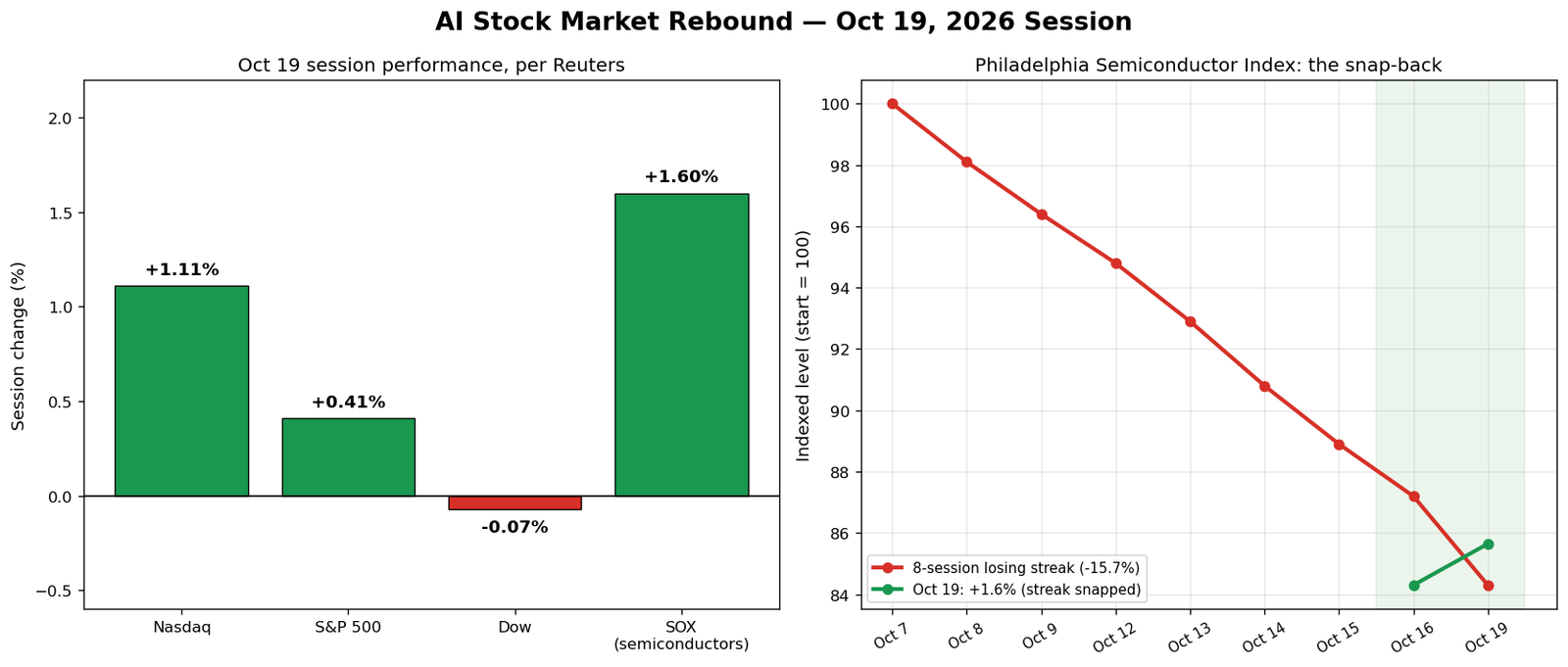
The chart above shows Monday’s session performance on the left and the semiconductor index’s drawdown-and-recovery on the right. Note that only the session results and the drawdown endpoints — roughly 15.7% down across eight sessions, then 1.6% up on Monday — come from Reuters’ reporting; the intra-streak levels are illustrative.
The CoreWeave Stress Test
If you want one company that embodies the financing fears behind the selloff, it’s CoreWeave. The neocloud has become the market’s canary in the coal mine for the AI debt story, carrying roughly $50 billion in debt to fund its GPU infrastructure.
CoreWeave’s stock plunged more than 25% last week as investors repriced the risk of all that leverage — and tellingly, it barely budged on Monday, slipping 0.4% even after Goldman Sachs upgraded it to “buy.” When a company can’t rally on an upgrade from Goldman Sachs, the market is telling you the problem is structural, not informational. The question isn’t whether CoreWeave’s business is good; it’s whether ~$50 billion of debt is survivable when long-term rates sit above 5%. We’ve covered CoreWeave’s debt fears and its soaring bond yields in detail before — Monday’s action suggests those fears are far from resolved.

Monday’s Movers: What Actually Moved and Why
Beyond the indexes, Monday’s session had clear standouts — and the drivers matter more than the percentages:
| Stock | Monday Move | Driver |
|---|---|---|
| Amazon | +5% | Morgan Stanley named it a top pick, refocusing attention on AWS’s AI-driven growth |
| Tesla | +3.8% | Rebound buying ahead of Wednesday’s earnings report |
| Intel | +2.4% | J.P. Morgan upgraded the stock to neutral, lifting sentiment on the chipmaker |
| CoreWeave | -0.4% | Goldman Sachs “buy” upgrade couldn’t offset lingering $50B-debt fears |
| Cleveland-Cliffs | +16% | Third-quarter profit beat; steel demand held up better than expected |
A few patterns worth noting. First, the winners were specific: an analyst upgrade (Amazon, Intel) or pre-earnings positioning (Tesla), not a broad “risk-on” tide — remember the Dow finished in the red and utilities fell 2%. Second, Cleveland-Cliffs’ 16% pop on a genuine Q3 profit beat is a reminder that old-economy earnings still matter when they’re good. And third, CoreWeave’s inability to rally is the single most important datapoint of the day for the financing story: the debt fear is concentrated, and it hasn’t gone away.
What to Watch This Week
The bounce, such as it is, now has to survive contact with reality. Meta and Tesla report earnings on Wednesday; SpaceX is due Tuesday. These aren’t side events — they’re the companies whose capital spending plans will determine whether the financing narrative improves or deteriorates. Big tech has been pledging enormous AI infrastructure budgets; investors now want to see whether those pledges survive contact with 5%-plus borrowing costs.
If Meta and Tesla confirm their AI capex plans are intact, the “financing fear” thesis weakens and the rebound has a foundation. If they hedge, delay, or fund spending with fresh debt at these rates, Monday’s rally becomes just another oversold bounce in a longer repricing. For the full earnings calendar context, see our tech earnings this week preview.
One more note for the history books: October 19, 2026 was also the 39th anniversary of Black Monday, the 1987 crash. Wall Street chose to mark the occasion with a rebound rather than a rout — a fitting reminder that anniversaries don’t move markets, but the cost of money does.
The Bigger Picture: How to Think About the AI Trade Now
Monday’s session clarified the market’s real question. It’s not “is AI real?” — every major company on earth is still spending on it. It’s not even “is AI profitable?” — the cloud giants’ AI revenues keep growing. The question is narrower and harder: at 5% long-term rates, who pays for the next wave of data centers, and on what terms?
That’s a question investors can actually analyze, unlike debates about whether AI is a bubble. It connects to the Fed’s first rate hike in three years and the broader rate environment: when the cost of capital rises, the bar for every new project rises with it. Some projects will still clear it. Some won’t. The selloff was the market’s clumsy way of saying it had stopped distinguishing between the two — and Monday’s selective rally, with upgrades and earnings driving individual winners, suggests it’s starting to discriminate again.
As global markets diverged on the news and AI stocks rebounded after the selloff in early futures trading, the honest summary is the one Michael James gave: the rubber band snapped back because it had stretched too far, too fast. Whether it keeps stretching in the right direction depends on something no weekend can fix — the financing math. For ongoing market pulse coverage of the AI rebound, the story to track this week isn’t the technology. It’s the money.
Frequently Asked Questions
Why did AI stocks sell off before the October 19, 2026 rebound?
Investors grew uneasy about how the enormously expensive AI buildout will be financed, with the 10-year Treasury yield near 5.08% making debt-financed data centers harder to justify. It was a financing concern, not a technology concern — AI demand itself didn’t falter.
How far did chip stocks fall before rebounding?
The Philadelphia Semiconductor Index fell for eight straight sessions, losing about 15.7% — its longest losing streak since October 2008, during the financial crisis. It snapped the streak with a 1.6% gain on Monday, October 19.
What does the 10-year Treasury yield have to do with AI stocks?
Data centers are hugely capital-intensive and often debt-financed. When long-term borrowing costs rise — as they have with the 10-year yield around 5.08% — interest payments swell and the projected returns on new data center projects shrink, making the AI buildout harder to fund.
Why didn’t CoreWeave rally with the rest of the market on October 19?
CoreWeave carries roughly $50 billion in debt and plunged more than 25% the prior week. Even a Goldman Sachs “buy” upgrade couldn’t lift the stock — it slipped 0.4% — signaling that investors see the problem as structural (too much leverage at high rates), not informational.
Is the AI stock rebound sustainable?
Traders like Michael James of Rosenblatt Securities call it an oversold bounce and warn the market is “far from out of the woods.” Sustainability likely hinges on this week’s big tech earnings — Meta and Tesla report Wednesday, SpaceX on Tuesday — and whether their AI infrastructure spending plans survive current borrowing costs.
What happened to the Dow on October 19, 2026?
The Dow Jones Industrial Average slipped 0.07% to 51,966.03 even as the Nasdaq and S&P 500 rose, with utilities falling 2% — a sign the rebound was narrow and concentrated in tech and chip stocks rather than broad-based.
The Bottom Line
Monday’s AI stock market rebound in October 2026 was real — the Nasdaq’s 1.11% gain and the semiconductor index’s 1.6% snap-back are facts, not spin. But it was a relief rally, not a resolution. The selloff exposed the market’s genuine vulnerability: an AI buildout financed with debt in a 5%-yield world. Until earnings show that spending can survive the financing math, every bounce deserves the skepticism traders are giving it. Watch the money, not just the machines.