
Electric vs Hybrid Cars: Which One Actually Saves You More in 2026?
Walk onto any car lot in 2026 and you’ll feel the pressure: shiny electric cars promising pennies-per-mile driving on one side, and dependable hybrids sipping fuel on the other. The electric vs hybrid cars debate has never been louder — or more confusing. Both technologies got better at the same time.
So which one actually saves you more money, fits your life better, and holds up over years of ownership? This guide answers that with real 2026 data — prices, fuel and charging costs, maintenance bills, range figures, and which incentives still exist — so you can decide with confidence instead of guessing.
Electric vs Hybrid Cars: The Quick Verdict
Before we dig into the numbers, here’s the short answer.
Buy an electric car if…
- You can charge at home overnight (garage or driveway with an outlet).
- Your daily driving is under ~200 miles and you rarely road-trip long distances.
- You want the lowest possible fuel and maintenance costs over time.
- Local electricity rates in your area are reasonable.
Buy a hybrid if…
- You can’t charge at home — apartment living, street parking, or no garage.
- You regularly drive long distances or take frequent road trips.
- You want to cut fuel costs dramatically without changing any habits.
- You want the best overall value right now with zero planning overhead.
Now let’s see why.
Purchase Price: Hybrids Win Up Front
The sticker price is still the hybrid’s biggest weapon. A new hybrid typically runs $5,000–$15,000 less than a comparable EV, depending on segment and trim — the difference between a comfortable monthly payment and one that stretches your budget.
Why the gap? Batteries remain the most expensive part of an electric car, and while pack prices have fallen for years, they haven’t fallen enough to erase the difference. Scale matters too: Toyota alone has sold tens of millions of hybrids, and that production maturity shows up in pricing.
There is a counterweight: the used-EV market has become a genuine bargain bin. Edmunds data shows the average asking price for a used EV on September 1, 2026 was $36,367 — down almost 7% since the old federal credit disappeared — as off-lease cars flood the market. Open to buying used, and the price gap shrinks fast.
Still, for a brand-new purchase, the hybrid costs less on day one. Full stop.
Fuel and Charging Costs: EVs Pull Ahead
Once you’re driving, the math flips hard in the EV’s favor. According to EPA’s 2026 fuel economy data, the median new EV uses 37.1 kWh per 100 miles (91 MPGe), while the median hybrid burns through 26.5 MPG worth of gasoline.
Translate that into dollars using real 2026 prices — the EIA’s U.S. average residential electricity rate of 18.31 cents per kWh and $4.331 per gallon of regular gas:
- EV (home charging): about 6.8 cents per mile
- Hybrid: about 16.3 cents per mile
- Conventional gas car: about 20.6 cents per mile
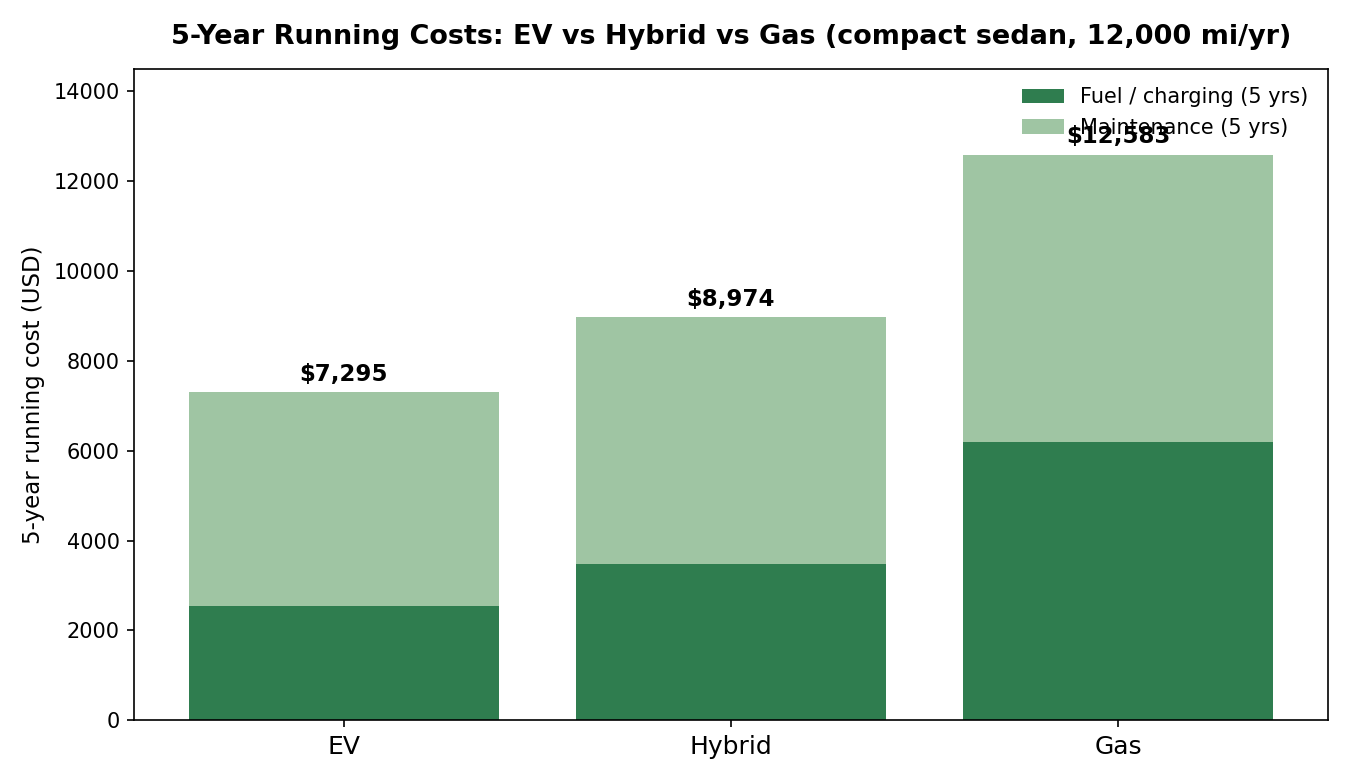
At 12,000 miles a year, that’s roughly $816 for the EV versus $1,956 for the hybrid — more than $1,100 a year in fuel savings. A detailed EV vs hybrid cost-per-mile comparison of popular models puts the 5-year fuel bill for a compact sedan at $2,550 for the battery-electric version versus $3,474 for the hybrid — and the gap widens for SUVs.
But — and this is the biggest “but” in the whole comparison — those EV numbers assume home charging. Public DC fast charging averages $0.40–$0.60 per kWh, which can push an EV’s per-mile cost into hybrid territory. If every charge happens at a public station, the fuel advantage mostly evaporates. Home charging is the engine of EV savings.

Range and Road Trips: The Freedom Factor
Range anxiety isn’t dead — it’s just more specific now. The average new EV in 2026 achieves roughly 300 miles of range, with more than 70 models on the market, and the most efficient ones do far better: Edmunds measured 393 real-world miles from a 2026 Tesla Model 3 RWD in independent testing. For a driver covering under 40 miles a day, a 300-mile EV means charging once a week.
Hybrids don’t even play this game — they win it by default. A typical hybrid goes 500–600 miles per tank, and refueling takes five minutes at any gas station on the planet. No apps, no route planning, no waiting at a charger in the rain.
Two caveats that matter in real life:
- Cold weather cuts EV range by 20–30%. If you live somewhere with real winters, plan for it — and check our guide on how to prepare your car for winter for cold-season tips that apply to every powertrain.
- Plug-in hybrids split the difference. A PHEV runs 30–55 miles on electricity — enough for most commutes — then switches to gas for longer trips. The catch: it only saves money if you actually plug it in. EPA telematics data suggests the average U.S. plug-in hybrid runs on electricity for only about 55% of its miles.
If you road-trip often or live where charging is thin, the hybrid (or PHEV) is the lower-stress choice.
Maintenance: Fewer Moving Parts, Real Savings
EVs have no oil to change, no spark plugs, no transmission fluid, no exhaust system, and — thanks to regenerative braking — brake pads that can last 100,000 miles or more. The savings are real and measurable.
AAA’s 2026 Your Driving Costs study tracked maintenance, repair, and tire costs over five years and 75,000 miles at 15,000 miles per year:
- Medium sedan: EV $1,602/yr vs hybrid $1,619/yr vs gas $1,827/yr
- Compact SUV: EV $1,402/yr vs hybrid $1,506/yr vs gas $1,954/yr
- Full-size pickup: hybrid $1,539/yr vs EV $1,618/yr vs gas $1,788/yr — the hybrid truck was actually cheaper to maintain than the electric one
So EVs win maintenance most of the time, but hybrids sit remarkably close. Broad estimates put annual EV maintenance around $949 versus $1,279 for a conventional car, with hybrids in between. Over a decade, the EV’s maintenance edge is worth roughly $3,300 versus a gas car; the hybrid’s, about $1,500–$2,000.
One genuine EV maintenance downside: tires. EVs are heavier with instant torque, so expect replacements every 30,000–40,000 miles instead of the 50,000–60,000 a gas or hybrid car typically manages.
Charging Infrastructure vs Gas Stations
This is the least “numbers” part of the decision and the most lifestyle part. There are around 150,000 gas stations in the U.S. — public EV chargers now number in the hundreds of thousands too, but they aren’t evenly distributed, and a 30-minute fast charge is not a 5-minute fill-up.
The practical question is simple: can you charge at home? If yes, you start every day with a “full tank” and rarely think about public charging — most EV charging happens at home. A wall-mounted charger in the garage makes ownership nearly frictionless.
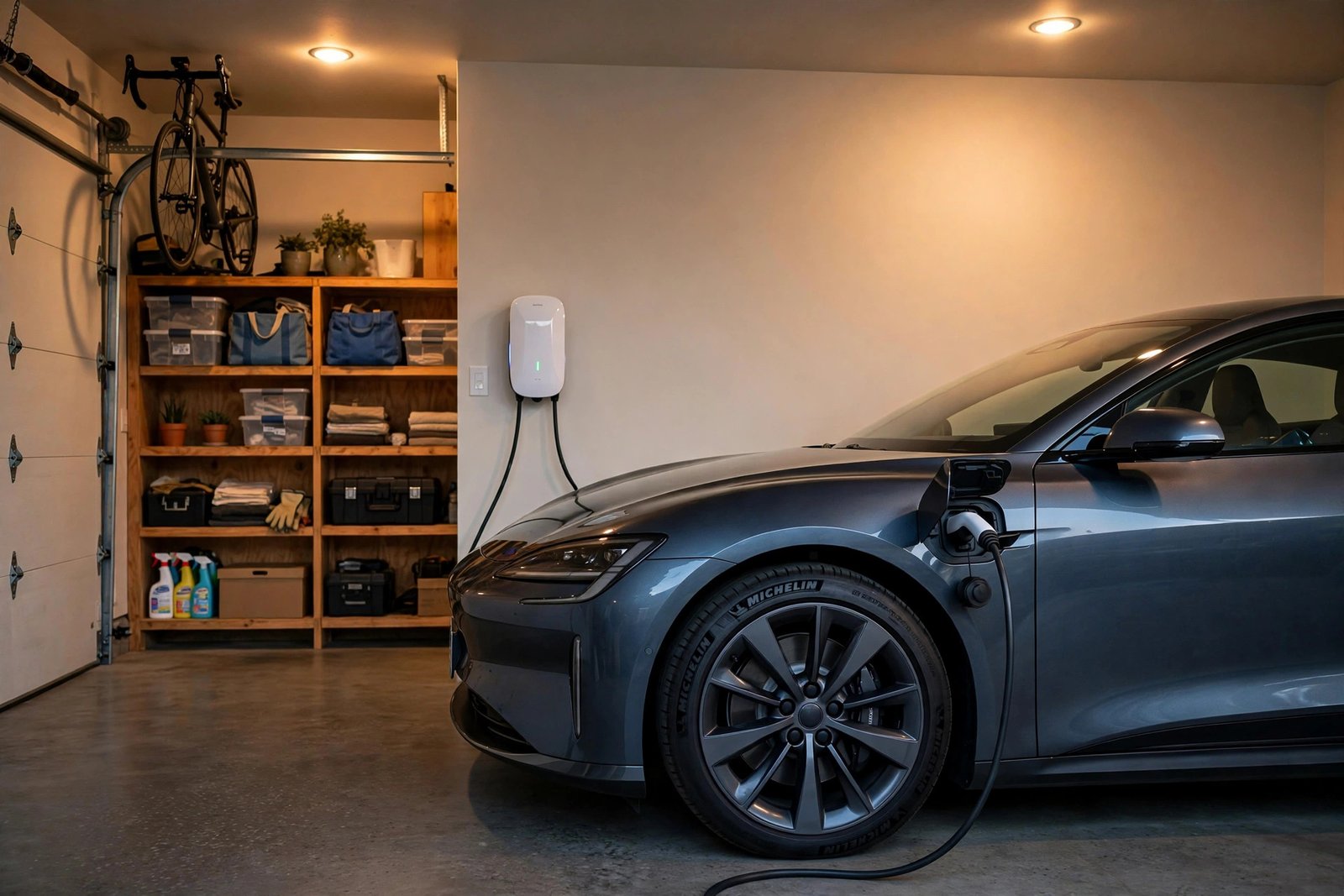
If you can’t charge at home — apartment, condo, street parking — an EV means planning your life around chargers. That’s doable for some, annoying for most. A hybrid asks for none of this: it fuels anywhere, in minutes, forever.
Incentives in 2026: What’s Actually Left
Here’s the headline many shoppers missed: the federal EV tax credit is gone. The $7,500 new-EV credit and the $4,000 used-EV credit ended for vehicles acquired after September 30, 2025, under the One Big Beautiful Bill Act — three months earlier than many expected. There is no replacement credit and no phase-down. In 2026, the federal purchase incentive for an EV is $0.
The federal home-charger credit (30% up to $1,000) also ended for chargers placed in service after June 30, 2026. What remains:
- State and local incentives. Several states still offer rebates — New Jersey’s Charge Up program, for example, offers up to $4,000 at point of sale when funded. These vary wildly by state and budget, so check before you buy.
- Utility programs. Many utilities offer off-peak charging rates or charger installation rebates.
- Manufacturer deals. With the credit gone, automakers have stepped in with their own discounts and lease offers to keep EVs moving.
Hybrids, for what it’s worth, never had a federal credit this decade — so nothing changed for them. The playing field is now level, and that helped hybrids, which never needed the subsidy to make their math work.
Battery Longevity and Warranty
The number-one EV worry is still “what happens when the battery dies?” The data is reassuring: modern EV batteries lose roughly 2% per year on average, meaning most packs will outlast the car itself.
And you’re protected by law. Federal rules require automakers to warranty EV and hybrid high-voltage batteries for a minimum of 8 years or 100,000 miles, guaranteeing at least 70% of original capacity. In states following California’s stricter rules, the floor rises to 10 years / 150,000 miles, and the warranty transfers automatically to used-car buyers.
Hybrids carry their own battery warranties (typically 8–10 years), and Toyota’s hybrid batteries have a legendary reliability record — many last 200,000+ miles. Neither technology should scare you on battery life in 2026.
Resale Value and Depreciation
This is where hybrids quietly shine. AAA’s 2026 analysis found that across four vehicle segments, hybrids were the overall ownership-cost winner — combining fuel savings with mild depreciation and lower finance charges. EVs, by contrast, have depreciated hard: heavy depreciation pushed total ownership costs for EV midsize sedans nearly 30% above their gas equivalents.
Fast-improving battery tech is the double-edged sword: today’s EV is tomorrow’s outdated model, which scares resale values. Hybrids, with mature tech and steady demand, hold value better. If you trade cars every 3–5 years, the hybrid’s resale advantage can erase much of the EV’s fuel savings.
Insurance, at least, has normalized — AAA’s study showed EV insurance ($2,277/year in the compact crossover class) roughly on par with gas models and slightly cheaper than hybrids. If you want to understand what’s driving your premiums in general, our breakdown of why car insurance is so expensive digs into the real reasons behind renewal notices.
Environmental Impact
On tailpipe emissions, there’s no contest: EVs produce zero, hybrids produce less than gas cars but still burn fuel. On a lifecycle basis, EVs still come out ahead in most U.S. regions because the grid keeps getting cleaner — though how far ahead depends on your local electricity mix and how long you keep the car.
Hybrids are the pragmatic middle: a 45–60 MPG hybrid roughly halves fuel consumption versus a conventional car, delivering most of the emissions benefit with none of the infrastructure demands.
Electric vs Hybrid Cars: Side-by-Side Comparison
| Factor | Electric (EV) | Hybrid (HEV) |
|---|---|---|
| Purchase price | Higher — typically $5k–$15k more than a comparable hybrid | Lower — the budget-friendly entry point |
| Fuel/charging cost | ~6.8¢/mile with home charging; far cheaper | ~16.3¢/mile; about 2.4× more than an EV |
| Range | ~300 miles average (2026); 20–30% less in cold weather | 500–600 miles per tank; unaffected by weather |
| Maintenance | Lowest — ~$1,402–$1,602/yr; no oil, fewer brakes | Low — ~$1,506–$1,619/yr; close behind EVs |
| Charging infrastructure | Best with home charging; public charging slower & pricier | Any gas station, 5 minutes — zero planning |
| Resale value | Depreciating faster as tech improves | Holds value better; AAA’s 2026 ownership-cost winner |
| Environmental impact | Zero tailpipe emissions; lowest lifecycle emissions | Roughly half the fuel use of gas; a strong middle ground |
Frequently Asked Questions
Are electric cars actually cheaper than hybrids to own?
It depends. EVs cost less per mile to fuel (~6.8¢ vs ~16.3¢ with home charging) and less to maintain, but hybrids cost $5,000–$15,000 less up front and hold value better. AAA’s 2026 analysis found hybrids the overall ownership-cost winner across four segments, mainly on milder depreciation. Keep the car 8+ years and charge at home, and the EV usually wins; trade in every few years, and the hybrid often wins.
Is the $7,500 EV tax credit still available in 2026?
No. The federal EV tax credit — $7,500 for new EVs and $4,000 for used — ended for vehicles acquired after September 30, 2025. There is no federal purchase incentive for an EV bought in 2026. Check your state and utility for remaining local incentives before you buy.
How far can a typical electric car go in 2026?
The average new EV in 2026 delivers roughly 300 miles of range, with more than 70 models available. Real-world range varies with temperature, speed, and driving style — cold weather can cut it by 20–30%, and highway driving drains batteries faster than city commuting. Independent testing has shown some models beating their EPA ratings by 30+ miles.
What is the biggest disadvantage of a hybrid compared to an EV?
A hybrid still burns gasoline, so its per-mile fuel cost is roughly 2.4 times higher than a home-charged EV, and it needs more maintenance (oil changes, filters, more brake wear). It also can’t match the EV’s zero tailpipe emissions. The hybrid’s advantages — lower price, no charging needed, better resale — are about convenience and economics, not running costs.
Do I need a garage to own an electric car?
Not strictly, but it makes ownership dramatically easier and cheaper. Home charging is what unlocks the EV’s fuel savings (public fast charging costs $0.40–$0.60/kWh, erasing much of the advantage). Without home or workplace charging, most drivers will find a hybrid more practical.
How long do EV and hybrid batteries last?
Modern EV batteries degrade about 2% per year and most will outlast the vehicle. Federal law mandates a minimum 8-year/100,000-mile battery warranty (70% capacity retention), rising to 10 years/150,000 miles in California-rule states. Hybrid batteries are famously durable — many Toyota hybrids exceed 200,000 miles on the original pack.
Conclusion: A Simple Framework for Your Decision
The electric vs hybrid cars question doesn’t have one right answer — it has one right answer for you. Run your situation through this framework:
- Choose the EV if you can charge at home, drive mostly local miles, plan to keep the car long-term, and want the absolute lowest running costs. The fuel and maintenance savings are real and compound every year you own it.
- Choose the hybrid if you can’t charge at home, drive long distances regularly, trade cars every few years, or just want maximum flexibility with minimum hassle. Right now, it’s the smartest overall value play.
- Consider a plug-in hybrid if your commute is short but your weekends are long — but only if you’ll actually plug it in every night. A PHEV you never charge is just an expensive hybrid.
Whichever you pick, you’re choosing between two mature, reliable technologies — not a gamble. In 2026, they’re simply two different answers to the same question: how do you want to spend your money, and your time, getting where you’re going?