
Ultraprocessed Foods Brain Damage Study: What the New Research Actually Found
If your pantry is full of packaged snacks, frozen pizza, instant noodles, and sugary drinks, a major new study has uncomfortable news: people who ate the most ultraprocessed foods were roughly 40% more likely to show signs of silent brain damage on MRI scans. The ultraprocessed foods brain damage study, published October 15, 2026 in JAMA Network Open, followed 8,783 Canadian adults and found something even the researchers didn’t expect — vascular injury in the brains of otherwise healthy middle-aged people who had no history of heart disease.
This isn’t a scare piece about one bad snack. It’s a serious look at a large, peer-reviewed study — what it measured, how it was done, what the numbers actually mean, and what remains genuinely uncertain. Because when headlines scream “your food is destroying your brain,” you deserve the full picture, not just the frightening part.

What the Ultraprocessed Foods Brain Damage Study Actually Found
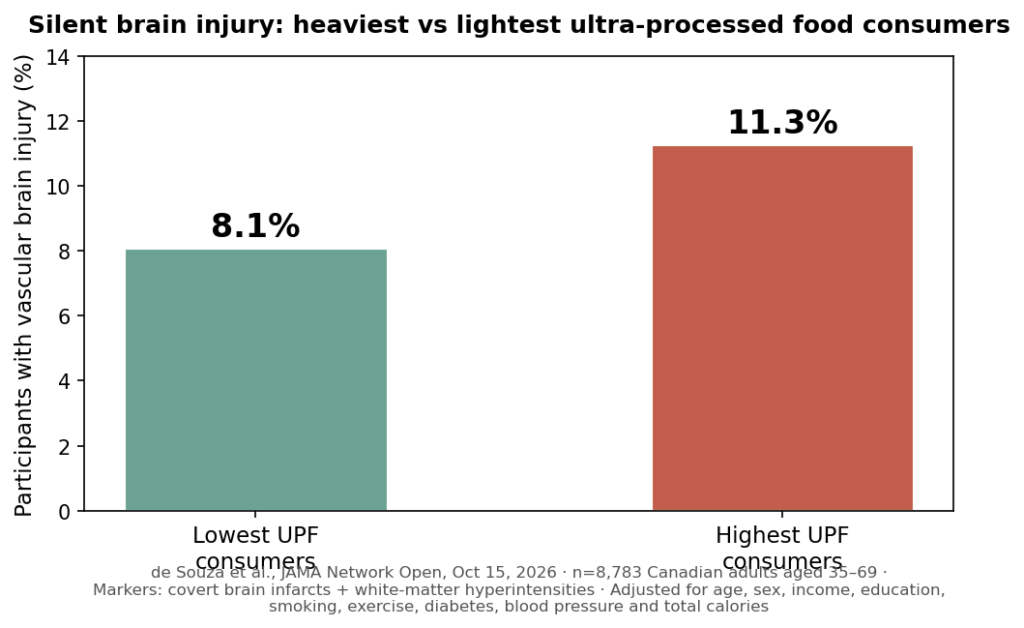
Here’s the core result, stripped of hype: researchers compared adults who ate the most ultra-processed foods (UPFs) with those who ate the least, then looked at their brain MRI scans for two markers of vascular brain injury — covert (silent) brain infarcts and white-matter hyperintensities.
Among the heaviest UPF consumers, 11.3% showed signs of vascular brain injury. Among the lightest consumers, it was 8.1%. That’s a relative increase of about 40% — a difference that held firm even after the researchers adjusted for age, sex, income, education, smoking, exercise, diabetes, blood pressure, and total calorie intake.
The adjustment matters enormously. It’s easy to assume heavy UPF eaters are simply less active or heavier, and that the brain finding is really just a shadow of overall lifestyle. But the researchers controlled for those factors, and the association persisted. That’s what makes this study harder to dismiss than the usual “junk food is bad” headline.
How the Study Was Done
The study, led by the Population Health Research Institute (PHRI) of McMaster University and Hamilton Health Sciences in Canada, was straightforward in design and strong on execution. First author Russell J. de Souza, an associate scientist at PHRI and associate professor at McMaster, worked with senior author Dr. Sonia Anand on the analysis.
The sample: 8,783 Canadian adults aged 35 to 69, all with no history of heart disease. Each participant completed detailed dietary questionnaires, underwent an MRI brain scan, and had their body fat measured. The researchers then ranked participants by how much of their diet came from ultra-processed foods and compared the brain scan results of the top and bottom consumers.
Two details give this study real weight. First, the participants were healthy — no prior heart disease, and middle-aged rather than elderly, which rules out the objection that the brain changes were just a function of old age. Second, the study was published in JAMA Network Open, a well-regarded peer-reviewed medical journal, and announced through the Population Health Research Institute’s press release on the findings.
What “Silent Brain Injury” Really Means
The phrase “silent brain damage” sounds terrifying, so let’s translate it into plain language. The study looked for two things:
Covert brain infarcts (silent strokes)
A covert brain infarct is essentially a small stroke that produced no obvious symptoms — no face drooping, no arm weakness, no speech problems. The person doesn’t know it happened, but on an MRI, the damaged tissue is visible. The reason scientists care is that silent strokes are not harmless footnotes: research over the years has linked them to higher future risk of symptomatic stroke, cognitive decline, and dementia. One silent infarct roughly doubles a person’s risk of a future overt stroke, according to prior neurology research.
White-matter hyperintensities
White matter is the brain’s wiring — the insulated fibers that carry signals between regions. Hyperintensities are bright spots on MRI where that wiring shows signs of damage, often from small-vessel disease. They’re extremely common in older adults, but finding them at elevated rates in healthy middle-aged people is the concerning part of this story. White matter is the brain’s wiring — the insulated fibers that carry signals between regions. Hyperintensities are bright spots on MRI where that wiring shows signs of damage, often from small-vessel disease. They’re extremely common in older adults, but finding them at elevated rates in healthy middle-aged people is the concerning part of this story.
None of this means the participants were walking around with dementia. It means the vascular plumbing feeding their brains showed more wear than expected for their age and health status. Think of it like arterial plaque discovered on a scan of someone who feels fine — a warning sign, not a diagnosis.
Which Foods Counted as Ultra-Processed
“Ultra-processed” doesn’t just mean “junk food.” The classification used in most nutrition research (the NOVA system) defines ultra-processed foods as industrial formulations made mostly from ingredients you wouldn’t find in a home kitchen: flavorings, colorings, emulsifiers, preservatives, protein isolates, high-fructose corn syrup, and other additives designed to make products cheap, shelf-stable, and hyper-palatable.
Everyday examples include soft drinks, packaged snack cakes and cookies, instant noodles, frozen pizza, hot dogs and processed deli meats, breakfast cereals marketed as healthy, sweetened yogurts, energy bars, and most fast food items. A plain roasted chicken breast is minimally processed; a bag of chicken-flavored chips is ultra-processed. The distinction is about industrial formulation, not just calories or fat.
Context matters here: Canada’s Heart and Stroke Foundation reported in 2025 that nearly half of the average Canadian’s food is ultra-processed. This isn’t a story about a fringe habit — it’s about the default diet of entire countries. That’s precisely why researchers are so interested in what UPF-heavy diets do to the body over decades.

Why Women Seemed More Affected
One of the more striking details reported in coverage of the study: the association between heavy UPF consumption and silent brain injury and stroke risk was strongest among women, as reported by HealthDay’s coverage of the research.
Why would that be? The study itself doesn’t fully answer this, and researchers are careful about speculating. But there are plausible threads. Women in the sample may have different patterns of body-fat distribution and metabolic response to UPF-heavy diets. The researchers also found that the heaviest UPF consumers carried more body fat overall — including more deep visceral fat, the metabolically active fat around internal organs that’s linked to inflammation and blood-vessel damage that may reach the brain.
Hormonal and metabolic differences, differences in vascular biology, and even differences in which specific UPFs men and women tend to eat could all play a role. For now, “strongest among women” is an observation awaiting an explanation — worth flagging, not worth building a theory on yet.
The Body-Fat Connection
The study didn’t just scan brains; it also measured body fat. The heaviest UPF consumers carried more total body fat and, crucially, more deep visceral fat. Visceral fat isn’t inert padding — it functions almost like an organ, releasing inflammatory signals into the bloodstream.
That inflammation may be the bridge between diet and brain. Chronic low-grade inflammation damages blood vessels everywhere, including the small vessels feeding the brain. Damage those small vessels and you get exactly the markers this study measured: white-matter hyperintensities and small silent infarcts.
This is still a hypothesis about mechanism, not a proven chain. But it’s a biologically coherent one, and it fits with what we know from brain health research in otherwise healthy adults: the brain is exquisitely sensitive to vascular health, and the same dietary patterns that harm the heart and arteries likely harm the brain through similar pathways.
What the Researchers Themselves Said: The Caveats
This is the section that separates a serious article from a scare piece. The authors were explicit about the limits of their work, and honest reporting should amplify them:
- The study does not prove cause and effect. This is the single most important sentence in the entire story. It’s an observational association: heavy UPF eating and brain injury markers travel together, but the study can’t prove one caused the other. There could be unmeasured factors — stress, sleep, environmental exposures — that influence both diet and brain health.
- The finding surprised the researchers. De Souza himself said he would not have expected this finding in healthy middle-aged adults — which is a refreshingly candid admission. When the researcher is surprised, you should treat the result as intriguing rather than settled.
- Diet was measured by questionnaire. Dietary questionnaires rely on people’s memory of what they ate. They’re the standard tool in nutrition research, but they’re imprecise — people under-report junk food and over-report vegetables. The true effect could be bigger or smaller than measured.
- Longer-term research is needed. A single snapshot (even a large, well-adjusted one) doesn’t show how brain injury markers develop over years of eating patterns. The authors called for longitudinal follow-up — tracking the same people over time to see whether cutting UPFs changes the trajectory.
None of these caveats erase the finding. A 40% relative increase in a sample of nearly 9,000 healthy adults, robust to adjustment for the obvious confounders, is genuinely worth paying attention to. But “worth paying attention to” and “proven to damage your brain” are different claims, and conflating them helps no one.

What This Means for You: Practical Swaps That Actually Work
You don’t need to overhaul your entire life on the basis of one study. But if the ultraprocessed foods brain damage study has you side-eyeing your pantry, the practical response is refreshingly simple: swap UPFs for minimally processed alternatives where the swap is easy and painless. Here are the highest-impact switches:
| Common Ultra-Processed Item | Minimally Processed Alternative | Why It Helps |
|---|---|---|
| Sugary breakfast cereal | Oats with fruit and nuts | Same convenience, no added syrups or flavorings |
| Flavored/sweetened yogurt | Plain yogurt with honey and berries | You control the sweetness; keeps the protein |
| Packaged snack cakes | Nuts, fruit, or healthy snacks for weight loss that keep you full | Real satiety without the hyper-palatable engineering |
| Processed deli meats | Roast chicken or turkey breast from the deli counter | Skips nitrates and the worst of the sodium load |
| Store-bought granola/protein bars | A small handful of trail mix | Most bars are candy with marketing; nuts aren’t |
The 80/20 principle applies: nobody eats perfectly, and one study doesn’t require perfection. If half your calories currently come from ultra-processed foods (remember, that’s the Canadian average), moving to a third or a quarter is a meaningful change. Cook one more meal at home per week. Read the ingredient list — if it reads like a chemistry exam, consider the alternative.
And don’t neglect the boring basics that support brain health regardless of diet debates: staying hydrated (how much water you should drink a day has the real numbers), regular movement, decent sleep, and keeping blood pressure in check. The brain’s vascular health is the common thread through all of it.
Frequently Asked Questions
Does this study prove ultra-processed foods damage the brain?
No. It found a strong association: heavy UPF consumers were about 40% more likely to show markers of vascular brain injury on MRI. But it’s an observational study, and the authors themselves say it does not prove cause and effect. Other unmeasured factors could contribute, and longer-term studies are needed.
What exactly did the researchers find on the brain scans?
Two markers of vascular brain injury: covert (silent) brain infarcts — small strokes without obvious symptoms — and white-matter hyperintensities, which indicate damage to the brain’s signal-carrying wiring. Both were more common among the heaviest UPF consumers: 11.3% versus 8.1% among the lightest consumers.
How many people were in the study?
8,783 Canadian adults aged 35–69, all with no history of heart disease, led by researchers at the Population Health Research Institute of McMaster University and Hamilton Health Sciences. Results were published October 15, 2026 in JAMA Network Open, with media coverage from October 16 onward.
Was the effect the same for men and women?
No — the association was strongest among women, according to HealthDay’s reporting on the study. The researchers haven’t yet established why; differences in body-fat patterns, vascular biology, or specific dietary habits could be involved.
What counts as ultra-processed food?
Industrial formulations made with ingredients you wouldn’t use in a home kitchen: flavorings, colorings, emulsifiers, preservatives, protein isolates, high-fructose corn syrup. Think soft drinks, packaged snacks and cookies, instant noodles, frozen pizza, hot dogs, processed deli meats, and most fast food — not simply anything that comes in a package.
Should I throw out all my packaged food?
Not on the basis of one study. But the broader nutrition science points consistently in one direction: diets heavy in ultra-processed foods are associated with worse outcomes across the board — heart disease, diabetes, and now potentially brain vascular health. The sensible response is gradual: swap the easiest UPFs for minimally processed alternatives first, and don’t chase perfection.
The Bottom Line
The ultraprocessed foods brain damage study is a genuinely important piece of research: nearly 9,000 healthy adults, published in a major journal, with a striking and carefully adjusted finding that even surprised its own authors. An 11.3% versus 8.1% gap in silent brain injury markers is not nothing — it’s the kind of signal that should make all of us look at our grocery carts with fresh eyes.
But it’s also one observational study, and one observational study is a starting gun, not a finish line. What it does justify is attention, not panic: fewer industrial formulations, more real food, and keeping an eye on the follow-up research — because if the causal link firms up, this study will be remembered as the early warning. The science of brain health keeps converging on a theme echoed in recent Alzheimer’s gene research too: what happens in the brain’s wiring and vessels matters long before any symptom appears. Feeding those vessels well is one of the few levers entirely in your hands.