October 22, 2026. The Tesla Meta Q3 earnings results are in. Tesla and Meta both reported third-quarter results after the market close on Wednesday, October 21 — and both beat expectations, though in very different ways. Meta topped forecasts on revenue and earnings per share, but its operating income was weighed down by a $9.9 billion legal charge, and the company paired the results with a surprise announcement: an effective 2-for-1 stock split. Tesla, meanwhile, beat expectations on gross margin and free cash flow, sending its shares to three-month highs, and set an audacious new target of producing about 5 million vehicles a year by 2030.
Yesterday we published what to watch in the Tesla and Meta Q3 reports — this is the results follow-up. Here is what actually happened, how it compared with expectations, and how markets reacted on Thursday. This is your complete guide to the Tesla Meta Q3 earnings results.

Meta Q3 2026: Revenue and EPS Beat, but a $9.9B Legal Charge Weighed on Operating Income
Meta Platforms reported third-quarter revenue and earnings per share ahead of forecasts, and its shares rose on the news, according to InvestingLive’s Asia-Pacific market coverage. The beat on the top and bottom lines confirms that Meta’s advertising engine is still firing — no small feat in a quarter where investors were openly questioning Big Tech’s AI spending.
The asterisk is the legal charge. Meta’s operating income was weighed down by a $9.9 billion legal charge — a one-time hit large enough to visibly dent the quarter’s profitability even as the underlying business outperformed. One-time charges like this are exactly why seasoned investors look past headline earnings to the operating trends: the business beat, the lawyers’ bill did not.
Meta’s Effective 2-for-1 Stock Split, Explained
Alongside earnings, Meta announced plans for an effective 2-for-1 stock split — executed through a new class of non-voting shares. That is the precise structure as reported: rather than a conventional split of existing shares, Meta will create a new non-voting share class that has the economic effect of doubling the share count.
Why does the structure matter? Non-voting shares let a company raise capital and increase liquidity — more shares outstanding at a lower per-share price, which can broaden the investor base — without diluting voting control. For a founder-led company, it is a way to have it both ways: the currency of a lower share price with the control of the existing voting structure. Investors cheered the combination of the earnings beat and the split, pushing the shares higher.

Tesla Q3: Gross Margin and Free Cash Flow Beat; Shares Hit Three-Month Highs
Tesla’s quarter was a different kind of beat. The company exceeded expectations on gross margin and free cash flow — the two metrics investors have been watching most closely as price cuts and competition squeeze the auto business — and its shares climbed to three-month highs on the news.
Margin and cash flow beats matter more than a revenue beat for Tesla right now because they answer the core bear-case question: can the company stay profitable while it pivots toward AI, robotics, and autonomy? A strong gross margin says the core car business still has pricing power; strong free cash flow says the pivot is self-funding. Both boxes got checked.
And then there is the long-term target: Tesla set a goal of producing about 5 million vehicles a year by 2030. That is a massive step up from current output and implies the company expects its next-generation platforms — and possibly its robotaxi ambitions — to do the heavy lifting. Whether the target is realistic is a debate for another day; as a signal of management’s confidence coming out of this quarter, it is unambiguous.
Tesla Meta Q3 Earnings Results vs. Expectations
To put the beats in context, here is what analysts expected going into the reports, per our Q3 preview published yesterday:
- Meta: analysts expected EPS of roughly $6.58 on revenue of about $63.34 billion. Meta came in ahead on both — with the caveat that the $9.9 billion legal charge weighed on operating income.
- Tesla: analysts expected EPS of about $0.4481 on revenue near $27.92 billion, with FactSet via Dow Jones Newswires expecting net profit of $782.2 million — down from $1.37 billion a year earlier. Tesla beat on the metrics that mattered most to the stock: gross margin and free cash flow.
The pattern across both reports is one investors have seen all earnings season: the headline numbers matter less than the specific lines the market is worried about. For deeper context on how AI spending is playing across the sector, see our AI stock market rebound analysis and the latest CoreWeave stock news — the AI infrastructure trade these results feed into.

How Markets Reacted on October 22, 2026
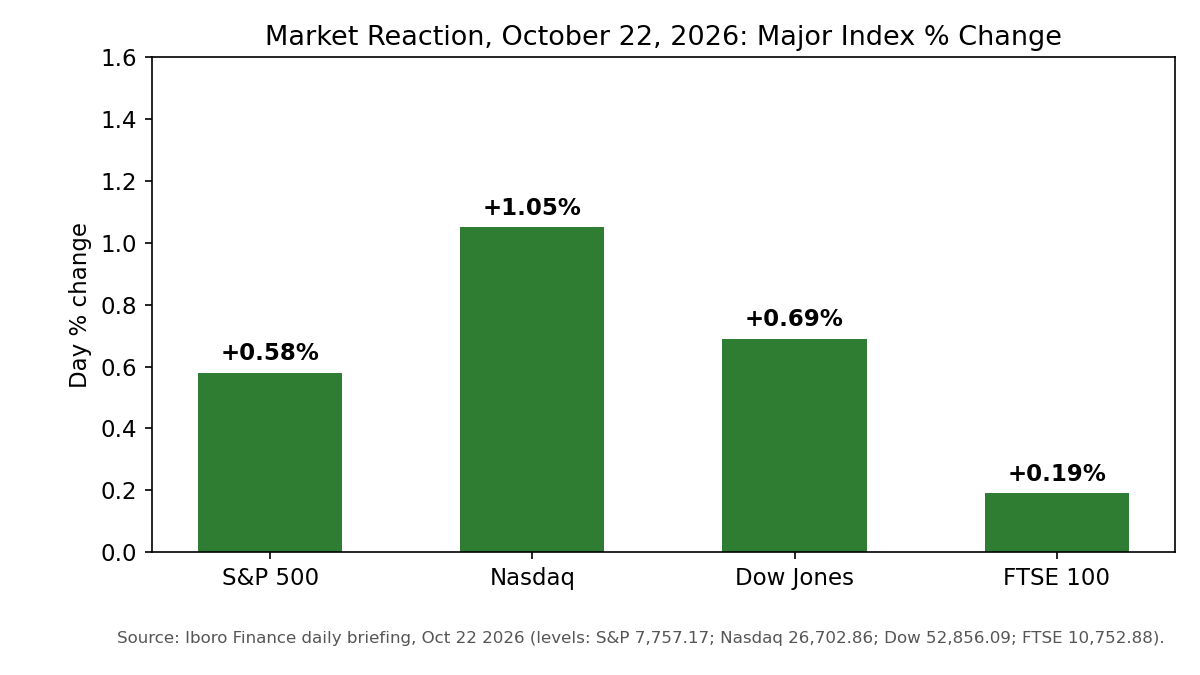
Thursday’s session was broadly positive, with tech earnings doing the lifting. Per the Iboro Finance daily briefing, the major indexes all finished higher:
- S&P 500: 7,757.17, up 0.58%
- Nasdaq: 26,702.86, up 1.05%
- Dow Jones: 52,856.09, up 0.69%
- FTSE 100: 10,752.88, up 0.19%
Elsewhere in markets: the US 10-year yield sat at 5.15% (up 0.57%), gold eased 0.88% to $4,106.10, crude oil fell 3.22% to $98.51, Bitcoin slipped 0.13% to $82,837.29, Ether traded at $2,443.22, and the euro held at $1.1245. The picture is a familiar one for this earnings season: equities bid on tech results while rates stay elevated — a tension worth watching, as our Fed rate coverage has tracked. Additional reporting on the results is available from AI Stock Wire and Zacks. The Tesla Meta Q3 earnings results helped lift the broader market on Thursday.
What This Means for Investors
Step back from the headlines and the two reports tell two different investment stories. Meta’s is about a business firing on all cylinders with a legal bill attached: revenue and EPS ahead of forecasts, shares rising, and a stock split that increases liquidity without disturbing voting control. The $9.9 billion charge is the kind of item that looks alarming in a headline and matters much less in a valuation model — it is one-time, it is known, and the market has already moved past it. The real question for Meta shareholders is whether the advertising engine can keep funding the AI buildout without the spending ever showing up as returns. For investors parsing the Tesla Meta Q3 earnings results, the contrast between the two reports is the real story.
Tesla’s story is about credibility on the metrics that matter. Beating on gross margin and free cash flow — rather than just revenue — directly rebuts the bear case that price cuts have permanently broken the business model. Shares at three-month highs say the market bought it. The 5-million-vehicles-by-2030 target is a different animal: it is management telling you where they think the next growth leg comes from, and investors will spend the next several quarters deciding whether to believe it. Targets like that are free to announce and expensive to miss.
And the market backdrop is doing both stocks a favor for now: a tech-led rally on October 22 with the Nasdaq up 1.05%, even as the 10-year yield sits at an elevated 5.15%. That tension — earnings optimism versus rate gravity — is the trade defining this market, and these two reports just became its latest data points.
Frequently Asked Questions
When did Tesla and Meta report Q3 2026 earnings?
Both companies reported after the market close on Wednesday, October 21, 2026. Markets reacted during Thursday’s October 22 session, with all major indexes finishing higher.
Did Meta beat expectations in Q3 2026?
Yes — Meta reported revenue and earnings per share ahead of forecasts, and its shares rose. However, operating income was weighed down by a $9.9 billion legal charge, a one-time item investors are looking past.
What is Meta’s 2-for-1 stock split?
Meta announced an effective 2-for-1 stock split executed through a new class of non-voting shares. Economically it doubles the share count (lowering the per-share price), while the non-voting structure preserves existing voting control.
How did Tesla do in Q3 2026?
Tesla beat expectations on gross margin and free cash flow — the two metrics investors were watching most — and its shares climbed to three-month highs. The company also set a target of producing about 5 million vehicles a year by 2030.
What is Tesla’s 2030 production target?
About 5 million vehicles per year by 2030, as announced alongside the Q3 results. It implies major growth from current output, likely driven by next-generation platforms.
How did the overall market react on October 22?
Positively: the S&P 500 rose 0.58%, the Nasdaq gained 1.05%, the Dow added 0.69%, and the FTSE 100 edged up 0.19%, with tech earnings providing the lift while the 10-year yield held at 5.15%.
Conclusion
Q3 2026 gave both sets of shareholders something to cheer — and something to watch. Meta delivered the beats, absorbed a $9.9 billion legal hit, and handed investors a 2-for-1 split via non-voting shares. Tesla proved its margins and cash flow can carry the story while pointing to 5 million vehicles a year by 2030. The market’s verdict on October 22 was clear: green across the board, led by the Nasdaq’s 1.05% gain. The open questions now are whether Meta’s legal overhang is truly one-time, and whether Tesla’s 2030 target survives contact with competition. Earnings season has more answers coming — we will keep tracking them. Taken together, the Tesla Meta Q3 earnings results show two companies executing well in very different ways.