
Wall Street Is Holding Its Breath: Tesla and Meta Q3 Earnings October 2026 — What to Watch as the Reports Drop
Wall Street is holding its breath tonight — and for good reason. The results are NOT out yet: both the tesla and meta q3 earnings october 2026 reports land after today’s closing bell, on Wednesday, October 21, 2026. When they do, two of the most closely watched companies on earth will tell investors, within minutes of each other, whether the AI trade that has carried markets all year is still on solid ground. This isn’t a recap — the numbers haven’t crossed the wire. It’s your preview guide: the confirmed schedule, what each company is expected to report, the five metrics that will actually move each stock, and how to read the results yourself when they land after the close.
This week is the opening act of megacap earnings season: Netflix already reported on October 20 — our tech earnings preview for this week laid out what to expect — and the calendar rolls straight on to Microsoft and Alphabet on October 28, Amazon and Intel on October 29, Apple on November 2, and Nvidia on November 18. What happens tonight sets the narrative template for all of them. For broader context on the recent rotation, see our piece on the AI stock market rebound of October 2026, where chip stocks snapped back as financing fears eased.

Tesla and Meta Q3 Earnings October 2026: When Each Company Reports
Meta Platforms reports its Q3 2026 results after the market close on Wednesday, October 21, 2026, with its earnings call at 1:30 p.m. PT (4:30 p.m. ET), per the company’s own disclosure. Tesla reports after the close the same day, per Dow Jones Newswires and multiple earnings-preview desks.
That double-header is what makes tonight special. Most quarters, the two companies report on different days and the market digests each in isolation. Reporting on the same evening means the comparison is immediate and unavoidable: Meta’s ad-fueled cash machine against Tesla’s margin-squeezed car business, both judged on the same question — are you spending enough on AI to matter, but not so much that shareholders revolt?
What Wall Street Expects: Analyst Estimates for Both Companies
Let’s start with the numbers the street is anchoring on, because tonight’s trades will all be framed as “beat or miss” against these bars. Per earnings previews published October 20, the consensus going into the print looks like this:
| Company | Expected EPS (Q3 2026) | Expected Revenue (Q3 2026) | Key profit datapoint | Source of estimates |
|---|---|---|---|---|
| Meta Platforms | ~$6.58 | ~$63.34B | — | geesefinance.com earnings preview, Oct 20 |
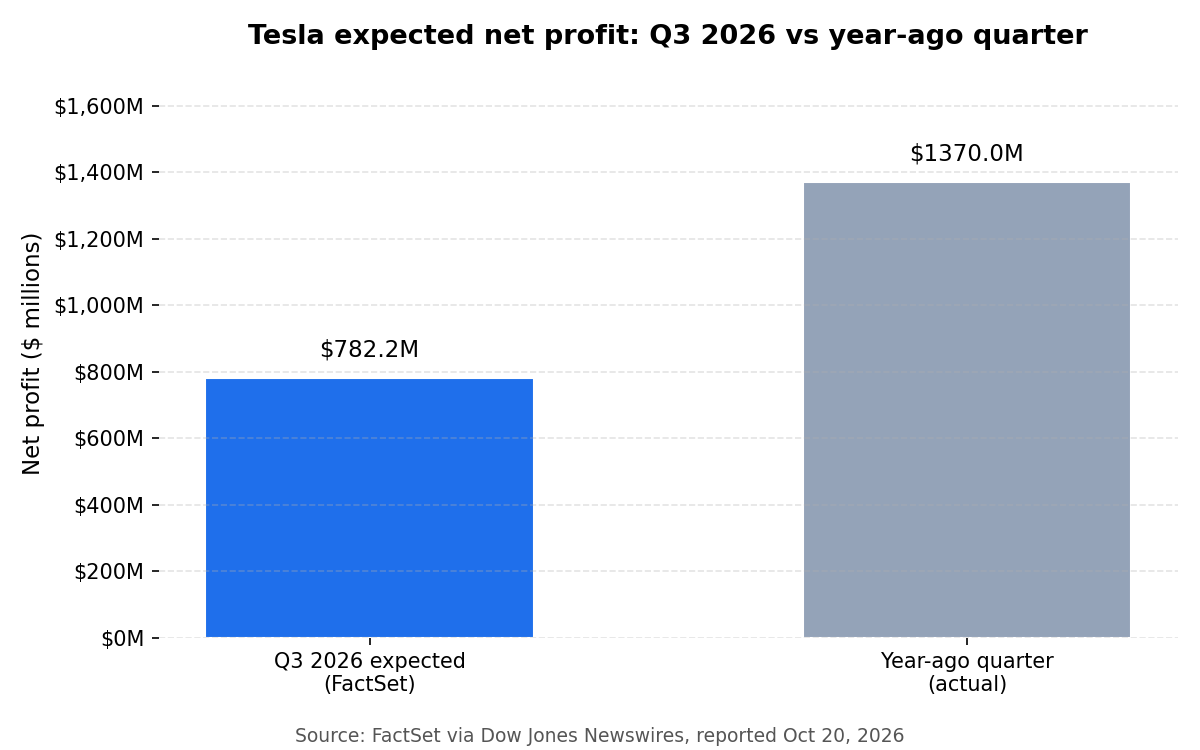
| Tesla | ~$0.4481 | ~$27.92B | Net profit $782.2M expected, vs $1.37B a year earlier | geesefinance.com; FactSet via Dow Jones Newswires, Oct 20 |
| Tesla (alternate bar) | $0.26 | ~$28.3B | — | stockmarketloop.com preview, Oct 20 (stock at $373.71, +1.6%) |
Note the split on Tesla: two credible previews are working with meaningfully different EPS bars — roughly $0.45 versus $0.26 — which usually means analysts are unsure where the quarter’s auto gross margin landed. That uncertainty is exactly what creates big after-hours moves, and a stock at $373.71 going into the print is pricing in optimism tonight will have to justify.
The most sobering expectation is the FactSet number relayed by Dow Jones Newswires: Tesla’s net profit is expected to come in at just $782.2 million, down from $1.37 billion in the same quarter a year earlier. That’s a drop of more than 40% in bottom-line profit. The chart below puts that contraction in plain terms — and it’s the backdrop for every bullish argument Tesla’s supporters will make tonight.
Meta, by contrast, comes in with a cleaner setup on paper: nearly $63.34 billion in expected quarterly revenue and EPS around $6.58. But Meta’s stock rarely trades on the quarter’s revenue line alone. For Meta, the quarter is almost always about what the numbers say about the next twelve months of AI spending.
The 5 Metrics That Will Move Meta’s Stock Tonight
Meta’s headline EPS and revenue will get the push alerts, but the stock will actually trade on these five things:
1. Ad revenue growth vs. expectations
Meta is still, underneath it all, an advertising company. The expected $63.34 billion in total revenue lives or dies on whether ad demand from large and small advertisers held up through the quarter. Investors will compare the growth rate to the prior quarter and to Alphabet, which reports October 28. Softness here would raise questions about the digital ad cycle itself — and that would spill over into the rest of big tech.
2. AI capital expenditure and forward guidance
The street wants to know two things: how much was spent this quarter, and whether next year’s spending guide is going up again. Higher capex is fine if ad revenue is accelerating; it’s punished brutally when it isn’t. Watch how management frames the payback on the call — “efficiency gains in ranking and ads delivery” is the phrase that calms markets.
3. Reality Labs losses
The division that houses the metaverse and smart-glasses efforts has been a multi-billion-dollar quarterly drag for years. Investors don’t expect it to be profitable; they expect the losses to be stable or shrinking. Any surprise widening of Reality Labs losses on the same night capex guidance rises would be a double hit the stock wouldn’t like.
4. Family of Apps margins
Buried inside the report, the operating margin of Meta’s core apps business tells you whether the ad machine is getting more or less efficient. This is the engine that funds everything else, and it’s the number that separates Meta’s AI story from companies that spend on AI without a cash cow behind it.
5. Commentary on AI monetization
The call matters as much as the numbers. Investors will listen for concrete evidence that AI is generating revenue — not just saving costs. New ad products, AI-driven engagement lifts, early enterprise AI revenue: anything that turns “AI spending” into “AI returns” is what keeps the multiple expansion going.

The 5 Metrics That Will Move Tesla’s Stock Tonight
Tesla’s bar is different — and lower, given the profit decline baked into expectations. The bulls aren’t really arguing about this quarter’s EPS; they’re arguing about what this quarter’s EPS says about 2027. Here’s what matters:
1. Automotive gross margin
This is Tesla’s version of Meta’s ad revenue: the core number that tells you whether the business model still works. With net profit expected down more than 40% year over year, investors need to see that vehicle margins have at least stabilized. Every basis point of margin moves the 2026 earnings story, because it determines whether Tesla can keep funding its AI bets from the car business or has to lean harder on growth narratives.
2. Energy generation and storage growth
Tesla’s energy business has quietly become one of the most important parts of the investment case. It’s higher-margin than cars, it’s growing fast, and it gives Tesla a second growth engine that doesn’t depend on vehicle price wars. Deployment numbers and margin for energy will be parsed closely for signs that this engine is still accelerating.
3. Cybercab and Optimus updates
Tesla’s valuation has increasingly little to do with cars sold this quarter and a lot to do with robots and robotaxis promised for the future. Any concrete update — Cybercab timelines, Optimus production milestones, pilot-program data — is what the AI-optimistic part of the shareholder base is waiting for. Vague promises get shrugged off; specifics move the stock.
4. Robotaxi guidance and regulatory progress
Related but distinct: investors want to hear about geographic expansion of robotaxi operations and the regulatory path in new markets. The bear case on Tesla is that robotaxis remain a perpetual “next year” story; the bull case needs dates, cities, and fleet numbers.
5. Free cash flow and the balance sheet
With profit shrinking, cash generation becomes the safety net. Tesla’s ability to fund AI infrastructure, new factories, and robotaxi fleets without tapping capital markets is a core part of the story. A strong free-cash-flow print would do more to reassure tonight’s audience than a small EPS beat.

Tuesday’s Market Setup: The Tape Going Into the Prints
Context matters: stocks don’t report in a vacuum, and Tuesday’s session gave both companies a reasonably friendly runway. The after-market tape for Tuesday, October 20, showed the Dow gaining 529.85 points (+1.02%) to close at 52,495.88, the S&P 500 adding 21.84 points (+0.28%) to 7,712.57, and the Nasdaq essentially flat, down just 6.07 points (-0.02%) to 26,424.82. Brent crude slipped below $109 a barrel, WTI hovered around $101.10, and the 10-year Treasury yield sat at 5.116% — a backdrop of rising equities, easing oil, and elevated-but-stable rates.
That mix is broadly constructive for growth stocks, but the flat Nasdaq is the tell: the market didn’t want to commit ahead of tonight. Expect the real positioning in the after-hours session — the first reaction to any print is always mechanical (beat or miss versus the bar), and then the conference call decides whether the move sticks.
How to Read the Results Tonight: A Retail Investor’s Checklist
You don’t need a Bloomberg terminal to judge these reports like a professional. When the numbers hit after the bell, run through this sequence:
First, check the headline beat or miss — revenue and EPS versus the estimates in the table above. But don’t stop there; headlines move stocks for minutes, not days.
Second, read the segment details. For Meta: Family of Apps revenue and margins, Reality Labs losses. For Tesla: automotive gross margin excluding credits, energy deployments. The segment breakdown is where the real quarter lives.
Third, listen to the capex and guidance language. Meta’s forward spending plans and Tesla’s production outlook for the coming quarters matter more than anything that already happened in Q3 — stocks are priced on the future; the quarter is just evidence.
Fourth, watch the conference call tone, not just the transcript. Are analysts getting straight answers on AI payback? Is management volunteering new data points, or dodging? Markets read confidence — or the lack of it — in real time.
Finally, wait for the second-day reaction. After-hours moves are thin and emotional; the regular session the next day, with full analyst notes published, is the verdict that counts. Headlines move stocks for minutes; fundamentals move them for quarters.
What It All Means for the AI Trade
Step back from the two tickers and look at what tonight really adjudicates. The AI trade of 2026 rests on a simple bargain: investors fund enormous AI capital spending today in exchange for a believable story about returns tomorrow. Meta is the purest test of that bargain — it has the ad cash flow to spend and the AI applications to show returns. Tesla tests the other side: the “AI company that happens to sell cars” narrative, with expected net profit down over 40% year over year, means only credible progress on Cybercab, Optimus, and robotaxis can carry the valuation.
Use the estimates table above as your scorecard, run the five-metric checklist for each company, and don’t let the after-hours noise rush your judgment. The numbers land tonight; the meaning gets decided over the days that follow. For the market-setup data behind this piece — Tuesday’s closes, oil, and Treasury yields — the after-market tape for Tuesday, October 20 and the Meta and Tesla earnings preview are worth bookmarking, along with the Tesla Q3 earnings preview for the alternate estimate bar.
Frequently Asked Questions
When do Tesla and Meta report Q3 2026 earnings?
Both companies report after the market close on Wednesday, October 21, 2026. Meta’s conference call begins at 1:30 p.m. PT (4:30 p.m. ET). Tesla reports the same evening, with results typically released shortly after 4 p.m. ET followed by its earnings call.
What are analysts expecting from Meta’s Q3 2026 earnings?
Per previews published October 20, 2026, analysts expect Meta to report earnings per share of roughly $6.58 on revenue of about $63.34 billion. The stock will likely trade more on AI capital-expenditure guidance and ad-revenue growth than on the headline numbers.
What are analysts expecting from Tesla’s Q3 2026 earnings?
Expectations are split: one preview puts Tesla at EPS of about $0.4481 on revenue of $27.92 billion, while another sets the bar at $0.26 on $28.3 billion. FactSet expects net profit of $782.2 million, down from $1.37 billion in the year-ago quarter. Key metrics to watch: automotive gross margin, energy deployments, and any Cybercab or Optimus updates.
Why do Tesla and Meta earnings matter for the AI trade?
Both companies are central to the market’s AI narrative from opposite directions: Meta is spending heavily on AI infrastructure funded by its ad business, and Tesla’s valuation increasingly reflects AI bets on robotaxis and humanoid robots. Their reports set the tone for Microsoft, Alphabet, Amazon, and Nvidia, which report in the weeks after.
Where can I find the official Tesla and Meta earnings releases?
Both companies publish results on their investor relations sites — Tesla investor relations and Meta investor relations — typically within minutes of the market close, alongside the earnings call webcasts.
What should I watch for in the conference calls?
For Meta: any quantification of AI-driven ad revenue gains and the 2027 capex outlook. For Tesla: specifics on Cybercab timelines, Optimus milestones, and robotaxi expansion. Concrete numbers and dates move stocks; vague optimism usually doesn’t.
Conclusion: Tonight Sets the Template
The tesla and meta q3 earnings october 2026 reports are more than two quarterly check-ins — they’re the opening statements in the trial of this year’s AI trade. By tomorrow morning, every megacap reporting after them will be answering the questions these two reports raise. Tonight, Wall Street holds its breath; tomorrow, it starts asking harder questions.
The tesla and meta q3 earnings october 2026 reports are more than two quarterly check-ins — they’re the opening statements in the trial of this year’s AI trade. Meta needs to show that its AI spending is an investment with visible returns, not just a cost center with good intentions. Tesla needs to show that its future is being built on schedule, not just described on schedule. Both report within hours of each other tonight, and by tomorrow morning, every megacap reporting after them — Microsoft, Alphabet, Amazon, Apple, Nvidia — will be answering the questions these two reports raise.
Use the estimates table above as your scorecard, run the five-metric checklist for each company, and don’t let the after-hours noise rush your judgment. The numbers land tonight; the meaning gets decided over the days that follow. For the market-setup data behind this piece — Tuesday’s closes, oil, and Treasury yields — the after-market tape for Tuesday, October 20 and the Meta and Tesla earnings preview are worth bookmarking, along with the Tesla Q3 earnings preview for the alternate estimate bar.