

Nasdaq Sinks 2.6% as AI Spending Fears Return: What Happened and What Comes Next
Published October 23, 2026 — covering the trading session of Thursday, October 22, 2026
Thursday, October 22, 2026 was the day the AI trade slammed into a wall. The nasdaq ai selloff october 2026 dragged the Nasdaq Composite down 2.6% to 26,008.86 — its steepest single-day drop since June — as investors took one look at the latest round of big-tech earnings and decided the money being poured into artificial intelligence has gotten uncomfortably large.
It wasn’t a broad panic. The Dow Jones Industrial Average finished essentially flat, and some corners of the market actually rose. This was a surgical selloff: the market didn’t hate everything — it hated the AI spending story. And the names it hated most were the ones that had carried the rally for months.
Here’s what happened, why it happened, and what could come next.
The nasdaq ai selloff october 2026 in Numbers
Before diving into the why, let’s get the scoreboard straight from the October 22 close, as reported by Reuters, the Motley Fool, and Upstox:
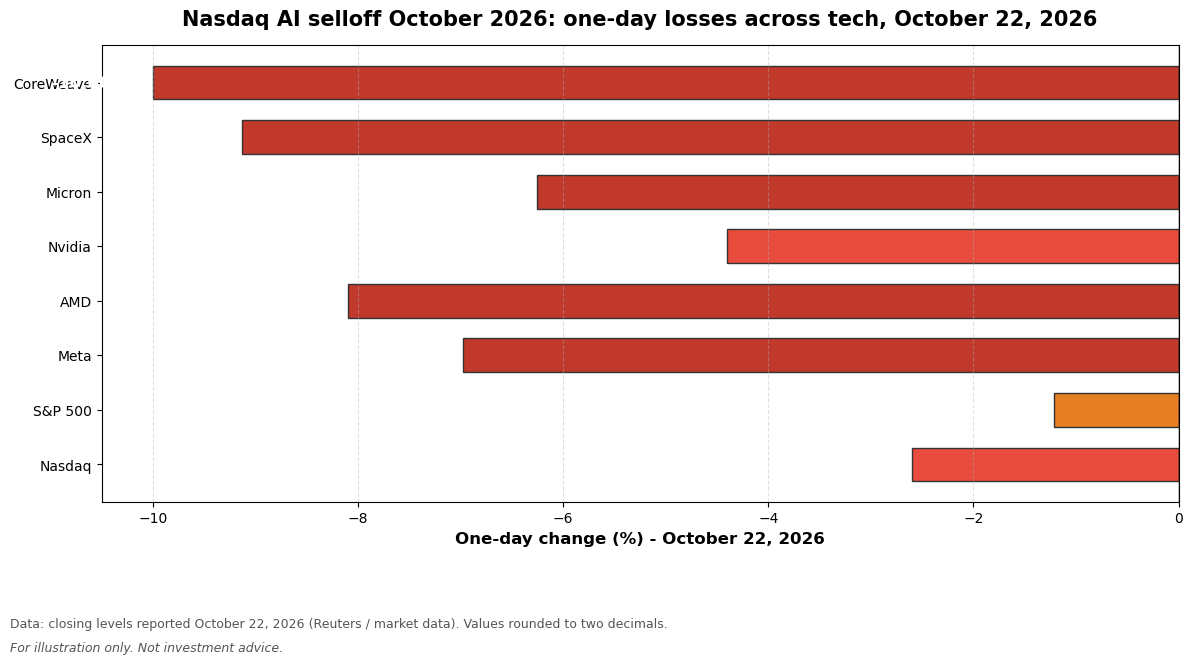
- Nasdaq Composite: −2.60% to 26,008.86 — the steepest daily decline since early June
- S&P 500: −1.21% to 7,663.43, its biggest drop since a 1.52% slide on July 29
- Dow Jones Industrial Average: +0.02% to 52,867.98 — essentially flat, eking out a nominal gain just before the closing bell
The damage was heavily concentrated in technology. The Philadelphia Semiconductor Index (SOX) — the chip benchmark that has driven much of the current bull market — plunged 6.7%, its worst day since June 23. With Thursday’s fall, the SOX is now off more than 26% from its record closing high of June 22, though it remains up 51.5% so far this year, according to Reuters’ account of the session.
The split personality of the day showed up in the market’s internals: the S&P 500 posted 35 new 52-week highs against only 3 new lows, while the Nasdaq recorded 70 new highs and 247 new lows. Translated: the average stock did fine. The AI darlings got demolished.
Why AI Spending Fears Came Roaring Back
The spark came from the earnings everyone had been waiting for. Meta and Tesla both reported third-quarter results this week — and both reports are covered in our roundup of Tesla and Meta’s Q3 results — but the numbers weren’t the problem. The spending was.
Meta actually beat analyst expectations. Revenue jumped 26% year over year to $64.60 billion, and earnings per share came in at $3.83, up from $1.05 a year earlier. But investors zeroed in on two things: the company posted its first cash outflow in more than a decade because of its AI expenditures, and it raised its projected capital spending for this year to $135–145 billion. Meta also unveiled plans to issue new non-voting shares — essentially a two-for-one split — to raise capital for the AI buildout.
“We hit major milestones this quarter toward delivering personal superintelligence for everyone – including launching Muse and Muse Wonder, our first frontier model. Our investments are paying off, the core business is strong, and we’re seeing velocity across the board.” — Mark Zuckerberg, Meta CEO
The market’s response was brutal: Meta shares fell 6.98% to $648.85. Tesla dropped 3.1% even though the EV maker unexpectedly posted positive free cash flow and cut its 2026 capital expenditure plans — no amount of discipline could offset the mood.
Then Nvidia CEO Jensen Huang lit the fuse under the whole neocloud complex, saying demand for neoclouds is “off the charts” but that capital is scarce. As the Motley Fool’s midday market coverage noted, when demand is booming but the money to fund it is tightening, investors hear one thing: the AI infrastructure boom may be financed on shakier ground than assumed.
“Investors are starting to realize that there are some holes in the AI story,” said Paul Nolte, senior wealth adviser and market strategist at Murphy & Sylvest, in comments to Reuters. “And that’s having an impact on the indices because they’re so heavily weighted toward technology.” His colleague’s summary was even blunter: “The only part of the market that is really suffering here is technology, which has been the golden child of the markets up until about June.”
This wasn’t a one-off freakout, either. The same AI capex anxiety triggered a rebound in chip stocks earlier this month when financing fears briefly eased — and that optimism has now fully unwound. Lam Research didn’t help matters, warning of supply chain constraints as it posted results.
The Oil Shock That Made Everything Worse
As if the AI jitters weren’t enough, energy markets delivered a second punch. Brent crude settled up roughly 4% at around $113.17 a barrel — near a five-month high — after Houthi attacks in Saudi Arabia stoked fears of supply disruptions and a wider Middle East conflict. Reports also pointed to possible US–Israeli strikes on Iran, adding a geopolitical risk premium to every barrel.
Why does oil matter to a tech selloff? Because rising crude feeds inflation, and rising inflation constrains the Federal Reserve. Investors are worried that persistent Middle East tensions could keep prices high and force the Fed to continue raising interest rates — the exact opposite of the easy-money backdrop that inflated tech valuations in the first place.
The good news for consumers is nil; the good news for context is that oil spikes have repeatedly acted as the market’s reality check during this rally. When energy costs climb, the market suddenly remembers that the AI buildout competes for capital with everything else in a higher-rate world.

Who Got Hit Hardest
Start with the chip stocks, which bore the brunt of the nasdaq ai selloff october 2026. Nvidia fell 4.40%, AMD cratered 8.10%, Micron Technology dropped 6.26%, Marvell Technology slid 8.6%, SanDisk lost 8.51%, Applied Materials gave up 8.15%, and Intel sank 5.1%. Moderna, Lam Research, and Lumentum Holdings were also among the notable laggards, per Upstox’s recap of the session.
The neocloud trade took the ugliest beating. SpaceX descended 9.13%, and CoreWeave — the AI cloud provider whose debt has already been in the spotlight — dropped 10% after Jensen Huang’s “capital is scarce” remark landed. If you’ve been following CoreWeave’s bond-yield saga, today’s move fits the pattern: when the market questions AI financing, the most leveraged AI names fall first and hardest.
Even the Magnificent 7 weren’t spared. Apart from Apple, which rose 1.2%, every member of the group fell: Meta dropped nearly 7%, Amazon fell 4.6%, Tesla and Alphabet both lost 3.1%, and Microsoft declined 2.2%, according to Al Jazeera’s breakdown of the session. With the group making up more than a third of the overall market, that kind of synchronized slide is exactly how a 2.6% Nasdaq day happens.

The Safe-Haven Rotation
Not everything went down — and the parts that went up tell their own story about how investors read Thursday.
- Bonds rallied: the 10-year Treasury yield fell to roughly 4.96–5.01%, its biggest single-day drop in over a year, as money fled risk and piled into safety.
- Bitcoin fell 3.4%, trading more like a risk asset than digital gold on the day.
- The equal-weight S&P 500 rose 0.73% — meaning the average large-cap stock gained ground even as the headline index fell. The pain was concentrated at the top.
- Spotify soared more than 9% on improved margins — a reminder that companies delivering profits today, not promises for 2030, still get rewarded.
Consumer defensive and utility stocks were the biggest sector gainers, a Reuters report via The Korea Times noted. When investors buy toothpaste stocks and sell semiconductors on the same day, the message is unmistakable: show me the cash flow.
What to Watch Next Week
Thursday’s rout doesn’t settle the AI spending debate — it just raises the stakes for the reports still to come. Tech earnings this week have been dominated by Meta and Tesla, but the heavier hitters are next: Alphabet, Microsoft, and Amazon all report next week, and their capital expenditure plans will either calm the market’s nerves or confirm its worst fears.
The three questions that will decide where this goes:
- How big are the capex numbers? Meta’s $135–145 billion guide is the new bar. If Alphabet, Microsoft, and Amazon come in similarly aggressive, expect more volatility.
- Where’s the revenue? Investors tolerated massive AI spending while revenue growth kept pace. The moment the spending looks decoupled from returns, the selling starts.
- How does the Fed read the oil spike? If crude stays above $110, rate-cut hopes fade — and rate-cut hopes are part of what’s been holding up tech multiples.
As the Motley Fool’s analysts put it, it doesn’t take much to spook already-nervous investors: any sign that AI demand may fall, or that heavy capital spending won’t pay off, can trigger a selloff fast. Next week’s earnings will give the market its next big data point on both.
FAQs
Why did the Nasdaq fall 2.6% on October 22, 2026?
The nasdaq ai selloff october 2026 was triggered by renewed fears about AI infrastructure spending after Meta and Tesla earnings failed to reassure investors. Meta beat revenue expectations but posted its first cash outflow in over a decade due to AI costs and raised its capital spending guidance to $135–145 billion. Jensen Huang’s comment that capital is scarce for neoclouds added fuel, and a ~4% spike in Brent crude to near five-month highs deepened the risk-off mood.
How much did Meta stock fall, and why did it drop after beating earnings?
Meta fell 6.98% to $648.85 despite reporting Q3 revenue of $64.60 billion (up 26% year over year) and EPS of $3.83 versus $1.05 a year earlier. The stock dropped because investors focused on the spending, not the beat: Meta’s first cash outflow in more than a decade, its raised capex guidance, and its plan to issue new non-voting shares to fund AI expansion.
Which stocks were hit hardest in the selloff?
CoreWeave (−10%), SpaceX (−9.13%), Marvell (−8.6%), SanDisk (−8.51%), Applied Materials (−8.15%), AMD (−8.10%), Micron (−6.26%), Meta (−6.98%), Intel (−5.1%), Nvidia (−4.40%), and Amazon (−4.6%). The Philadelphia Semiconductor Index fell 6.7% overall — its worst day since June 23.
What happened to the S&P 500 and Dow on October 22?
The S&P 500 fell 1.21% to 7,663.43, its biggest decline since July 29. The Dow Jones Industrial Average finished essentially flat, up 0.02% at 52,867.98. The equal-weight S&P 500 actually rose 0.73%, showing the damage was concentrated in mega-cap tech rather than the broader market.
Why did oil prices spike on the same day?
Brent crude rose about 4% to settle near $113.17 a barrel — close to a five-month high — after Houthi attacks in Saudi Arabia stoked fears of supply disruptions and a wider Middle East conflict. Reports of possible US–Israeli strikes on Iran added to the geopolitical risk premium.
What should investors watch next week?
Earnings from Alphabet, Microsoft, and Amazon. Their capital expenditure plans and commentary on AI demand will either validate or challenge the market’s current fears about AI spending. Watch also for any moves in crude oil and Federal Reserve signals on interest rates.
Conclusion
The nasdaq ai selloff october 2026 was not a rejection of artificial intelligence — it was a rejection of the price tag attached to it. The technology keeps delivering: Meta’s revenue grew 26%, neocloud demand is, in Jensen Huang’s words, “off the charts.” But markets run on expectations, not enthusiasm, and Thursday’s message was that the burden of proof has shifted. AI spending now has to justify itself quarter by quarter.
Whether October 22 was a healthy reset or the start of something uglier depends almost entirely on what Alphabet, Microsoft, and Amazon say next week. Until then, the market has made its preference clear: cash flow today beats promises tomorrow.
Disclaimer: This article is for informational purposes only and is not investment advice. Markets involve risk; always do your own research or consult a licensed financial adviser before making investment decisions.