

How to Avoid Holiday Weight Gain Without Skipping the Good Stuff
Every December the same warning makes the rounds: you are about to gain five pounds, maybe ten, and there is nothing you can do about it. It is dramatic, memorable, and mostly wrong. If you want to know how to avoid holiday weight gain, the good news is that the numbers are far kinder than the myth — and the strategies that work are smaller and simpler than the internet makes them sound.
Here is the part nobody tells you at the buffet: the average adult gains about a pound over the holidays, not five. That is what researchers found when they weighed people instead of asking them to guess. A pound is not nothing — it adds up year after year if you never lose it — but it is a beatable number. You need a plan, a scale, and a few decisions made before the food arrives. Whether you are hosting, travelling to family, or surviving the office party season, this is the evidence-backed way through — including packing for a winter trip when your routine falls apart.
How Much Weight Do People Really Gain Over the Holidays?
The best-known study comes from the US National Institutes of Health, published in the New England Journal of Medicine in 2000. Researchers weighed 195 adults four times from autumn to spring. Between mid-November and mid-January, the average gain was 0.37 kg — under a pound — and most of it, about 0.8 lb, happened in the six weeks between Thanksgiving and New Year’s Day. Fewer than one in ten participants gained more than five pounds.
Other reviews agree. The Society of Behavioral Medicine puts the typical holiday gain at about one to two pounds between mid-November and January. Dr Donald Hensrud of the Mayo Clinic puts it at about three quarters of a pound, and points out the sting in the tail: “We only gain a little over a pound the entire year, so most of it is during the holiday season and it’s cumulative.” The weight is small — but it sticks: a year later, the holiday pound was still there.
That reframes the whole problem. How to avoid holiday weight gain is not about surviving one giant meal. It is about stopping a small, quiet gain from becoming your new normal, year after year.
How to Avoid Holiday Weight Gain: The 10 Tips That Actually Work
Each tip below is backed by a study, a guideline, or a clinical recommendation, and small enough to do at a real party with real food in front of you. Pick three or four and do them properly — that is how to avoid holiday weight gain without turning the holidays into a chore.
1. Weigh yourself every day
This is the single most powerful finding in the research, and the simplest. In a 2019 study in the journal Obesity, researchers at the University of Georgia asked 111 adults to weigh themselves daily through the holidays, with a graph showing their weight trend. The daily-weighing group maintained their weight — on average down 0.13 kg — while the control group, who did not weigh themselves, gained 2.65 kg, nearly six pounds. People who were overweight or obese did even better, losing an average of 1.46 kg.
It is not magic. A daily weigh-in is an early warning system: a small rise on Tuesday becomes a slightly smaller plate on Wednesday, long before it becomes a problem in January. The Society of Behavioral Medicine lists daily self-weighing as its first tip. Weigh first thing in the morning, in similar clothes, and watch the trend over days rather than panicking over one reading. Water and salt can move the number overnight — the trend is what matters.
2. Build your plate before you fill it
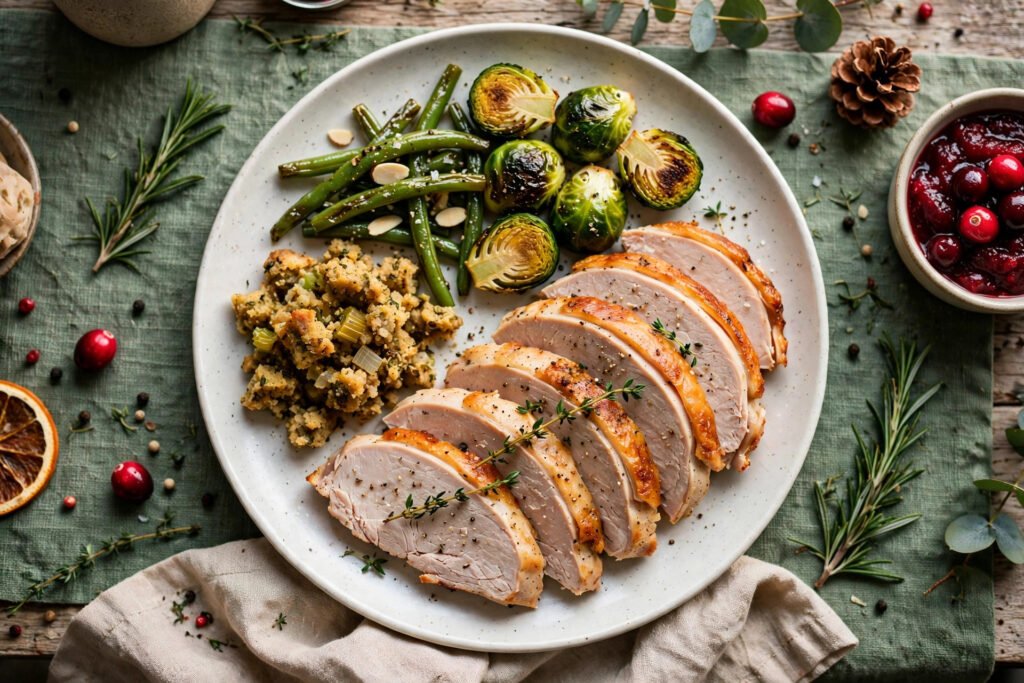
Walk the buffet before you pick up a plate. Look at everything, then decide what is actually worth it to you. The plate method is the easiest version of portion control ever invented: half the plate vegetables and salad, a quarter lean protein, a quarter everything else. Turkey breast is lean, filling, and high in protein. The rich dishes are not banned; they just get a smaller share.
Use a smaller plate if one is available — your eyes judge fullness by the plate, not by the calories. And sit down to eat: people who graze standing at the snack table eat more than people who plate their food and sit with it, partly because they never register eating.
3. Slow down — the 20-minute rule
It takes roughly 20 minutes for your stomach to tell your brain that you are full. The signal travels by hormones and nerve impulses, and it is not instant: stretch receptors and hormones like cholecystokinin need time to reach the brain. Eat a full meal in ten minutes and you will go back for seconds before your brain gets the message.
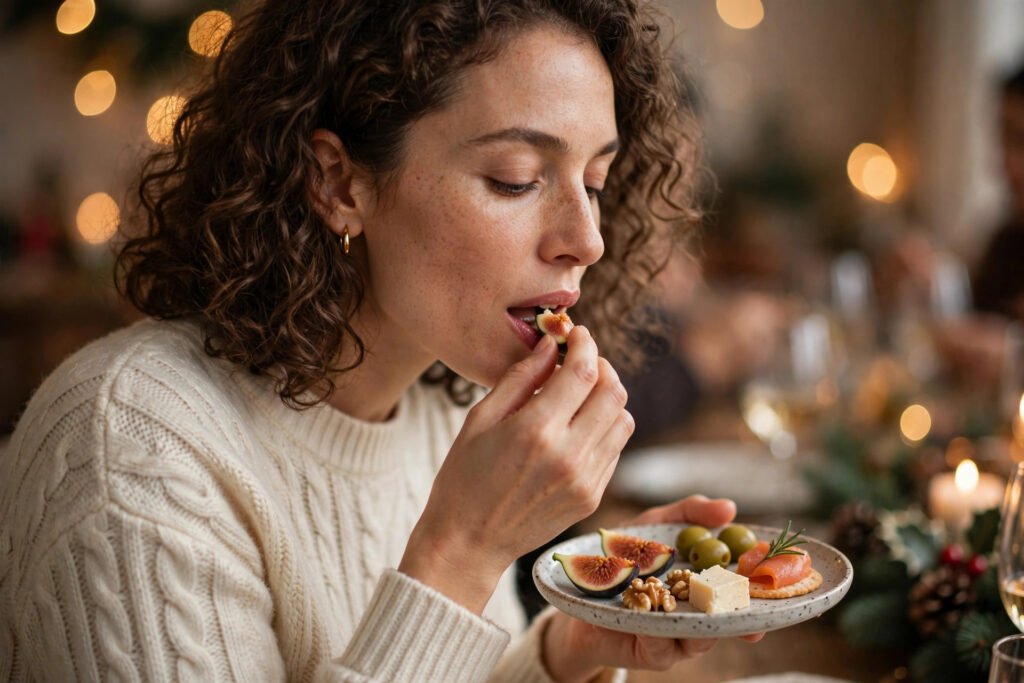
So give the signal time to arrive. Put your fork down between bites. Chew properly. Harvard Health suggests ten minutes before seconds — still hungry after the pause, eat more; if not, you have saved yourself a plate you did not want. Eating slowly also helps your gut health: rushed meals trigger bloating and indigestion.
4. Never arrive starving
The worst thing you can do before a holiday party is skip meals to “save” calories for later. It never works. You arrive ravenous, your blood sugar is low, and the first thing you meet is a table of cheese, crackers, and pastry. Dr Hensrud of the Mayo Clinic recommends the opposite: eat something healthy before you go — fruit, a handful of nuts — so you walk in calm instead of desperate.
Eat a normal breakfast and lunch on party days, and have a protein-rich snack an hour or so before you head out. Our guide to healthy snacks for weight loss has plenty of options that travel well. The point is to take the edge off your hunger, so your decisions are decisions, not reflexes.
5. Watch the drinks — they are the silent calories
Food gets all the attention, but drinks are where holiday calories sneak in uncounted. A cup of eggnog carries about 224 calories, and a standard 175 ml glass of wine can contain up to 158 calories, according to the NHS. Two glasses of wine plus an eggnog is roughly 500 calories before you have eaten — and alcohol makes you hungrier and loosens your restraint at the dessert table.

The fix is not abstinence. It is alternation: one alcoholic drink, then a glass of water or sparkling water, then decide whether you want another. Eat before you drink, never on an empty stomach, and pick the drinks that are actually worth it to you. A small glass of something special beats three glasses of something ordinary. Keep water beside you — thirst is easily mistaken for hunger.
6. Know the numbers on your plate
You cannot manage what you cannot see, and holiday food is a master of disguise. A scoop of stuffing looks harmless. It is not. The table below uses figures from the USDA’s FoodData Central database, in the serving sizes a home cook would actually recognise. Read it once and buffets will never look the same.
| Food or drink | Serving | Calories |
|---|---|---|
| Roast turkey, white meat with skin | 4 oz | 200 |
| Bread stuffing | 1 cup | 390 |
| Mashed potatoes with milk and butter | 1 cup | 237 |
| Turkey gravy | 1/4 cup | 31 |
| Cranberry sauce, canned | 1/4 cup | 111 |
| Green bean casserole | 1/2 cup | 75 |
| Candied sweet potatoes | 1/2 cup | 234 |
| Dinner roll with butter | 1 roll | 123 |
| Pumpkin pie | 1 slice (1/8 of a 9-inch pie) | 316 |
| Pecan pie | 1 slice (1/8 of a 9-inch pie) | 503 |
| Eggnog | 1 cup | 224 |
Notice the pattern. The turkey itself is the bargain of the table — 200 calories for a generous portion of lean protein. The expensive items are the ones that look like sides: a cup of stuffing at 390 calories, a slice of pecan pie at 503. A single plate with one serving of each main dish adds up to roughly 1,300 calories, before seconds, dessert, and drinks. You do not need to count every calorie — just know which dishes deserve a small spoon.
7. Keep moving — the 150-minute rule
Activity is the other half of the equation, and the target is simpler than most people think. The CDC recommends that adults get at least 150 minutes of moderate activity a week — 30 minutes a day, five days a week — plus muscle-strengthening activity on two days. That is a brisk walk, not a gym membership: a walk after dinner, a dance at the party, a wander to look at the lights.

The table below, from Harvard Health Publishing, shows what 30 minutes of activity burns for a 155-pound adult. A brisk half-hour walk burns about 133 calories — roughly the cost of a dinner roll with butter. A half-hour run burns about 288. Movement creates breathing room in your calorie budget, and doubles as stress relief.
| Activity (30 minutes) | Calories burned (155 lb adult) |
|---|---|
| Walking, 3.5 mph | 133 |
| Walking, 4 mph (brisk) | 175 |
| Running, 5 mph | 288 |
| Cycling, 12–13.9 mph | 288 |
Make it social and it will actually happen. A family walk after the meal gets everyone out of the chairs, aids digestion, and turns the long sit after eating into the easiest win. If you are travelling, pack walking shoes before party shoes; cold air is tough on skin, so our guide to dry skin in winter is worth a read before you head out.
8. Choose your treats — all of them is not a choice
At a buffet, the most dangerous word is “everything.” A little of this, a little of that, and suddenly you have eaten six desserts without enjoying any of them. The fix is to choose before you serve. Survey the whole table first, pick the two or three things that are genuinely special to you — the dish your grandmother makes once a year, the pie from the bakery across town — and skip the rest without guilt.
Harvard Health’s holiday eating guide makes the same point in plainer language: be choosy, and spend your calories on the foods you love. A slice of pecan pie you truly want is a better experience than three desserts you ate because they were there.
9. Deal with the leftovers on purpose
The meal ends, but the food does not. The three days after Christmas are when most of the damage is done, one cold slice of pie at a time, at the open fridge. So deal with the leftovers on purpose. Pack boxes for guests before they leave. Freeze portions in single servings. Put the treats at the back of the fridge, and the fruit where you can see it.
If you are hosting, be kind to yourself: you do not have to finish everything you cooked. Food given away is not wasted — it did its job. And if you are a guest, take a box home happily, then freeze it the same day. Leftovers are only a problem when they sit in your kitchen with no plan.
10. Sleep, stress, and a little self-compassion
Short nights and high stress are a weight-gain machine all on their own. Sleep deprivation disrupts the hormones that control hunger — ghrelin, which makes you hungry, rises, while leptin, which tells you that you are full, falls — so a tired person is a hungry person, and a stressed person reaches for sugar and fat. It is biology, not a character flaw. Protect your sleep, even during the party season, and keep one calm hour a day for yourself.
Above all, do not throw in the towel. The most common pattern in holiday weight gain is not one big meal — it is one big meal followed by giving up entirely until January. As the Mayo Clinic puts it, you can still have fun and manage your weight with a little effort. One heavy day does not ruin the season. What ruins it is deciding, on December 26, that the season is already lost.
Frequently Asked Questions
How to avoid holiday weight gain at parties?
Eat a small protein-rich snack before you go, survey the buffet before you serve yourself, use a small plate, and alternate every alcoholic drink with a glass of water. Pick the two or three treats that are genuinely special to you and skip the rest.
How much weight do people actually gain over the holidays?
About a pound, on average. The NIH study published in the New England Journal of Medicine in 2000 measured an average gain of 0.37 kg — under a pound — between mid-November and mid-January, and the Society of Behavioral Medicine puts the typical range at one to two pounds. The problem is not the size. Most people never lose it, so it accumulates year after year.
Is it better to skip meals before a big holiday dinner?
No. Skipping meals to “save” calories almost always backfires: you arrive ravenous, eat faster, and eat more. Eat a normal breakfast and lunch, have a small snack before the event, and let your decisions at the table be decisions, not reflexes.
What is the single most effective tip?
Daily self-weighing. In the 2019 University of Georgia study, adults who weighed themselves daily through the holidays maintained their weight, while the control group gained an average of 2.65 kg. It is the cheapest early warning system there is: a small rise today becomes a smaller plate tomorrow.
Can you lose holiday weight gain in January?
You can, but the research says most people do not. In the NIH study, volunteers who gained weight over the holidays had not lost it a year later. Prevention beats repair: holding steady for six weeks is far easier than losing the same pound in January, when motivation is low and the gym is crowded.
Conclusion
That is how to avoid holiday weight gain — not with a diet, a detox, or a month of misery, but with a system. Weigh yourself every morning. Build your plate before you fill it. Slow down and let the 20-minute signal arrive. Eat before the party, watch the drinks, know the numbers, and keep moving. Together, they are the difference between a pound that stays and a pound that never arrives.
The holidays are for enjoying, and enjoying them properly means enjoying the food that matters and skipping the food that does not. Have the pie your grandmother makes. Dance at the party. Take the walk after dinner. That is how to avoid holiday weight gain and still enjoy every bit of it — and when January comes, you will be exactly where you were in November, which, after six weeks of feasting, is an achievement.



