
How to Cook a Turkey: The Complete Oven-Roasted Guide for First-Timers

There is a particular kind of quiet that falls over a kitchen the first time a whole turkey goes into the oven. The bird is bigger than you expected. The oven suddenly looks small. Everyone else is relaxed, because they assume you know what you are doing, and you are smiling while quietly wondering whether the whole meal depends on a piece of meat you have never cooked before. If that sounds familiar, you are in the right place. Learning how to cook a turkey is mostly a matter of planning, patience, and a thermometer — not talent, not luck, and not some secret family technique nobody wrote down.
Before you start: size, thawing, and a simple plan
The first decision is size, and it is easier than most people make it. Plan on 1 to 1.5 lb of turkey per person. That range covers a generous serving plus a little left over, which is exactly what most people want from a holiday bird. A smaller bird cooks faster and stays juicier, so do not buy the biggest turkey in the shop just because it looks impressive. A 14 lb bird comfortably feeds a table of nine or ten, and a 20 lb bird feeds a crowd of thirteen to twenty.
Thawing is the step first-timers most often get wrong, simply because it takes longer than anyone expects. Thaw the turkey in the fridge, allowing about 24 hours for every 4 to 5 lb. A 15 lb bird needs roughly three to four days, and a 20 lb bird about four to five days. Keep it in its wrapping on a tray on the lowest fridge shelf, so liquid cannot drip onto other food.
If you are short on time, read our guide to thawing a turkey safely before you try any shortcut, because the fridge method is the one this guide is built around. Do not leave a turkey out on the counter to thaw. The outside warms up far faster than the inside, and that is exactly the situation food safety guidance is designed to prevent.
What you need before the bird goes in
You do not need much equipment. A roasting pan with a rack lifts the bird out of its own juices so hot air can move around it and the skin can crisp all over. If you do not have a rack, a bed of rough-cut vegetables under the bird does a similar job. A meat thermometer is not optional. Colour and cooking time are rough clues. Temperature is the answer.
The part most first-timers get wrong: how to cook a turkey without drying it out
Most dry turkeys are not dry because the cook did something dramatic. They are dry because the bird was roasted too long, at too high a heat, with no thermometer to say when to stop. The meat keeps cooking after it leaves the oven, so a turkey pulled at exactly the right temperature and rested properly will be juicier than one left in until it looks done.
Now, the step that surprises most first-timers: never wash a raw turkey. Rinsing it under the tap does not make it cleaner. It splashes water, and the bacteria on the raw bird, onto the sink, the counter, and anything nearby. The USDA is clear on this point, and the USDA food safety guidance is the authority to follow when raw poultry is involved. Heat in the oven is what makes the turkey safe, not water from the tap. Skip the rinse entirely, and wash your hands and any surface the raw bird touched instead.
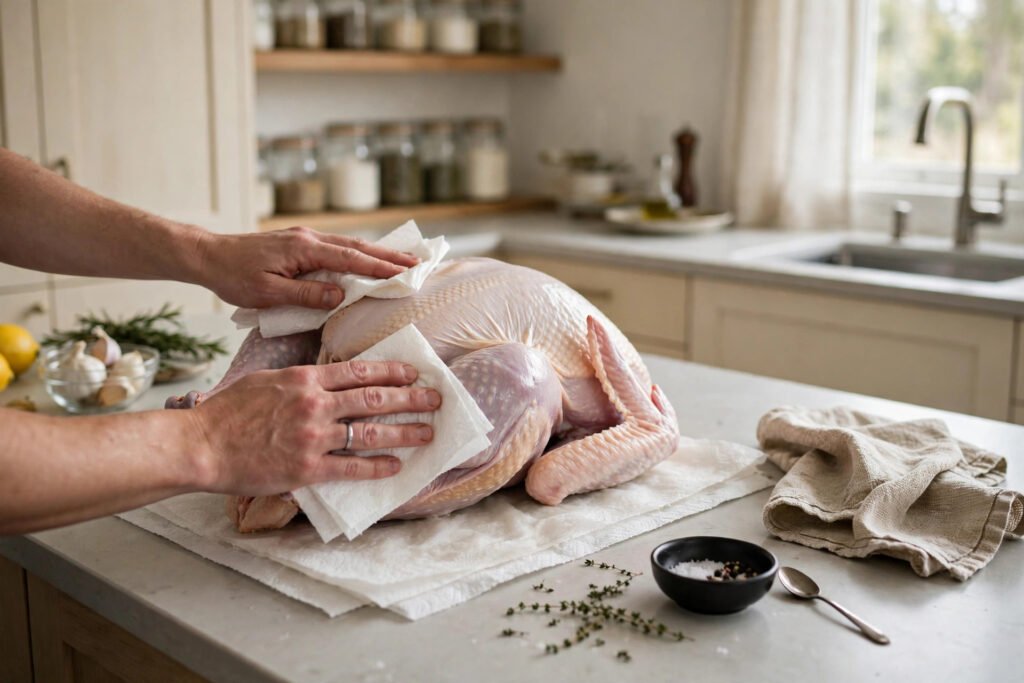
Pat the skin dry with paper towels, inside and out, and take your time over it. Wet skin steams in the oven instead of crisping, so a bird that goes in damp comes out pale and soft. A bird that goes in dry comes out golden and crisp. Dry skin also helps seasoning stick, so this one small job pays off twice.
Season the bird simply. Salt and pepper, inside and out, plus softened butter or oil rubbed over the skin, is enough for a first turkey. Herbs such as thyme, rosemary, and sage add flavour without complicating anything. For a deeper flavour, read our guide to brining a turkey before the big day, because brining needs to happen well before roasting starts.
Roasting: temperature, timing, and the two methods that work
There are two reliable ways to roast a turkey, and both work well. Pick one, stick to it, and do not keep changing the oven temperature or opening the door to check. Every time the door opens, heat escapes, the oven has to recover, and the cooking time stretches out. Trust the thermometer and the clock instead, and you will find that the question of how to cook a turkey comes down to holding a steady heat and knowing when to stop.
The first method, from The Kitchn, starts hot and then settles down. Heat the oven to 450°F, put the turkey in, then drop the temperature to 350°F for the rest of the roast. The hot start crisps the skin early, and the lower heat cooks the bird through gently. See the Kitchn turkey guide for a tested version.
The second method, from Food Network, is simpler: roast at a steady 325°F for the whole time, at about 15 minutes per pound. No temperature change, and the slower roast is forgiving for a first-timer. See the Food Network roast turkey method.
Whichever method you choose, use the times in the table below as a guide, not a promise. The Kitchn gives 13 minutes per pound for an unstuffed bird and 15 minutes per pound for a stuffed bird, and those figures are the basis for the table. Your oven, the starting temperature of the bird, and whether it is stuffed will all shift the real time a little. That is why the thermometer, not the clock, decides when the turkey is done.
| Turkey weight | Unstuffed time at 350°F (13 min/lb) | Stuffed time (15 min/lb) | Serves (1–1.5 lb per person) |
|---|---|---|---|
| 10 lb | 2 hours 10 minutes | 2 hours 30 minutes | 7–10 people |
| 12 lb | 2 hours 36 minutes | 3 hours | 8–12 people |
| 14 lb | 3 hours 2 minutes | 3 hours 30 minutes | 9–14 people |
| 16 lb | 3 hours 28 minutes | 4 hours | 11–16 people |
| 18 lb | 3 hours 54 minutes | 4 hours 30 minutes | 12–18 people |
| 20 lb | 4 hours 20 minutes | 5 hours | 13–20 people |
| 22 lb | 4 hours 46 minutes | 5 hours 30 minutes | 15–22 people |
| 24 lb | 5 hours 12 minutes | 6 hours | 16–24 people |
Place the turkey breast-side up on the rack in the roasting pan, and slide it into the oven. If you are stuffing the bird, fill the cavity loosely just before it goes into the oven, never the night before. Loose stuffing cooks through properly, while stuffing packed tight stays cool in the middle. Remember that stuffing inside the bird must also reach 165°F, so check it with the thermometer just as you check the meat.
For a smaller household, see our guide to roasting a turkey breast or cooking a turkey in an air fryer.
To baste or not to baste
Basting is optional. The Kitchn suggests basting every 45 minutes, spooning the pan juices over the breast to keep it moist and help it brown. The trade-off is that every baste means opening the oven door and letting heat out, so the roast takes a little longer.
The other approach is to skip basting entirely and leave the oven shut. A turkey roasted with the door closed cooks more evenly and finishes sooner, and the skin still browns well if it went in dry and well seasoned. If you like to fuss over the bird, baste every 45 minutes. If you would rather set it and leave it alone, skip basting and let the oven do the work.
Either way, watch the skin. If the breast or wing tips darken too fast, tent the bird loosely with foil — a loose tent slows browning, while a tight wrap traps steam and softens the crisp skin.
How to tell when the turkey is done
This is the moment the whole meal turns on, and it is also the moment first-timers feel most nervous. Forget the colour of the juices, forget how long the bird has been in, and forget whether the little plastic pop-up timer has popped. None of those are reliable. The only test that matters is temperature, measured in the right places with a thermometer you trust.
The turkey is done when it reaches 165°F in the thickest part of the thigh. That is the headline number, and it is the one to remember. But do not stop there. Check the breast as well, and check the innermost part of the wing, and if the bird is stuffed, check the centre of the stuffing too. Each of those spots must reach 165°F.
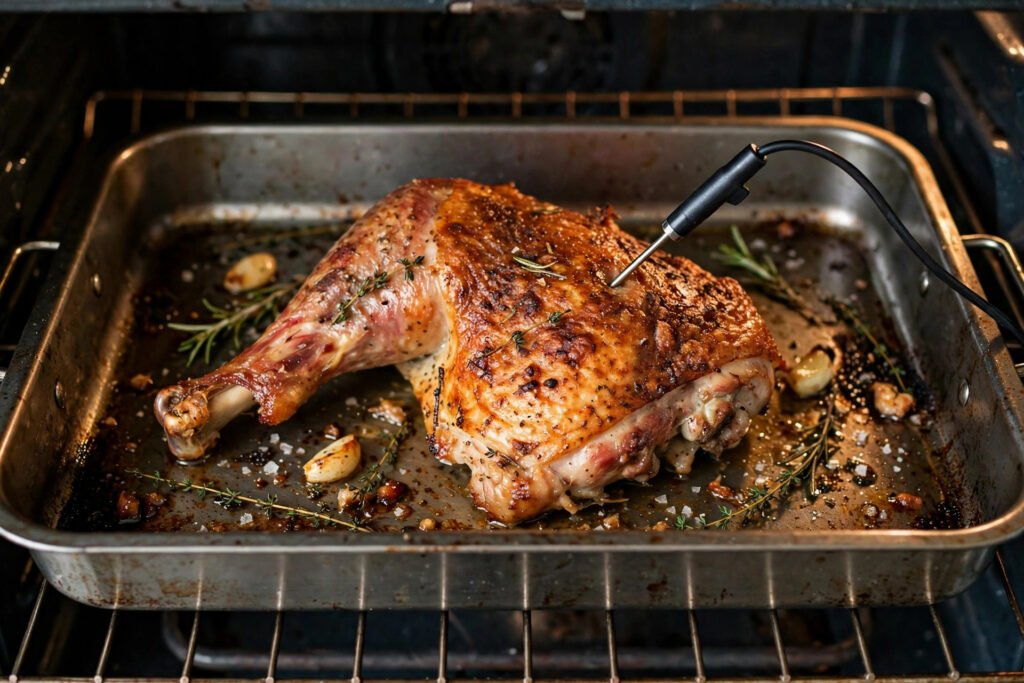
Slide the thermometer into the thickest part of the thigh, taking care not to touch the bone, because bone heats up faster than meat and will give you a falsely high reading. Push it into the centre of the meat and wait for the reading to settle. Then check the thickest part of the breast in the same way, and the innermost wing. If any spot is below 165°F, put the bird back in the oven and check again after a short while. If you are learning how to cook a turkey for the first time, this temperature check is the skill that matters most, and it is worth doing slowly and carefully.
| Where to check | Target temperature | What it tells you |
|---|---|---|
| Thickest part of the thigh | 165°F | The slowest-cooking meat is done and safe to eat |
| Thickest part of the breast | 165°F | The breast meat, which dries out first, is cooked through |
| Innermost part of the wing | 165°F | A tucked-away joint that can lag behind the rest of the bird is done |
| Centre of the stuffing | 165°F | Stuffing inside the bird, which heats last, is safe to serve |
If the breast hits 165°F well before the thigh, tent the breast loosely with foil and let the thighs catch up. For more detail, see the Serious Eats turkey guide and the Taste of Home turkey tips.
Resting and carving: the part you must not skip
When the thermometer says 165°F, take the turkey out of the oven, move it to a carving board, and leave it alone. Rest the bird for at least 20 to 30 minutes before carving. This is not wasted time. Resting lets the juices, which have been driven towards the centre by the heat, spread back through the meat. Cut into a turkey straight out of the oven and those juices run out onto the board. Wait half an hour and they stay where they belong, in the meat. That rest is the last, quiet step in learning how to cook a turkey well, and it makes a real difference to the first slice.
Tent the bird loosely with foil while it rests. The foil keeps it warm without trapping steam and softening the skin. Do not wrap it tightly, and do not put it back in a hot oven to keep it warm, because both will overcook the meat you have just cooked so carefully. A loose tent and a warm kitchen are enough.
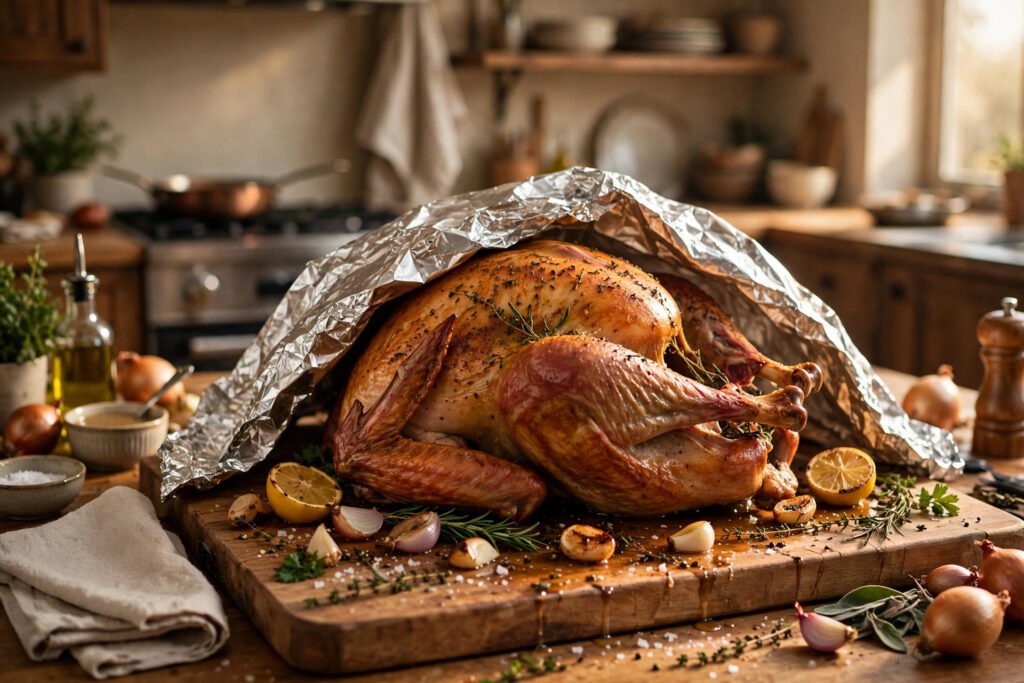
Use the resting time to finish the gravy, warm the side dishes, and get everyone to the table. Remove the legs first, then the thighs, then slice the breast meat away from the bone in even slices. A sharp knife matters more than speed.
Leftovers, food safety, and the day after
Once the meal is over, do not leave the turkey sitting out while everyone lingers at the table. Refrigerate leftovers within 2 hours. That is the rule, and it applies to the turkey, the stuffing, and the side dishes alike. Slice the leftover meat off the bone before you pack it away, because flat slices cool faster and stack neatly, and put it into shallow containers so it chills quickly and evenly.
Frequently asked questions
How long does a turkey take to thaw in the fridge?
Allow about 24 hours for every 4 to 5 lb. A 12 lb bird needs about three days, a 16 lb bird about four days, and a 20 lb bird about four to five days. Keep it in its wrapping on a tray on the lowest fridge shelf.
Should I wash the turkey before roasting it?
No. Never wash a raw turkey. Rinsing splashes bacteria from the raw bird onto the sink and counter, and it does not make the meat any cleaner. Pat the skin dry with paper towels instead, and let the heat of the oven make the bird safe.
What temperature should a turkey reach before I serve it?
The turkey is done at 165°F in the thickest part of the thigh. Check the breast and the innermost wing as well, and the centre of the stuffing if the bird is stuffed. Each spot should reach 165°F. Use a meat thermometer, away from the bone, rather than relying on time or colour alone.
Do I need to baste the turkey while it roasts?
No, basting is optional. Some cooks baste every 45 minutes with the pan juices to keep the breast moist and help it brown. Others skip basting entirely and leave the oven door shut, which keeps the heat steady and shortens the roast. Both approaches produce a good turkey.
How long should a turkey rest before carving?
Rest the turkey for at least 20 to 30 minutes before carving, tented loosely with foil. Resting lets the juices spread back through the meat, so the slices stay juicy instead of drying out on the board. Use the time to finish the gravy and warm the side dishes.
A first turkey you can be proud of
A good roast turkey is a thawed bird, dried and seasoned simply, roasted at a steady temperature, checked with a thermometer, and rested before carving. Each step is small on its own. Together they are the difference between a dry, anxious meal and a relaxed one.
If this is your first turkey, give yourself the gift of a plan. Choose the size from the table, count back the thawing days, write the oven time on the fridge, and keep the thermometer close. Once you have learned how to cook a turkey this way, the second one will feel easy — and when the bird comes out golden and the thermometer reads 165°F, you will know the meal is in good shape.



