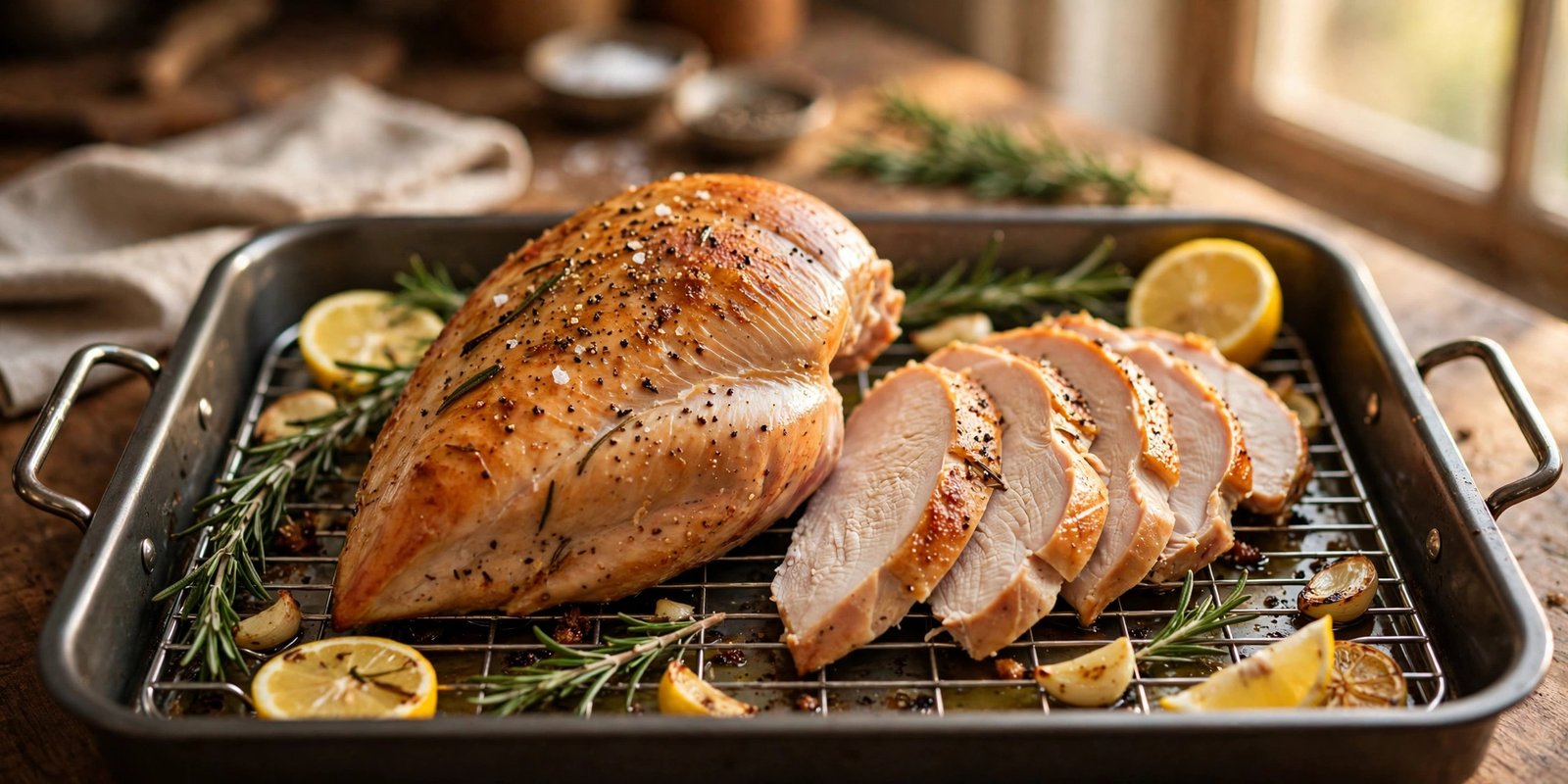

How to Roast a Turkey Breast: Juicy, Golden, and Ready in 2 Hours
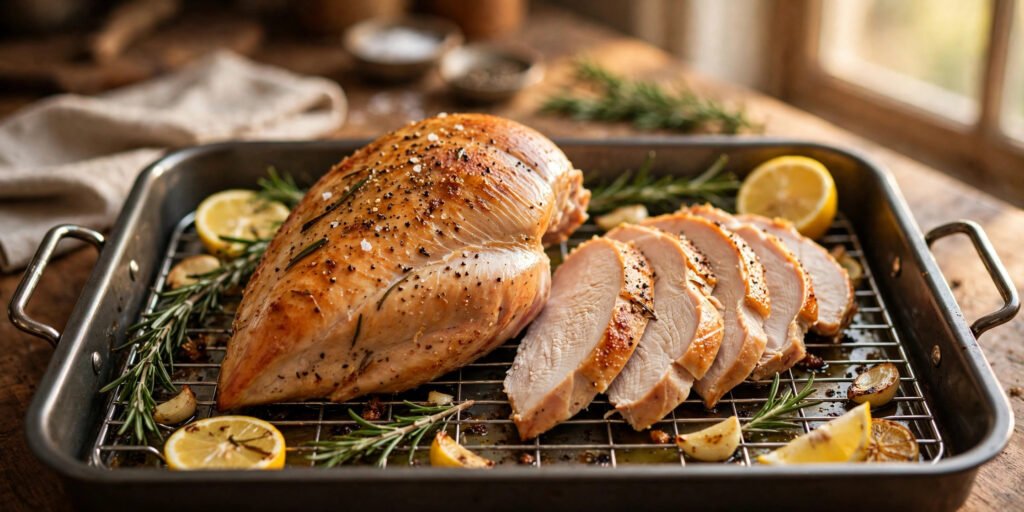
Not every Thanksgiving needs a twenty-pound bird. If you are cooking for four, or six, or just two, a whole turkey is a lot of work for a lot of leftovers — and the dark meat and the white meat never finish at the same time. Learning how to roast a turkey breast solves all of that at once: it cooks in about two hours, it is almost entirely the juicy white meat everyone reaches for first, and it fits in a regular roasting pan without a wrestling match.
This guide covers everything you need: why a breast beats a whole bird for a small crowd, how to choose between bone-in and boneless, the time-per-pound table that takes the guesswork out of timing, the butter-under-the-skin method that keeps the meat moist, and the USDA temperature rule that tells you exactly when it is done. Thanksgiving falls on Thursday, November 26, 2026, and a turkey breast is the easiest way to serve a proper holiday meal without spending the whole day in the kitchen.
One thing to know before you start: this method works for a fresh or fully thawed breast. A frozen breast cannot roast evenly, and it cannot absorb seasoning. If yours is still frozen, see our guide on how to thaw a turkey safely — a turkey breast thaws in the refrigerator in about a day, far faster than a whole bird.
Why a Turkey Breast Beats a Whole Bird for a Small Crowd
A whole turkey is built for a crowd. A breast is built for a table of two to eight, and it wins on nearly every point that matters. It roasts in roughly a third of the time — about two hours instead of four or five. It needs no special equipment: a roasting pan and a rack are enough, and it fits in a standard oven alongside the stuffing. And because it is all white meat, there is no dark meat going uneaten.
There is a quality argument too. The hardest part of roasting a whole turkey is that the legs and the breast cook at different rates — the legs need more time, the breast dries out while you wait. A breast on its own has no such conflict, so the whole piece comes out juicy.
It is also cheaper per serving for a small group. A whole turkey is often cheaper per pound, but you are buying bones, wings, and dark meat you may not eat. A breast costs more per pound and wastes almost nothing. For a table of six, a five- to seven-pound bone-in breast is the right size.
Bone-In vs Boneless: Which Should You Buy?
You will find two kinds of turkey breast at the store, and the choice matters.
Bone-in is the better choice for roasting. The bone insulates the meat, slows the cooking slightly, and keeps the breast juicier. It also gives you a carcass for stock afterward, and the skin crisps beautifully. A bone-in breast is usually sold as a half breast (one side of the bird), weighing three to eight pounds. Buy about three-quarters of a pound per person — a six-pound breast feeds eight comfortably.
Boneless is the convenient choice. It is a rolled, tied roast, usually three to four pounds, and it cooks faster and carves in neat, even slices. The trade-off is that it can dry out more easily, since there is no bone to slow the heat, so the butter-under-the-skin step and the resting step matter even more. Keep the netting or twine on during roasting so it holds its shape, and remove it before carving.
Either way, check the label. Some breasts are sold “enhanced” or “injected with a solution” — those are pre-salted, so go easy on the seasoning. A plain, unenhanced breast gives you full control. Butterball’s turkey breast cooking guide recommends the same check, and it is worth the ten seconds at the store.
Roasting Times: Minutes Per Pound and the 165°F Rule
Time-per-pound tables are a starting point, not a promise — ovens vary, and the only reliable test is a thermometer. But they are the best way to plan your day, so here is the standard guidance for a 325°F oven.
| Turkey breast | Weight | Minutes per pound at 325°F | Approximate total time |
|---|---|---|---|
| Bone-in | 3 to 4 pounds | 20 to 25 minutes | 1 to 1½ hours |
| Bone-in | 5 to 7 pounds | 20 minutes | 1¾ to 2¼ hours |
| Boneless, rolled | 3 to 4 pounds | 20 to 25 minutes | 1 to 1½ hours |
| Boneless, rolled | 5 to 6 pounds | 20 minutes | 1¾ to 2 hours |
These are approximate times from the standard roasting charts — start checking the temperature about 30 minutes before the low end of the range. The real rule comes from the USDA: turkey is done when a meat thermometer reads 165°F in the thickest part of the breast, away from the bone. Some cooks pull the breast at 160°F and let carryover heat finish the job during the rest, but 165°F is the safe number. The Kitchn’s turkey breast roasting guides use the same 165°F target, and every food-safety source agrees with it.
How to Roast a Turkey Breast, Step by Step
This method works for a bone-in breast of five to seven pounds, and it adapts easily to a boneless roast.
Step 1: Bring it to room temperature. Take the breast out of the refrigerator 30 to 45 minutes before roasting. A cold breast goes into a hot oven and the outside overcooks before the inside catches up. Pat it completely dry with paper towels, inside and out — dry skin is what crisps.
Step 2: Make the herb butter. Soften 4 tablespoons of butter and mash in 2 cloves of minced garlic, a tablespoon of chopped fresh rosemary, a tablespoon of chopped fresh thyme, a teaspoon of salt, and half a teaspoon of black pepper.
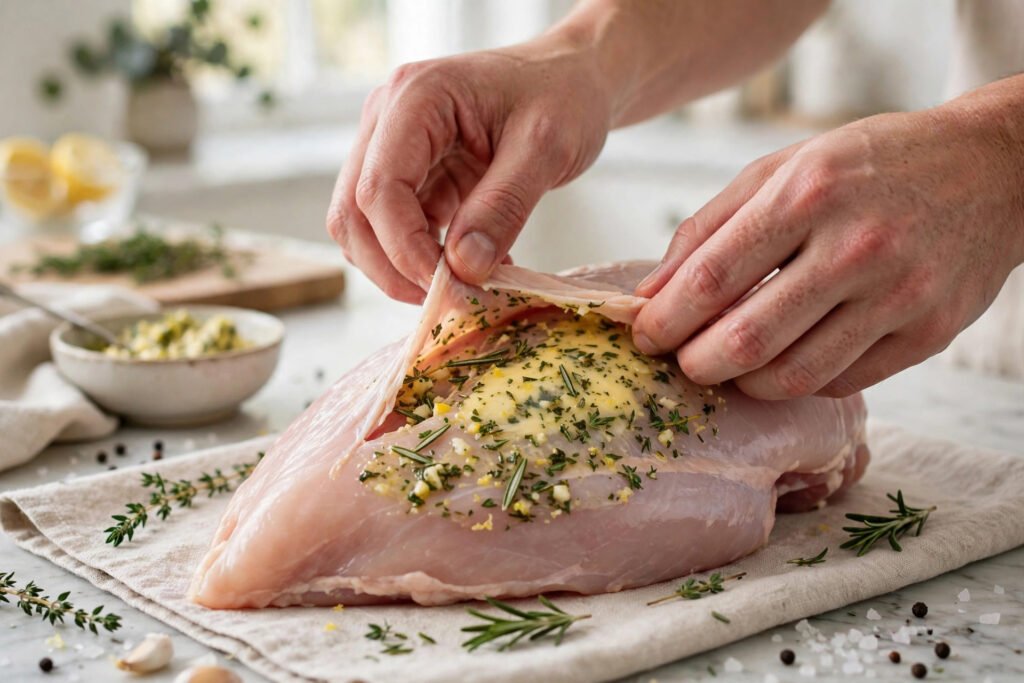
Step 3: Get the butter under the skin. This is the step that makes the difference between a good turkey breast and a great one. Gently slide your fingers between the skin and the meat of the breast, loosening the skin without tearing it. Push about two-thirds of the herb butter under the skin and spread it evenly. Rub the rest over the outside. The butter under the skin bastes the meat from the inside as it melts, and the butter on the outside helps the skin brown and crisp.
Step 4: Season the cavity and the pan. Season the inside of the breast cavity with salt and pepper, and tuck a halved lemon and a few sprigs of rosemary inside if you like — they perfume the meat as it roasts. Set the breast on a rack in a roasting pan, skin-side up. Scatter a sliced onion and a few carrot chunks around the pan; they will roast in the drippings and flavor the gravy. Pour a cup of low-sodium chicken broth into the bottom of the pan to keep the drippings from burning.
Step 5: Roast at 325°F. Put the pan in the center of a preheated 325°F oven. Do not open the door for the first hour — every opening drops the temperature and adds time. After an hour, check the color: if the skin is browning too fast, tent the breast loosely with foil. Baste once or twice with the pan juices if you like, but do not overdo it — constant basting drops the oven temperature and steams the skin.
Step 6: Check the temperature. Start checking about 30 minutes before the table says it should be done. Insert a meat thermometer into the thickest part of the breast, away from the bone. You are looking for 165°F. If the breast is at 150°F and the skin is already deep golden, tent it with foil.

Step 7: Rest for 20 minutes. This is not optional. Move the breast to a cutting board, tent it loosely with foil, and let it rest for 20 minutes. The juices redistribute through the meat, and the internal temperature rises a few degrees. Cut into it too soon and the juices run out onto the board instead of staying in the slices. While it rests, make the gravy from the pan drippings — our guide to how to make gravy from scratch walks through it.
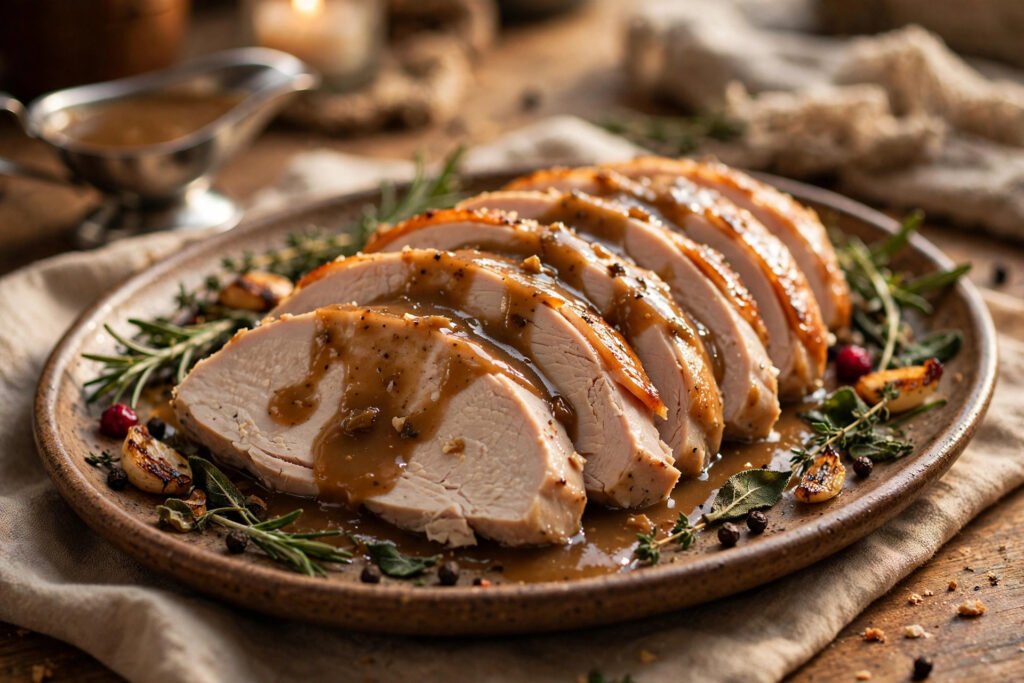
Step 8: Carve and serve. Remove any twine or netting. Slice the breast across the grain in even, half-inch slices, starting at the thick end. Arrange the slices overlapping on a warm platter and spoon a little of the pan juices over the top.
Resting and Carving: The Two Steps People Rush
Most turkey breast problems are not roasting problems — they are resting and carving problems. A breast pulled at exactly 165°F and carved immediately will still taste dry, because the juices have not had time to settle back into the meat. Twenty minutes of rest fixes that, and it costs nothing.
Carving matters just as much. Always slice across the grain — the lines of muscle fiber running through the breast — not along it. Slices cut across the grain are tender; slices cut with the grain are chewy. Use a long, sharp knife with long, smooth strokes, not sawing. For a bone-in breast, cut the meat away from the breastbone first in one large piece, then slice that piece across the grain. For a boneless roast, remove the netting and slice straight across.
Keep the skin on the slices — it is where the butter, the herbs, and the browning live. If the skin did not crisp as much as you wanted, a minute or two under the broiler, watched constantly, will finish it, but do this before slicing, not after.
What to Serve With It
Once you know how to roast a turkey breast, the meal around it is what makes it feel like Thanksgiving. The classics all work: the stuffing, the mashed potatoes, the cranberry sauce, the green beans. If you are building the menu, the stuffing goes into the oven when the breast comes out to rest — the timing lines up neatly. Our guide on how to brine a turkey covers the full-day schedule if you want to brine the breast first.
For a smaller, simpler meal, the breast pairs well with just two sides: a pan of stuffing and a green vegetable. Roasted Brussels sprouts or green beans with almonds both work. The cranberry sauce from scratch is worth making even for a small table — its sharpness cuts through the richness of the butter and the gravy.
Leftovers are the quiet bonus of a turkey breast. Slice the remaining meat thin, wrap it well, and refrigerate it within two hours. It keeps for three to four days and makes excellent sandwiches — the classic is turkey, cranberry sauce, and stuffing on good bread. For a smaller bird and a faster cook, our guide to cooking a turkey in an air fryer covers an even quicker option.
Mistakes That Dry Out a Turkey Breast
Skipping the thermometer. Time-per-pound tables are estimates, and every oven runs a little hot or a little cold. A breast roasted by the clock alone is a guess. A basic instant-read thermometer costs less than the turkey.
Roasting it too hot. A 425°F oven browns the skin fast and dries the meat before the center catches up. A 325°F oven is the sweet spot: hot enough to crisp the skin, gentle enough to keep the meat juicy.
Not resting it. Twenty minutes feels like a long time when dinner is ready and everyone is hungry, but cutting early costs you the juices you spent two hours protecting. Tent it with foil, make the gravy, and wait.
Over-seasoning an enhanced breast. If the label says the breast is enhanced or injected with a solution, it is already salted. Cut the salt in the herb butter in half, or skip it entirely, and taste the drippings before seasoning the gravy. Serious Eats’ turkey cooking guides make the same warning: double-salting is the most common way a good breast goes wrong.
Forgetting the food-safety basics. Keep the raw breast refrigerated until prep, wash your hands and any surface it touches, and never reuse a cutting board that held raw turkey for the cooked meat. FoodSafety.gov covers the full list. Food Network’s turkey breast recipes all follow the same 165°F standard.
Frequently Asked Questions
How long does it take to roast a turkey breast?
About 20 minutes per pound at 325°F — roughly 1 to 1½ hours for a 3- to 4-pound breast and 1¾ to 2¼ hours for a 5- to 7-pound bone-in breast. When you learn how to roast a turkey breast, the first lesson is to trust the thermometer, not the clock: start checking 30 minutes early, and the breast is done at 165°F in the thickest part.
Should I roast a turkey breast covered or uncovered?
Uncovered for most of the cook, so the skin crisps. If the skin browns too fast, tent the breast loosely with foil for the rest of the roast. Covering it from the start steams the skin and keeps it pale and soft.
Can I brine a turkey breast before roasting it?
Yes — the same ratios as a whole bird, for a shorter time: 8 to 12 hours wet, or 12 to 24 hours dry. A brined breast is noticeably juicier, and it roasts exactly the same way. Just cut back the salt in the herb butter, since the brine has already seasoned the meat.
How much turkey breast do I need per person?
About three-quarters of a pound of bone-in breast per person, or half a pound of boneless. A six-pound bone-in breast feeds eight comfortably, with some left for sandwiches. When in doubt, buy a little more — leftover turkey breast is the easiest problem to have.
Can I roast a turkey breast from frozen?
No. A frozen breast roasts unevenly — the outside overcooks while the center stays raw. Thaw it fully in the refrigerator first, which takes about a day for a breast, then roast as directed.
How do I keep the skin crispy?
Pat the breast completely dry before seasoning, get the butter under the skin rather than only on top, roast uncovered at 325°F, and do not baste constantly. Basting drops the oven temperature and steams the skin. If the skin still needs help, a minute or two under the broiler at the end — watched constantly — will finish it.
Conclusion
Knowing how to roast a turkey breast is the simplest way to serve a proper Thanksgiving dinner to a small table: a bone-in breast, herb butter under the skin, a 325°F oven, and a thermometer reading 165°F. Rest it for 20 minutes, slice across the grain, and serve it with the sides you love.



