
What’s Actually Happening Inside the Tank
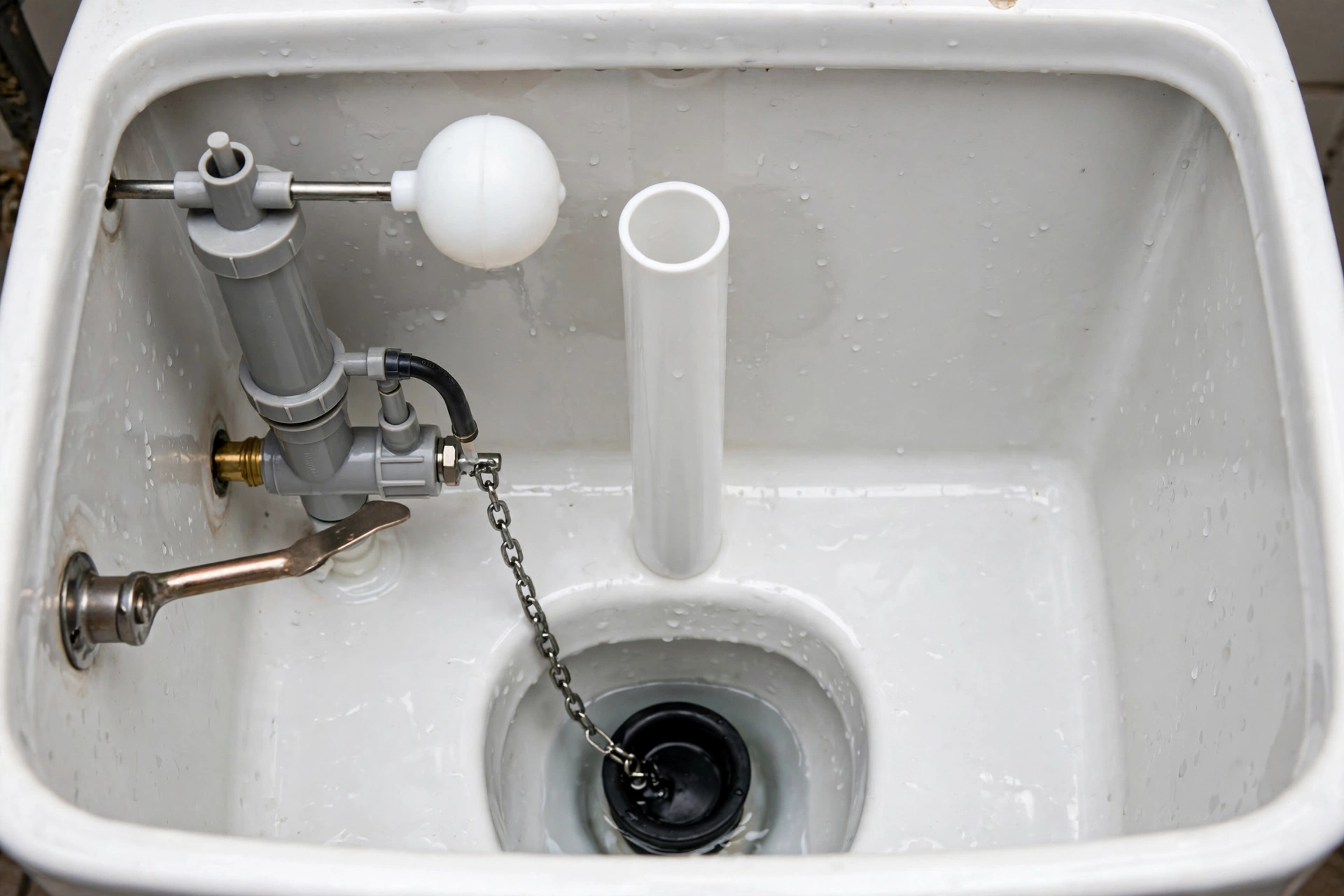
Take the lid off the tank (set it down carefully — it’s heavy porcelain) and you’ll see a surprisingly simple machine. When you press the handle, a chain lifts the flapper, a rubber seal that lets tank water rush into the bowl. As the tank empties, the flapper drops back down and seals the opening. Meanwhile the fill valve refills the tank, and a float riding on the water tells the valve when to shut off. The overflow tube in the middle is a safety drain: if the water level gets too high, excess flows into the bowl instead of onto your floor.
A “running” toilet means one of these parts isn’t doing its job: either water is leaking out of the tank (so the fill valve keeps topping it up), or the fill valve itself never shuts off. Your ears can usually tell you which one it is.
Diagnose by Sound: What That Noise Is Telling You
Stand quietly next to the toilet and listen. Each of these sounds points at a specific failure — find yours in the table below before you touch a wrench.
| What you hear or see | Likely cause | The fix |
|---|---|---|
| Constant hissing or trickling that never stops | Fill valve isn’t shutting off — worn seal or debris stuck in the valve | Clean or replace the fill valve; check the float setting |
| Tank refills on its own every few minutes (“phantom flush”) | Worn flapper letting water seep silently into the bowl | Replace the flapper (10-minute job, see below) |
| Water visibly running down into the overflow tube | Water level set too high — the float is riding too high | Lower the float so water stops ~1 inch below the tube’s top |
| Handle feels loose, or the chain looks tangled | Chain too long, too short, or caught under the flapper | Adjust the chain so there’s about 1/2 inch of slack |
| Bowl gurgles or drains slowly after flushing | Partial blockage downstream — a different problem | Clear the drain first; see how to unclog a drain without harsh chemicals |
The 30-second dye test (confirms a flapper leak)
If you suspect the flapper, confirm it before spending a cent. Put a few drops of food coloring (or a dye tablet) into the tank water, then don’t flush for 10 minutes. If color shows up in the bowl, tank water is seeping past the flapper — you’ve found your leak. This is the same test the EPA recommends to homeowners, and it catches the silent leaks you’d never hear.
How to Fix a Running Toilet: The 10-Minute Flapper Replacement
If the dye test turned the bowl water colored — or the tank is doing the phantom-flush routine — the flapper is your problem. This is the most common running-toilet repair there is, and it’s genuinely a ten-minute job. You’ll need one part and zero specialty tools.
What to buy: a universal replacement flapper, about $5. Toilets use either a 2-inch or 3-inch flapper — if you’re unsure, pop the old one off first (step 3) and bring it to the store to match. Most replacement flappers and fill valves at any hardware store are labeled for both sizes, and universal models fit the vast majority of toilets.
- Shut off the water. Turn the supply valve behind the toilet clockwise until it stops. If the valve is stuck or corroded, don’t force it with all your strength — a snapped valve turns a ten-minute job into a plumber call. (If it won’t budge, you can still do this repair; you’ll just work with the tank full and bail water out with a cup.)
- Drain the tank. Flush once. The tank won’t refill because the supply is off. Sponge or towel out the inch or so of water left at the bottom so you’re working dry.
- Remove the old flapper. Unhook the chain from the flush lever arm. The flapper itself slides off two small pegs on either side of the overflow tube — just pull it sideways off one peg and it comes free. Take a quick photo of how the chain was connected; you’ll thank yourself in two minutes.
- Install the new flapper. Slide it onto the same two pegs. Hook the chain to the flush lever arm, leaving about 1/2 inch of slack — too tight and the flapper can’t seal; too loose and the chain tangles underneath it.
- Turn the water back on slowly. Counterclockwise on the supply valve. Let the tank fill and watch the waterline: it should stop about 1 inch below the top of the overflow tube.
- Test it twice. Flush, wait for the refill to stop completely, and listen. Silence is success. If it still hisses, the problem is the fill valve, not the flapper — read on.
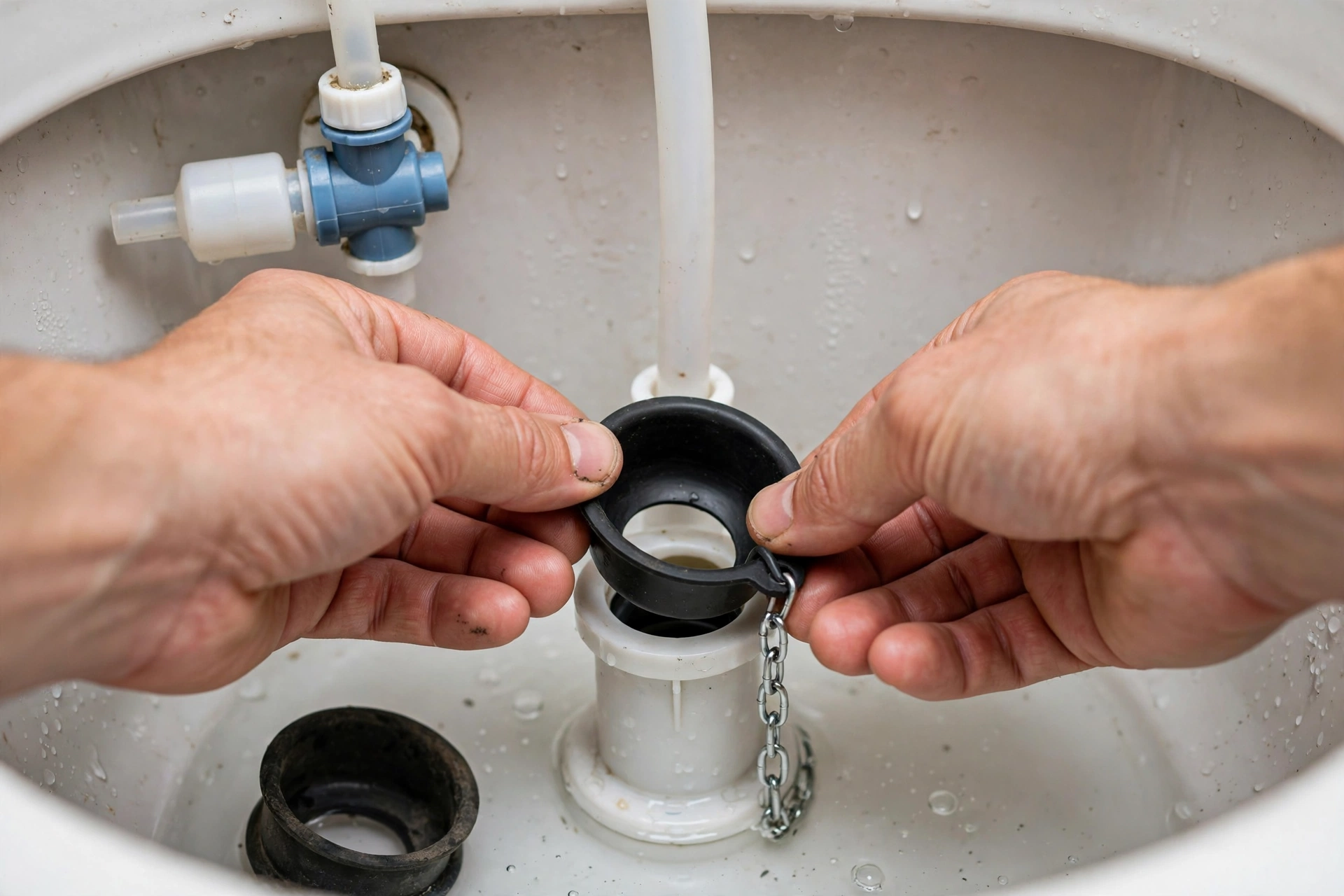
That’s the whole job. For a visual learner, there are excellent running toilet repair walkthroughs from home-improvement publishers that show the same steps on camera — worth a glance if you want to see the peg-and-chain arrangement before you start.
When the Fill Valve Is the Culprit
If the dye test came back clean but the hissing never stops, the fill valve itself is the problem — it’s letting water in continuously instead of shutting off. Two scenarios:
Scenario 1: The float is just set too high
This is a free, 60-second fix. If water is running into the overflow tube, lower the float:
- Cup-style float (a cylinder sliding on the valve shaft): squeeze the spring clip on the side and slide the cup down about an inch.
- Ball-style float (the classic floating ball on an arm): gently bend the metal arm downward slightly, or turn the adjustment screw at the top of the valve.
Flush and watch: the refill should now stop with the waterline about 1 inch below the top of the overflow tube.
Scenario 2: The valve seal is worn out
If adjusting the float changes nothing, the valve’s internal seal is shot. Replacing a fill valve is a 15-minute job and the part costs under $15:
- Shut off the supply valve and drain the tank (same as steps 1–2 above).
- Unscrew the water supply line from the bottom of the fill valve (have a towel ready — a little water will spill).
- Unscrew the plastic lock nut under the tank and lift the old valve out.
- Set the new valve’s height so its top sits about 1 inch above the overflow tube, drop it in, and tighten the lock nut by hand — then just a quarter-turn more with pliers. Overtightening cracks the porcelain.
- Reconnect the supply line, turn the water on slowly, and check for drips at the connection.
If you want a detailed illustrated version of this procedure, the toilet repair guides from Family Handyman walk through fill-valve replacement with photos for nearly every major valve brand.
How Much Water (and Money) a Running Toilet Really Wastes
Here’s the math that makes this repair worth doing today rather than “someday.” The EPA’s WaterSense program notes that a single running toilet can waste up to 200 gallons of water per day. The chart below shows how that scales with leak severity:
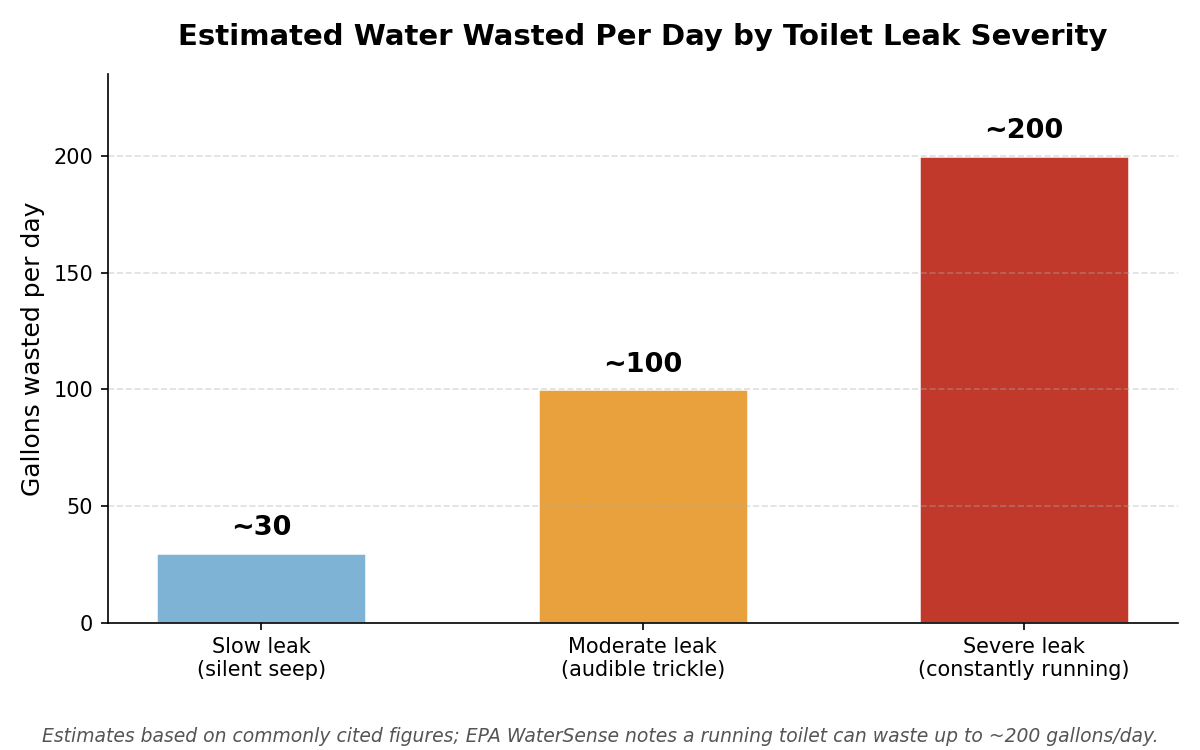
Run the numbers on the severe end: 200 gallons a day is 6,000 gallons a month — roughly what a small household uses in total. For perspective, the EPA estimates the average household loses more than 10,000 gallons a year to leaks of all kinds, and household leaks nationwide waste nearly a trillion gallons annually. Your one toilet can be a surprisingly large slice of that.
On the money side, the EPA notes that fixing easily corrected household leaks can save homeowners about 10 percent on their water bills. Your exact savings depend on your local rates (check your utility bill), but when a single fixture is wasting thousands of gallons a month, the payback on a $5 flapper is measured in days, not years.
Keep It From Happening Again
A running toilet is a maintenance problem, not a mystery. A few habits keep it from coming back:
- Do the dye test once a year. It takes 30 seconds of effort and catches silent flapper leaks long before your water bill does.
- Expect to replace the flapper every few years. Rubber flappers typically last around 3–5 years depending on your water quality — chlorinated municipal water wears them faster. When the rubber feels warped, slimy, or no longer sits flat, it’s done.
- Skip the drop-in bleach tablets. Those blue tablets that sit in the tank look convenient, but concentrated chlorine sitting against rubber degrades flappers and seals far faster than normal. Use in-bowl cleaners instead.
- Keep the whole bathroom’s plumbing healthy. A toilet that has to work harder because of downstream resistance wears faster — knowing how to unclog a drain without harsh chemicals keeps the rest of the system flowing freely too.
- Consider a WaterSense-labeled toilet when it’s time to replace. Modern high-efficiency toilets use 1.28 gallons per flush or less (versus 3.5+ for pre-1994 models), and the WaterSense label means the design has been independently tested to flush well at that low volume.
When to Replace the Whole Toilet Instead
Sometimes the running is a symptom of a toilet that’s simply at the end of its life. Consider replacement rather than another repair if you see cracks in the tank or bowl (these can fail catastrophically — don’t ignore them), if the toilet clogs constantly despite a clear drain, or if it’s a pre-1994 model guzzling 3.5 gallons or more per flush. At that point you’re not just fixing a leak, you’re upgrading decades of water waste in one move. If you’re weighing the bigger project, it’s worth knowing what a small bathroom remodel costs so you can decide whether a simple toilet swap or a full refresh makes more sense.
Frequently Asked Questions
Why does my toilet run every few minutes?
That’s the classic “phantom flush”: the flapper is letting water seep into the bowl so slowly you can’t see it, and every few minutes the tank level drops enough that the fill valve kicks on to top it up. Run the dye test to confirm, then replace the flapper — it solves this exact symptom the vast majority of the time.
Can I fix a running toilet without buying any parts?
Sometimes. If the chain is tangled under the flapper or has zero slack, adjusting it is free. If the water level is too high, lowering the float costs nothing. But if the flapper rubber is warped or the fill valve seal is worn, no adjustment will save them — the parts are cheap, so don’t fight a losing battle with adjustment alone.
How do I know whether it’s the flapper or the fill valve?
The dye test is the decider. Color in the bowl after 10 minutes without flushing means the flapper is leaking. No color but constant hissing means the fill valve isn’t shutting off. Fix whichever one the test points to — replacing the wrong part is the most common reason these repairs “don’t work.”
Is a running toilet an emergency?
Not in the water-damage sense — the water is going down the drain, not onto your floor. But it is urgent for your wallet: at up to 200 gallons a day, every week you wait can add thousands of gallons to your bill. If you need to buy time before the repair, turn the supply valve behind the toilet off between uses.
How long should a toilet flapper last?
Typically around 3–5 years. Hard water, heavy chlorine, and those in-tank bleach tablets all shorten its life. If your flapper is older than that and the toilet starts running, just replace it on principle — it’s the cheapest part in the tank.
The Bottom Line
Fixing a running toilet comes down to three moves: listen to diagnose by sound, dye-test to confirm a flapper leak, and spend ten minutes swapping the flapper — a $5 part that can stop up to 200 gallons of daily water waste. If the dye test comes back clean, adjust or replace the fill valve instead. Either way, it’s a beginner-friendly repair with one of the fastest paybacks in all of home maintenance. Your water bill will notice the difference within a single billing cycle.




[…] far cheaper than water damage from a botched repair. For related bathroom plumbing, our guide on how to fix a running toilet covers another classic DIY win, and if a slow drain is also on your list, see how to unclog a drain […]