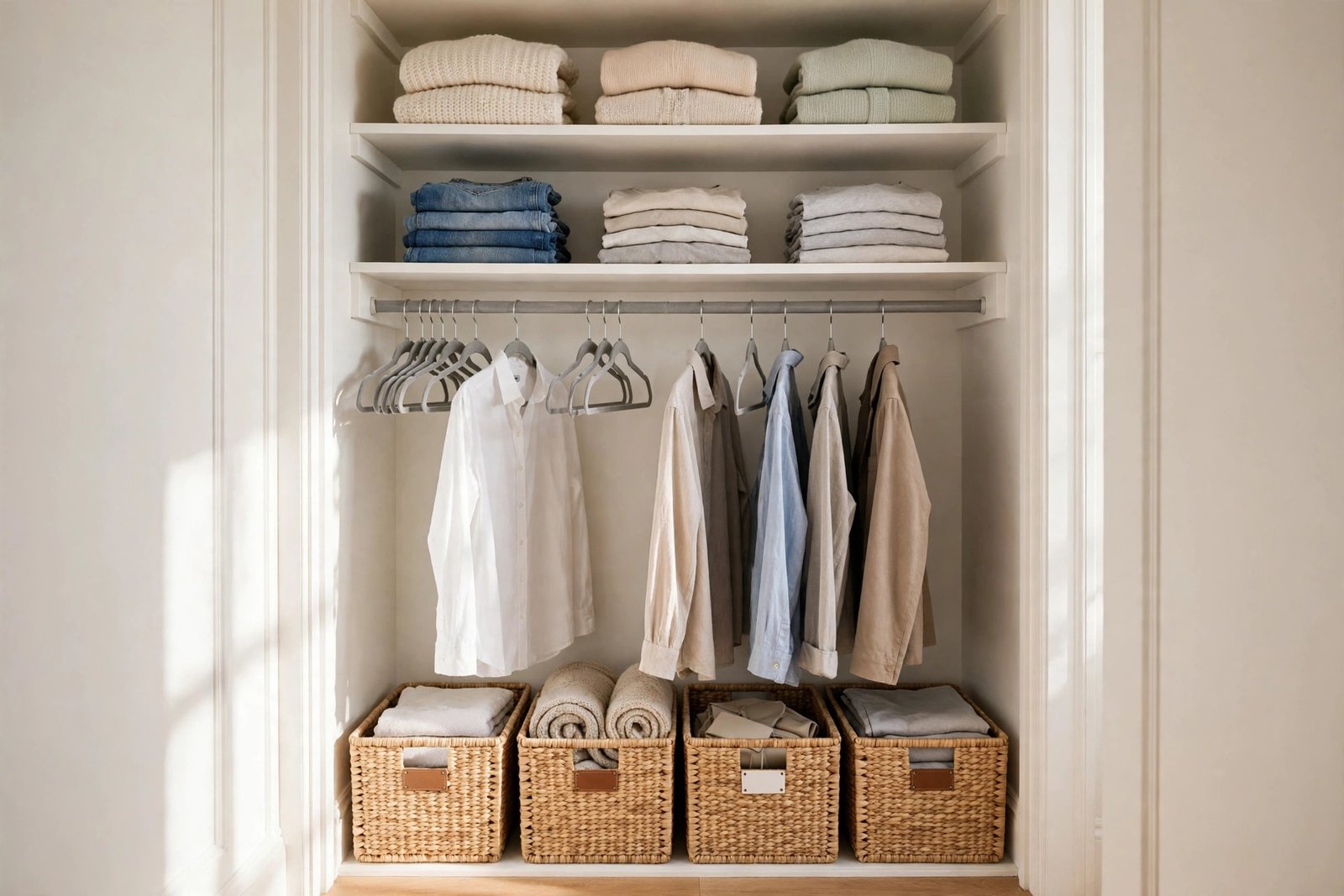

You open the closet door, something shifts on the top shelf, and you spend five minutes digging for the one shirt you actually want to wear. If that sounds familiar, you already know the real problem: a small closet is not short on space so much as short on decisions. Learning how to organize a small closet is less about buying clever containers and more about deciding what lives in the closet, giving everything a visible home, and building a routine that keeps it that way. Done in the right order — empty, edit, measure, then organise — a single afternoon can turn a cramped closet into one that works every morning.
Start by Emptying the Closet Completely
It is tempting to shuffle things around inside the closet, but that only rearranges the mess. Take everything out: every garment, every pair of shoes, every bag, every box on the top shelf, and the hooks you forgot were there. Put it all on the bed where you can see it. An empty closet lets you see the actual space you have — the rod height, the shelf depth, the dead corners, the floor area — instead of guessing around piles of clothes. It also forces an honest count: most people are surprised by how much is in there, and how much of it they never wear.
While the closet is empty, clean it. Wipe the shelves, vacuum the floor, and check the rod and brackets for wobble. A small closet works harder than a big one, so a loose bracket that goes unnoticed will fail at the worst moment. This is also the moment to note anything wrong with the space itself: a door that will not close, a shelf that sags, a light that has burned out. Fix the small things now, because they are much harder to fix once the closet is full again.
Edit Ruthlessly Before You Buy Anything
The single biggest mistake in small-closet organisation is buying bins and hangers before deciding what stays. No organiser can fix a closet holding twice what it can hold. Sort everything you took out into four piles: keep in this closet, move elsewhere, donate, and discard. The keep pile has a strict test: it fits, it is in good repair, you have worn it in the past year, and it belongs to the current season. Everything else leaves the closet, even if it stays in your home.
Off-season clothes are the easiest win. A small closet only has to hold this season’s wardrobe; last winter’s coats and this summer’s linen do not need to compete for the same rod. Pack off-season pieces into labelled boxes or vacuum bags and store them under the bed, on top of a wardrobe, or in another room. The same goes for occasion wear you reach for twice a year, spare bedding, and anything that belongs in a different room. Our guide to storing winter clothes properly covers how to pack coats and woollens so they come back fresh next season.
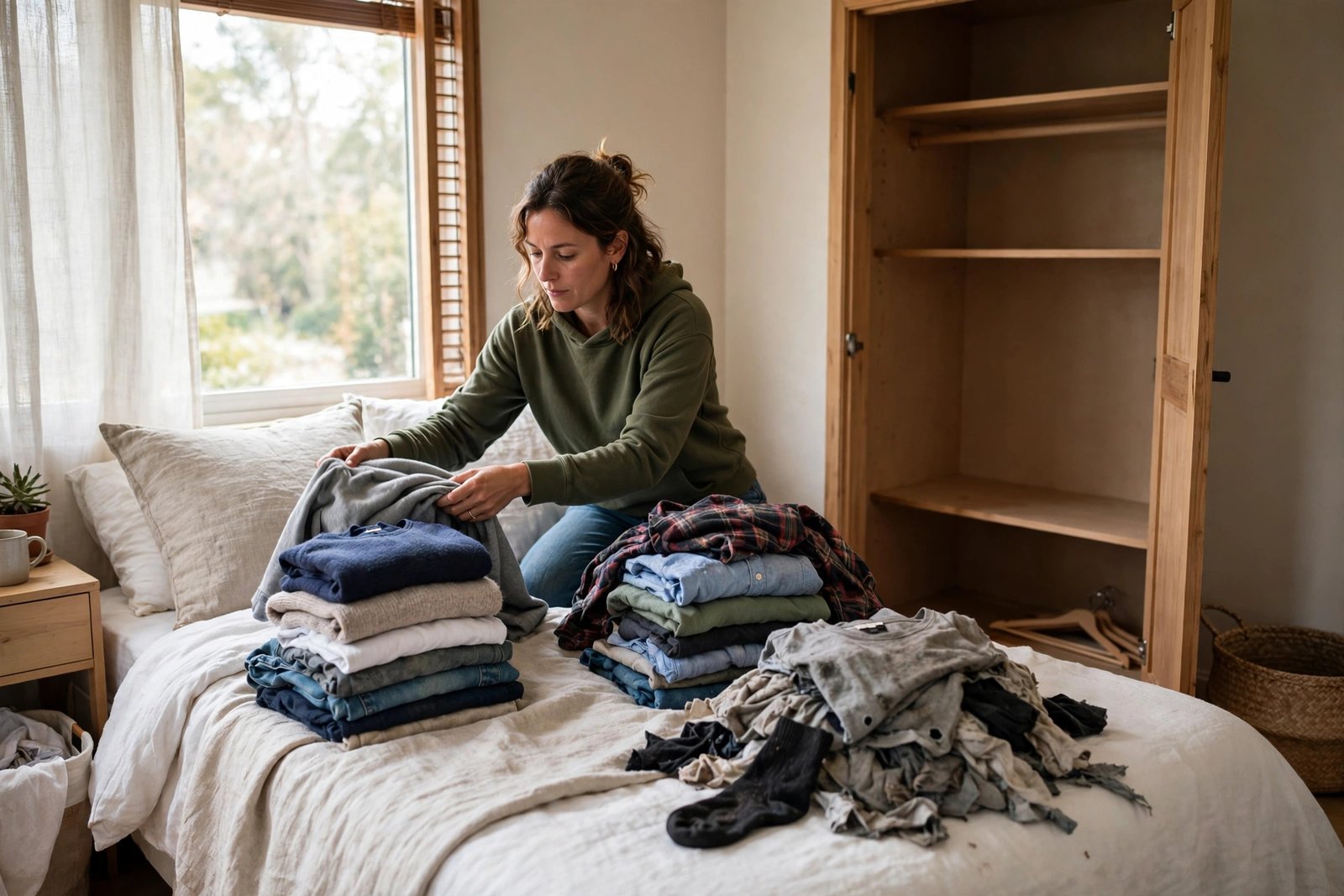
For the donate pile, be honest about the maybes. A shirt you have kept for three years “just in case” is not a wardrobe; it is storage. If something does not fit, is damaged beyond a simple repair, or you simply never reach for it, let it go. If you are struggling with the whole-house version of this decision, our guide to decluttering your home room by room walks through the same keep-or-let-go logic for every space. Fewer, better pieces also make getting dressed easier: a smaller wardrobe of things you actually like beats a large one full of compromises, which is the same idea behind our guide to building a capsule wardrobe.
Measure Before You Spend a Penny
Now measure the empty closet, because every organiser you buy has to fit real dimensions, not hopeful ones. Record four numbers: the width of the closet, the depth from the back wall to the inside of the door, the height from the floor to rod and to the ceiling, and the clearance when the door closes. A standard reach-in closet is about 24 inches deep and three to eight feet wide, with a single rod roughly 60 to 66 inches from the floor — but yours may differ, and a hanging organiser that is an inch too deep will stop the door closing.
Take the tape measure shopping with you, literally or as a note on your phone, and check every product against your numbers before buying. This one habit prevents the most common small-closet frustration: a set of bins that do not fit the shelf, a shoe rack that blocks the door, or a second rod that hangs too low for your longest coat. Measure first, buy second, and you will spend less and return nothing.
How to Organize a Small Closet With Zones
With the closet empty, edited, and measured, divide it into zones by how often you reach for things. The easiest-to-reach space — the main rod at eye level and the shelf at waist height — belongs to everyday clothes. The top shelf, which needs a stretch or a step stool, is for off-season or rarely used items. The floor is for shoes and heavier bags. The door and the side walls are for accessories. Every item gets one zone, and every zone has one job; a catch-all corner labelled “miscellaneous” becomes a dumping ground within a week.
Within the hanging zone, group clothes by category rather than by outfit: all shirts together, all trousers together, all jackets together, and within each group, arrange by colour from light to dark. That sounds fussy, but it is what makes a small closet fast to use — you scan one short run of shirts instead of hunting through the whole rod. Keep everyday pieces at the front of the rod and occasion wear at the back, and leave a little breathing room between garments; a rod packed so tight that hangers cannot move is a rod you will avoid using.
Double Your Hanging Space Without Drilling
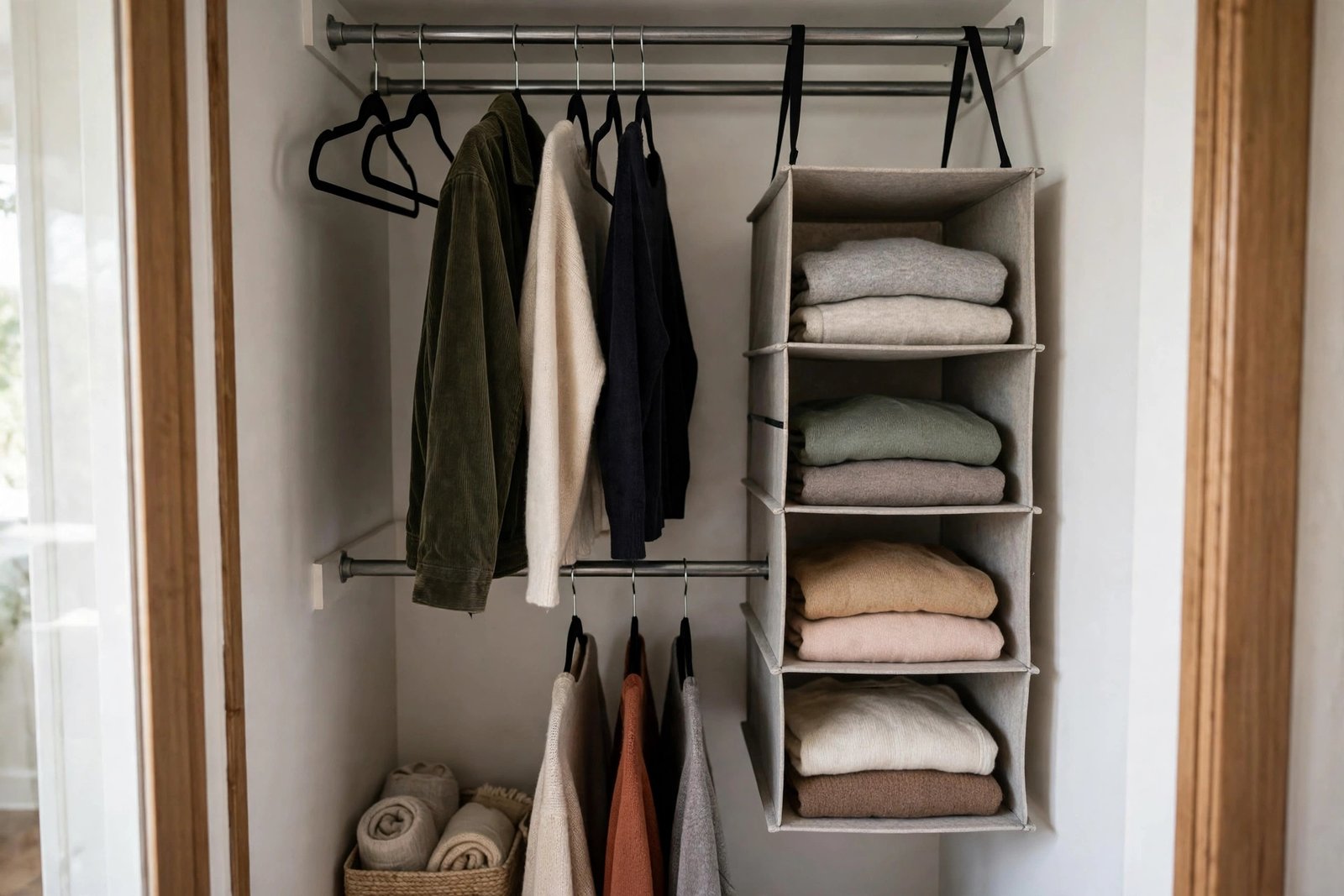
Most small closets have one rod and a lot of wasted air below it. The cheapest way to use that air is a second, lower rod. A rod doubler hooks over the existing rod and drops a second bar to about 40 inches from the floor, which is exactly where a double-rod closet puts its lower rail, and it needs no drilling — important if you rent. The upper rod holds shirts, blouses, and folded trousers; the lower rod holds skirts, shorts, and more tops. Long coats and dresses still need a full-length section, so keep one part of the closet single-rod for those and double up the rest.
Two hanger swaps also help. Slim, non-slip hangers take up less room than thick wooden or plastic ones — you can often fit a quarter more garments on the same rod — and they stop clothes slipping to the floor. Hanging shelf organisers, the fabric kind that hook onto the rod, create instant cubbies for folded jumpers, T-shirts, and bags without any fitting. They are cheap, they come down in seconds when you move, and they stop piles of folded clothes collapsing sideways.
Use the Full Height, the Door, and the Walls
A small closet’s most wasted space is often the top. Add a shelf above the rod if there is room for one, and store labelled boxes there for the things you need only occasionally. A second shelf can sit just below the ceiling for spare bedding and out-of-season accessories. Keep a folding step stool nearby, tucked behind the door, so reaching the top shelf is a ten-second job rather than a reason to leave things on the floor.
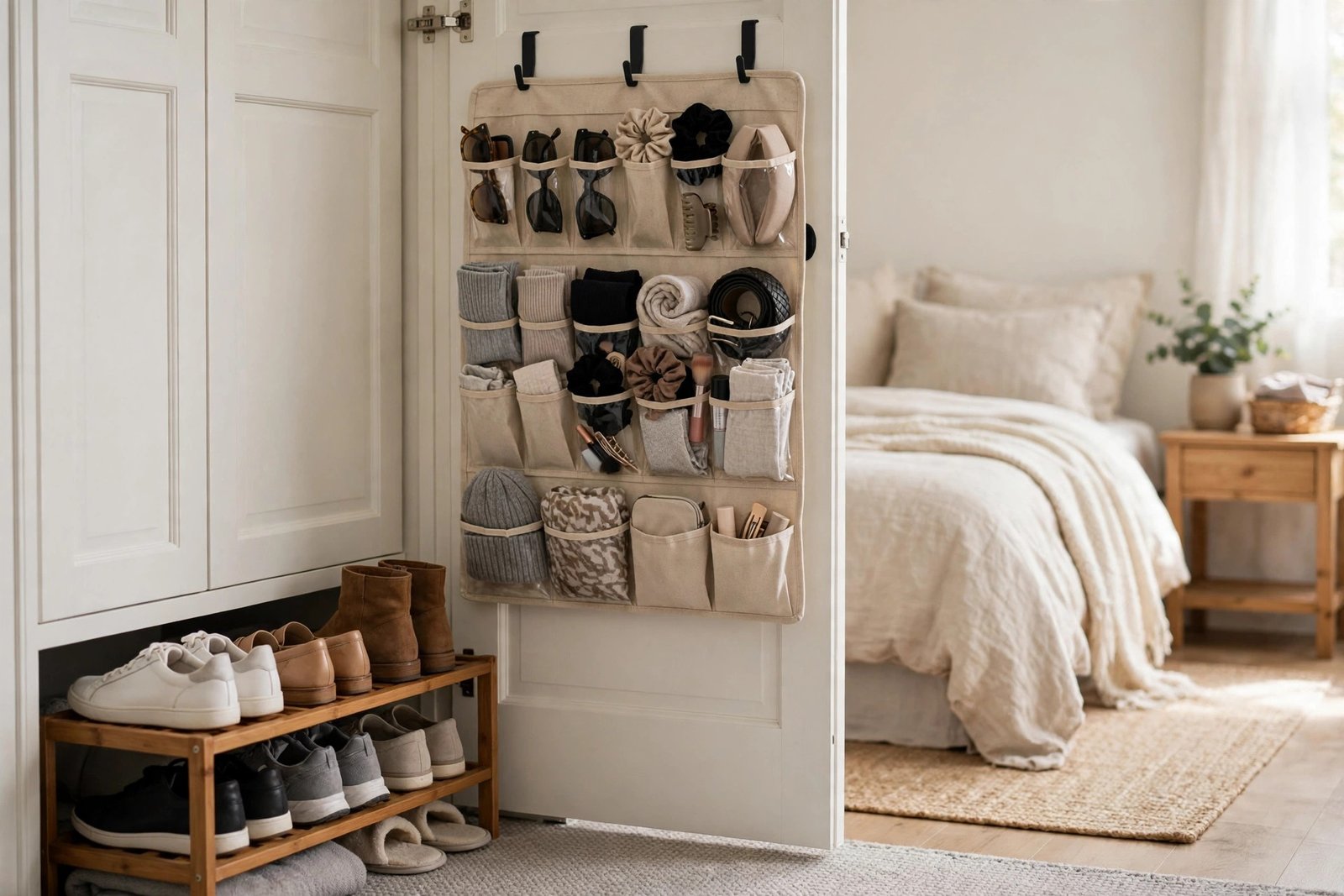
The back of the door is free real estate. An over-the-door rack holds shoes, scarves, belts, or jewellery — and a set of hooks gives bags a home that is not the top of the pile. If the closet has no door, a freestanding rail or a curtain can keep the contents tidy and out of sight, and wall-mounted hooks on the outside of the closet can hold tomorrow’s outfit.
Fold, Roll, and Store the Rest Smartly
Not everything should hang. Knitwear stretches on hangers, so fold sweaters and heavy knits. Jeans, T-shirts, and casual tops fold well too, and rolling soft items like T-shirts and scarves can save space in drawers and bins. Use small bins or baskets for the categories that otherwise scatter: one for belts and scarves, one for hats and gloves, one for gym kit. Label the bins, even if you think you will remember — future-you, in a hurry on a Monday morning, will not.
For drawers inside the closet, file-folding — standing folded items upright like files in a drawer — lets you see everything at a glance instead of only the top layer. It works best with soft, foldable items and a drawer divider to keep the rows upright. If a stack keeps toppling over, you are storing too much in that space: move the overflow to another zone, or let it go. A small closet that is 80 per cent full works; one that is 100 per cent full does not.
A 10-Minute Weekly Reset That Keeps It Tidy
A tidy closet is a habit, not a one-off project. Once a week, spend ten minutes putting the closet back to its system: return anything that has migrated to the chair or the bed, re-fold the top of each stack, hang anything that has slipped off, and take one thing out that no longer earns its place. Do it on laundry day, when clean clothes are coming back anyway, and it barely feels like a separate job.
The same weekly check is the right moment to fix small problems before they grow: tighten a wobbling bracket, replace a broken hanger, or move a seasonal item to the top shelf. If the reset takes more than ten minutes, the system is wrong, not you — something is in the wrong zone, or the closet is holding more than it can. The same approach works in other tight spaces: see our guide to organizing a small kitchen on a budget for the same zone-and-reset logic in a different room.
Small Closets for Two
Sharing a small closet needs a clear split, agreed while the closet is empty. Give each person a defined half — a rod, a shelf, and a drawer or box — and keep each person’s everyday clothes in their own zone. A shared shoe rack works only if each person has a fixed number of spaces; without a limit, one person’s shoes quietly take over the floor. The same rule applies to hooks: label them, or one person’s bags will fill them all.
If two people have very different wardrobes — one mostly hanging clothes, one mostly folded — split the space by type rather than by half. One side can be double-rod hanging, the other can be shelves and drawers, and the proportions can be renegotiated when the seasons change. The point is that the split is explicit and visible; an unspoken split is just a slow takeover.
Frequently Asked Questions
How do I organize a small closet on a budget?
Start by emptying and editing before you spend anything. Most small closets improve dramatically with no new purchases at all, and the only items worth buying early are slim hangers and a rod doubler, both of which are cheap. Add bins and shelf organisers only after you have measured and zoned, so you buy the right sizes once. Borrow the same order — empty, edit, measure, then organise — for any tight space in the home.
What should I put on the top shelf of a small closet?
Things you need rarely: out-of-season clothes, spare bedding, formal wear, and anything you reach for less than once a month. Put them in labelled boxes, with the label facing out, so you can find them without opening every box. Keep a folding step stool nearby so the top shelf is actually usable, not a place where things go to be forgotten.
How can I make a small closet look bigger?
Use matching hangers, keep the floor clear, and leave a little empty space on every shelf. A mirror on the inside of the door reflects light and makes the space feel larger, and a row of hooks keeps bags and accessories off the shelves. The biggest change, though, is simply having less in the closet: empty space is what makes a small closet feel spacious, not a cleverer container.
Should I use matching hangers in a small closet?
Yes, if you can. Matching slim hangers make a small closet look calmer, take up less room, and stop clothes sliding off the rod. You do not need expensive hangers — a set of slim, non-slip velvet hangers is inexpensive and works well for most clothes. Keep wooden hangers for heavy coats and structured jackets, where the extra support is worth the extra space.
How do I keep a small closet tidy long-term?
With a ten-minute weekly reset. Return anything that has migrated, re-fold the top of each stack, and take one thing out that no longer earns its place. Do it on laundry day, when clean clothes are coming back anyway, so it barely feels like a separate job. If the reset starts taking longer than ten minutes, the system needs adjusting: something is in the wrong zone, or the closet is holding more than it can.
What is the best way to store out-of-season clothes?
Clean them first, then store them in labelled, breathable boxes or cotton bags — not in plastic bin bags, which trap moisture. Put them on the top shelf, under the bed, or in another room, and keep a note of what is in each box so you are not opening them all to find one jumper. Add cedar or lavender to keep moths away, and check the boxes when the seasons change so nothing is forgotten for a year.
Conclusion
A small closet does not need more storage. It needs a system: empty it, edit honestly, measure before you buy anything, zone it by how often you reach for things, double the hanging space, use the full height, and keep it tidy with a ten-minute weekly reset. Do those things in that order, and a small closet stops being a daily frustration and becomes one of the easiest parts of your home to live with. Start with one drawer or one rail today, and the rest will follow.
For more step-by-step takes on the same problem, see the Simply Tidy Home practical system for small closets, the Clozzie guide to fitting more into a small closet, the Urbin ten-step small closet method, and the Rumbie collection of small closet tips.



