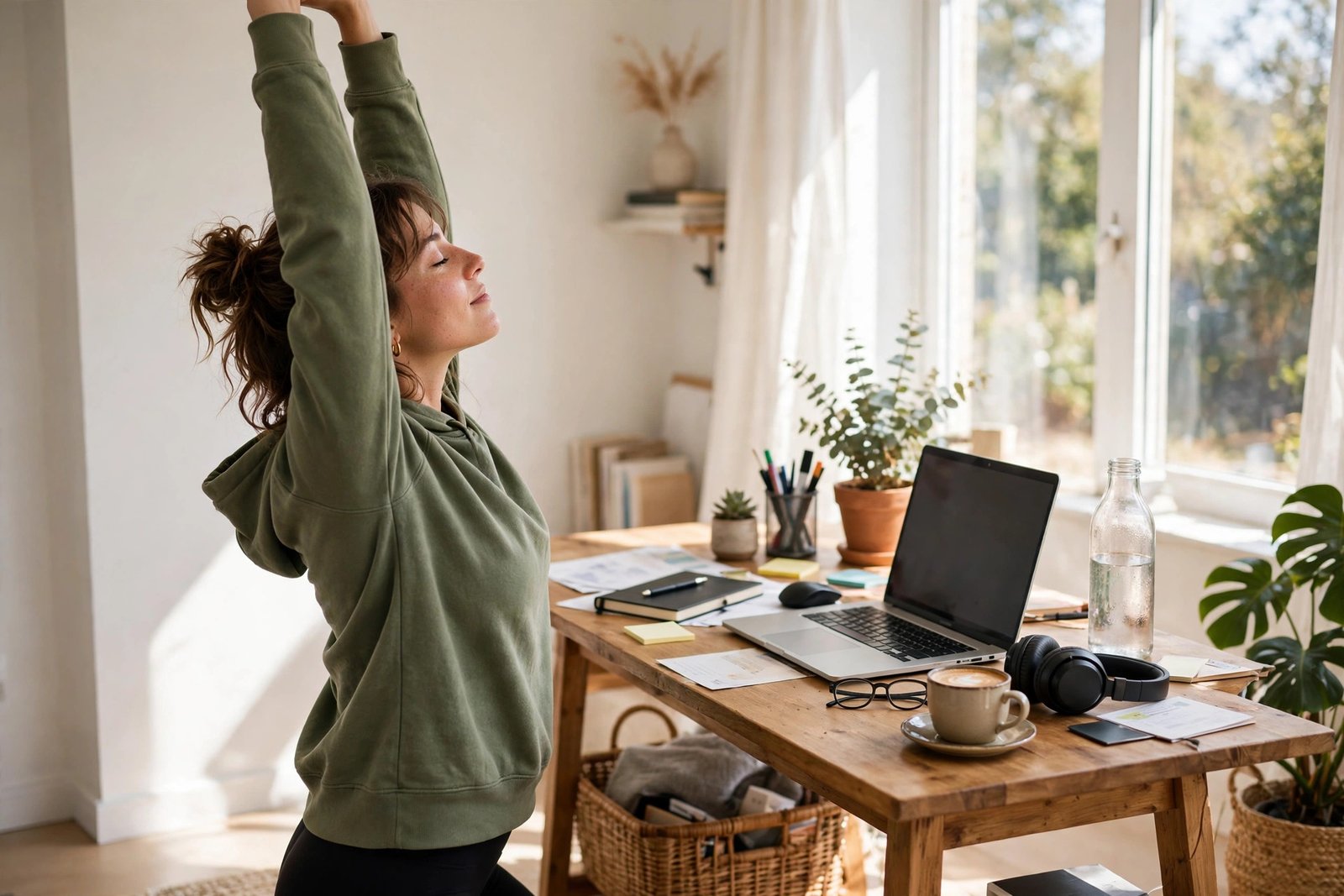

You stand up after hours at a desk and everything feels a beat behind you: your neck is tight, your shoulders sit near your ears, your hips feel locked, and the first few steps are oddly careful. If you want to know how to stretch after sitting all day, you do not need a long yoga class or fancy equipment. You need a short routine that targets the exact places sitting tightens, done gently, held long enough to work, and repeated often enough that stiffness does not build back up by tomorrow.
Sitting itself is not a moral failing, and a single stretch session will not undo a week of desk work. What helps is a practical pattern: a brief reset during the day, a fuller ten-minute routine when you finish work, and a few changes to how you sit in the first place. This guide gives you that pattern, with clear instructions for each stretch, sensible hold times, and honest warnings about pain that should not be stretched through.
Why Sitting All Day Makes You Stiff
When you sit for hours, especially hunched over a keyboard, some muscles spend the whole time shortened and others spend it switched off. Your hip flexors, at the front of the hips, stay bent. Your chest muscles shorten as your shoulders round forward. Your hamstrings and calves stay still in a bent-knee position, and the muscles of your upper back and glutes do very little. That combination is why the same spots complain every evening: neck, shoulders, mid-back, lower back, hips, and the backs of the legs.
Movement reverses that pattern by restoring normal muscle length, improving blood flow, and reminding your joints how to move through their range. It does not need to be intense. In fact, gentle, slow stretching works better after sitting than aggressive bouncing or forcing a joint to its limit. Aim for a mild stretch sensation, roughly a three out of ten in intensity, where you can breathe normally and talk. Sharp, shooting, or worsening pain is not a stretch to push through; it is a signal to stop and, if it persists, to speak to a healthcare professional.
Your chair and screen setup matter too. If your screen is too low, your neck will crane forward all day no matter how well you stretch afterwards. Our guide to fixing bad posture with exercises and desk fixes covers screen height, chair position, and the small setup changes that make evening stretching far more effective, because you are no longer fighting the same posture for eight hours first.
How to Stretch After Sitting All Day: The 10-Minute Routine
The core of how to stretch after sitting all day is a simple order: neck and shoulders first, then chest, then hips and legs, then back. Work from top to bottom so you do not forget the small areas, and hold each stretch for 20 to 30 seconds per side, breathing normally throughout. Do the whole sequence once when you finish work, and repeat the parts that feel tightest the next morning if you need to. The full routine takes about ten minutes.
1. Neck and upper trapezius stretch
Sit or stand tall, drop your right ear toward your right shoulder, and let your right hand rest gently on the side of your head for a little extra weight — do not pull hard. You should feel a stretch down the left side of your neck. Hold for 20 to 30 seconds, return to centre, and repeat on the other side. Then do slow neck rotations: look left, pause, look right, pause, and look down gently, keeping each movement smooth and unhurried. This is the move many desk workers feel first, because the neck carries the weight of a forward head all day.
2. Shoulder rolls and chest opener
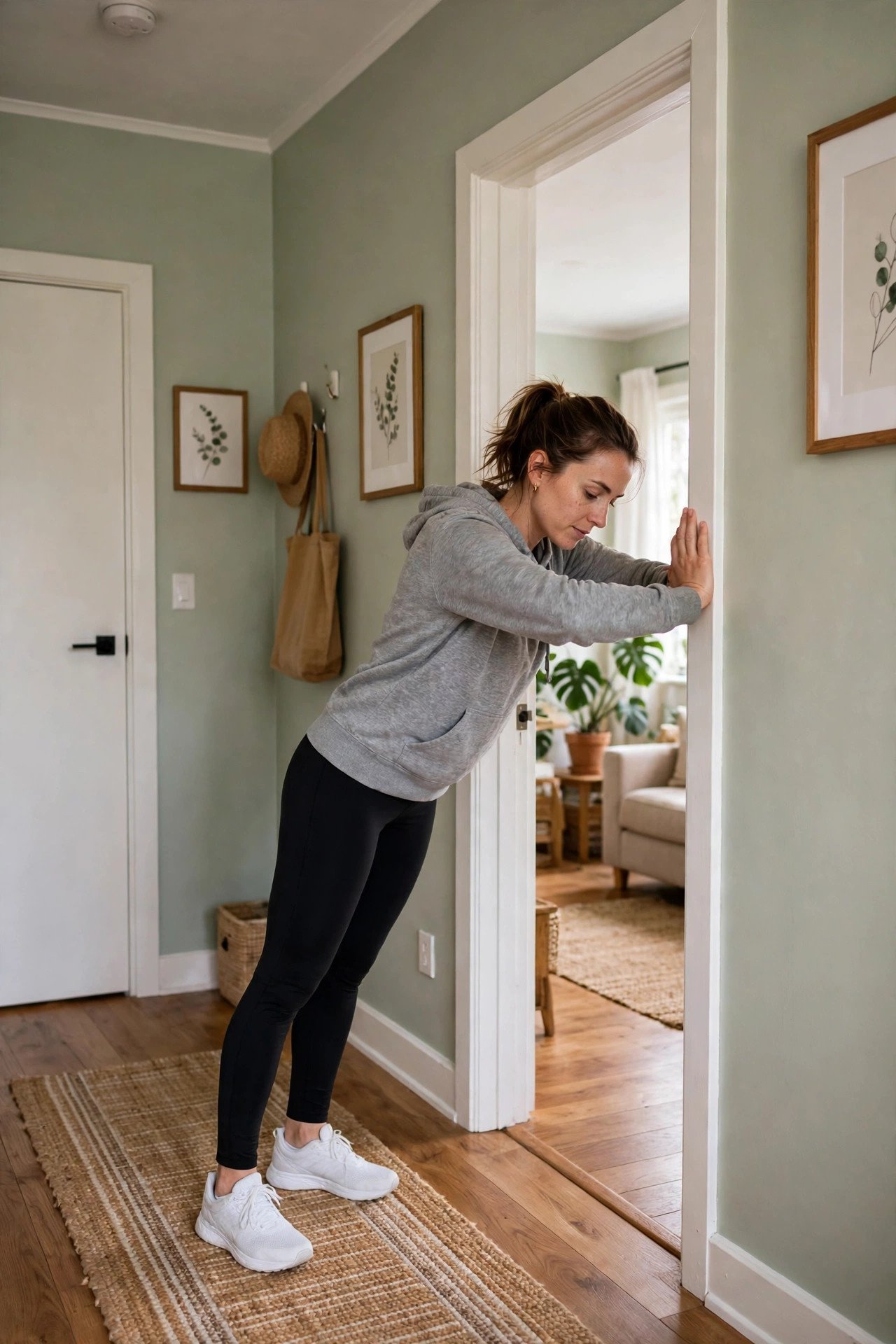
Roll your shoulders slowly up, back, and down for ten repetitions, making the circles as large and smooth as you can. Then stand in a doorway, place your forearms on the frame with elbows at about shoulder height, and take a small step forward until you feel a mild stretch across your chest and the fronts of your shoulders. Hold for 20 to 30 seconds, step back, and repeat once. This doorway stretch directly counters the rounded-shoulder posture of typing, and it is one of the most useful moves in the whole routine.
3. Half-kneeling hip flexor stretch
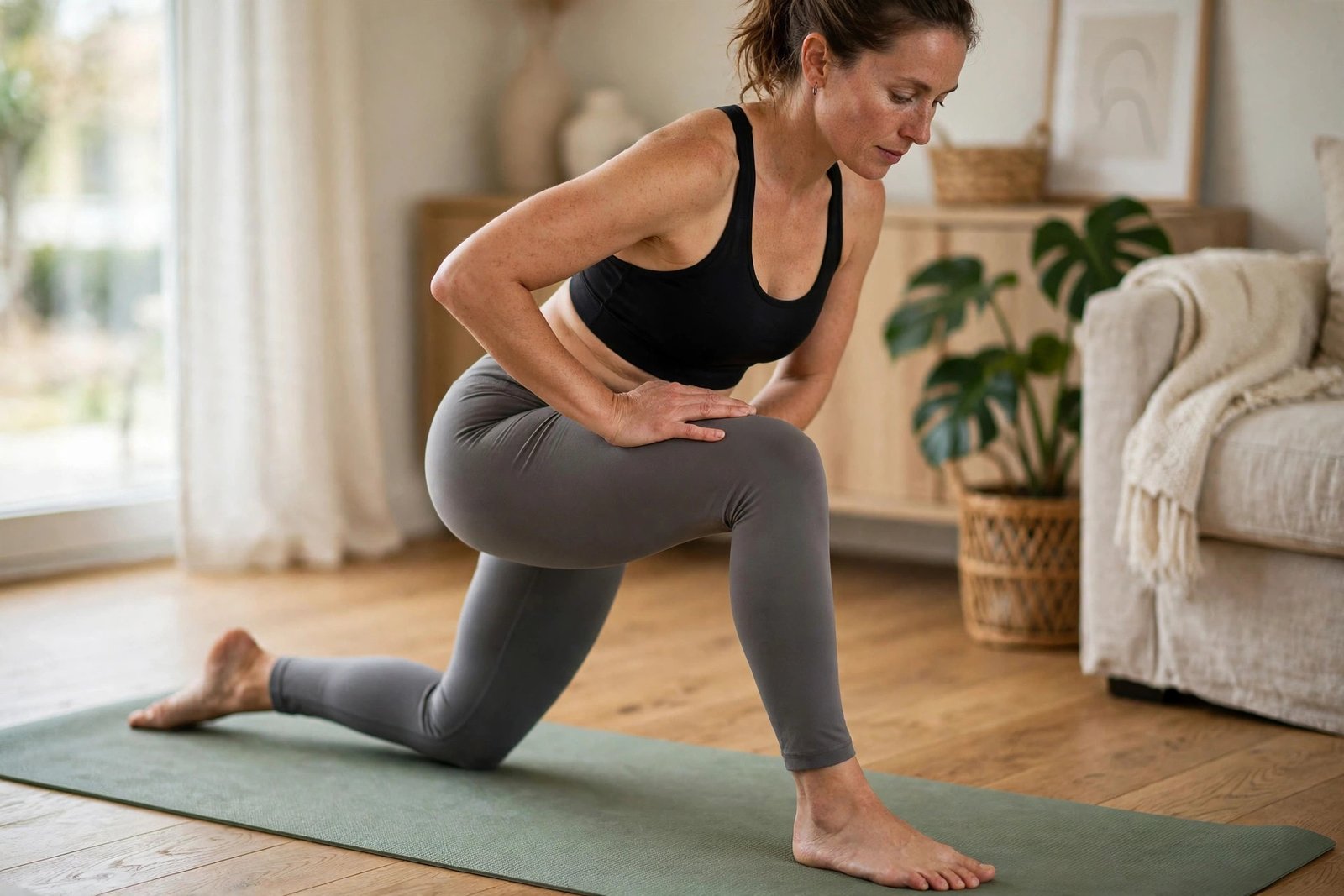
Kneel on your right knee with your left foot flat in front of you, knee above ankle, and your torso upright. Tuck your pelvis slightly under, as if pulling your belt buckle upward, then shift your hips gently forward until you feel a stretch at the front of your right hip and thigh. Keep your lower back long rather than arching it. Hold for 30 seconds, switch sides, and repeat. If kneeling is uncomfortable, place a folded towel or cushion under your knee, or do a standing version holding a chair for balance with one foot behind you.
4. Hamstring and calf stretch
For hamstrings, sit on the edge of a chair, extend one leg straight with your heel on the floor and toes up, and hinge forward from your hips with a long spine until you feel a mild pull behind the thigh. Hold for 20 to 30 seconds per side. For calves, stand facing a wall, place both hands on it, step one foot back with the back knee straight and heel flat on the floor, and lean forward gently until you feel the calf stretch. Hold for 20 to 30 seconds per side, then bend the back knee slightly for a second version that reaches the deeper calf muscle.
5. Cat-cow and seated spinal twist
Finish with your spine. On hands and knees, inhale as you arch your back gently and lift your head and tailbone, then exhale as you round your back and tuck your chin. Move slowly for eight to ten rounds. Then sit tall in a chair with feet flat, twist your torso to the right while keeping your hips facing forward, hold for 15 to 30 seconds, and repeat to the left. This combination moves the spine through both flexion and rotation, which is exactly what a day of sitting in one position denies it.
Desk Stretches You Can Do Without Leaving Your Chair
You do not need to wait until evening. A few seated moves, done for a minute at a time, keep stiffness from building to the point where the evening routine feels like rescue work. Try ankle pumps: lift your toes, then press them down, ten times per foot, to wake up your calves. Follow with seated knee lifts, raising one knee at a time five times per side. Add a seated spinal twist and a shoulder roll set, and you have a desk reset that takes under two minutes and needs no floor space.
The desk itself can be a stretching tool. With hands on the desk, step back and hinge forward at the hips with a flat back, letting your head relax between your arms, for a standing stretch through the back and hamstrings. Against a wall, place the backs of your hands on the wall and slide them slowly up and down to open the chest and shoulders. These are the kinds of simple moves a Mayo Clinic wellness physical therapist demonstrates for desk workers: shoulder rolls, wall slides, and desk stretches, done in short breaks through the day rather than saved for one heroic session. The Mayo Clinic guide to stretching throughout your workday recommends breaks every 30 to 45 minutes for exactly this reason — frequency beats duration when the problem is hours of stillness.

Breaks, Walking, and Making It Stick
A good rule for stretching after a long desk day is to move little and often, not just once at 6 p.m. Set a recurring timer or phone reminder every 30 to 45 minutes: stand up, walk to get water, do a shoulder roll set, or simply change position. Even a minute counts. Over a full workday, those micro-breaks add up to far more movement than a single evening routine, and they prevent the deep stiffness that makes evening stretching feel stiff and reluctant.
Walking is the simplest companion to stretching. A short walk after work, even ten to fifteen minutes around the block, warms the muscles you have just stretched and helps your hips and legs remember how to move after hours folded in a chair. If you are building back into regular movement, our guide to starting running when you are out of shape uses the same gradual principle: short, repeatable sessions first, intensity later. The same logic applies at work: if you use a walking pad or a standing desk, alternate sitting and standing rather than replacing one fixed position with another, because standing still all day brings its own stiffness. Pairing breaks with a work routine helps too — see our guide to being more productive working from home — and the Eat This stretching routine to relieve stiffness after sitting covers a similar chest, hip, and neck sequence if you want a second routine to compare with this one.
Make the routine easy to start. Lay out a mat or clear a small space near your desk the night before, pair the routine with something you already do — straight after you shut your laptop, or while dinner is cooking — and keep the list short. A ten-minute routine you actually do five days a week will help more than a thirty-minute routine you do once and abandon. If evenings are tight, split it: neck, shoulders, and chest in the evening, hips and legs the next morning. Consistency, not perfection, is what loosens a desk-bound body over weeks.
What Not to Do, and When to Get Advice
Do not bounce into stretches, force a joint past a comfortable range, or hold your breath to get deeper. Bouncing can trigger a protective tightening in the muscle, which is the opposite of what you want, and breath-holding raises tension everywhere. Stretch to a mild pull, breathe normally, and let the muscle release gradually over the hold. If a stretch feels easier on the second repetition than the first, that is progress, not a sign you should push harder.
Stop and seek professional advice if you have sharp, radiating, or worsening pain, numbness or tingling in your arms or legs, weakness, or pain after an injury or fall. The same applies if stiffness does not improve after a few weeks of regular gentle stretching, or if you have a known spine, hip, or joint condition. General stretching guidance, including this article, is not a substitute for diagnosis, and a physiotherapist can check whether a specific joint or nerve is involved and tailor the routine to you. Physical therapists quoted in the Men’s Journal guide to stretches for people who sit all day make the same point: the best stretches target the muscles sitting shortens — hip flexors, chest, hamstrings, and calves — but they should be done gently and stopped if they cause sharp pain.
Frequently Asked Questions (FAQ)
How long should I stretch after sitting all day?
About ten minutes is enough for a full routine, with each stretch held for 20 to 30 seconds per side. During the workday, add one-minute movement breaks every 30 to 45 minutes. Short and frequent beats long and rare.
Should I stretch before or after work?
Both help, for different reasons. Brief stretches during work prevent stiffness building up, and a fuller routine after work releases what has built up anyway. If you only have time for one, do the after-work routine, but add at least a few desk breaks during the day.
Is it normal to feel stiff every evening after sitting?
Mild stiffness after a long desk day is common and usually responds to movement. It becomes a concern if it is sharp, radiating, or worsening, if it comes with numbness or weakness, or if it does not improve after a few weeks of regular stretching. In those cases, speak to a healthcare professional.
Can stretching replace exercise?
No. Stretching improves flexibility and eases stiffness, but it does not replace aerobic activity or strength work. Think of it as maintenance between active sessions: it keeps you comfortable enough to move more, and moving more is what protects your health long term.
What is the single best stretch for desk workers?
If you could only pick one, pick the hip flexor stretch, because sitting shortens the front of the hips more than any other area. Pair it with a chest opener and a neck stretch, though, and you will cover the three spots most desk workers complain about.
Do I need equipment for these stretches?
No. Every stretch in this routine uses a chair, a wall, a doorway, or the floor. A folded towel under a knee and a mat for comfort are helpful, but neither is required.
Conclusion
You do not need to overhaul your life to feel better after a desk day. Stand up often, stretch the places sitting shortens — neck, chest, hips, hamstrings, calves, and back — and finish the day with a calm ten minutes that moves your spine in every direction. When you learn how to stretch after sitting all day as a daily habit, rather than an occasional rescue, evenings stop feeling like recovery and start feeling like your own time again. Start tonight with the ten-minute routine above, set a timer for tomorrow’s breaks, and give it two weeks before you judge it.



