
What Is Friendsgiving? History, Rules, and How to Host One
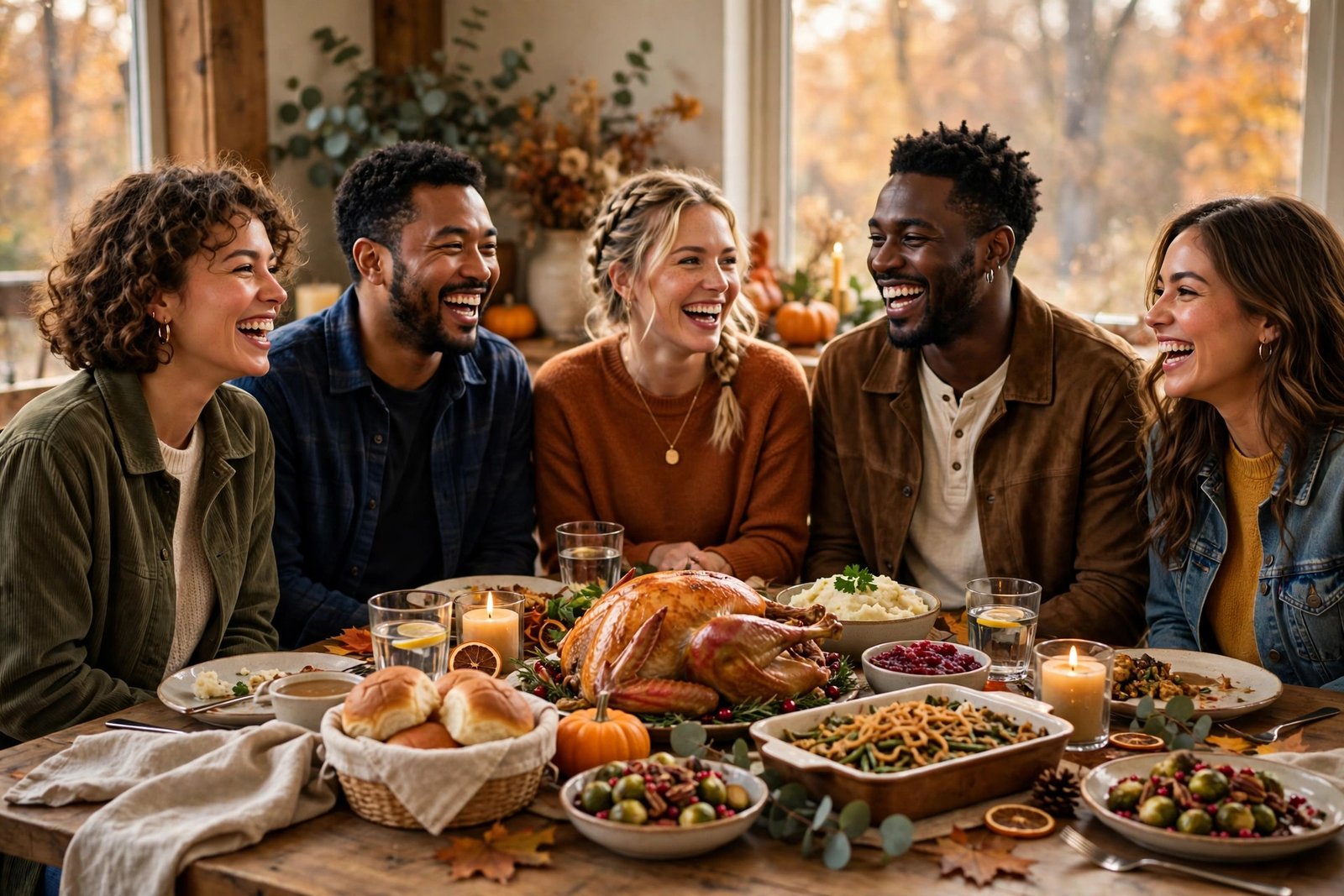
Somewhere between the last slice of pie and the third round of leftovers, Thanksgiving ends — and for a growing number of people, the best meal of the season hasn’t happened yet. It happens a few days earlier, or the weekend after, in a cramped apartment or a friend’s backyard, with a turkey that might be slightly overcooked and a table full of dishes nobody planned in advance. That meal is a Friendsgiving, and if you have never been to one, you are missing one of the warmest traditions on the American holiday calendar.
So what is Friendsgiving? In short, it is a Thanksgiving-style feast shared with friends instead of family. The menu looks familiar — turkey, stuffing, mashed potatoes, pie — but the rules are different. There is no assigned seating chart, no seating plan negotiated by your grandmother, and no one is flying across the country to be there. Instead, everyone brings something, everyone helps, and the whole point is the people at the table rather than the formality of the occasion.
What is Friendsgiving, exactly?
At its simplest, a Friendsgiving is a Thanksgiving-themed meal shared among friends. It is usually potluck-style, which means the host provides the main dish — often the turkey — and each guest brings a side, a dessert, or drinks. It can happen before Thanksgiving, after it, or instead of it. There is no fixed date, no official menu, and no rulebook handed down by tradition. That flexibility is the whole appeal.
What makes it different from an ordinary dinner party is the Thanksgiving frame. The food is seasonal, the mood is grateful, and the guest list is built around chosen family — the friends who have become the people you count on. For many guests, that is the point. A Friendsgiving is for the people who cannot get home for Thanksgiving, the ones who live too far away, the ones whose families are small or scattered, and the ones who simply prefer celebrating with the people they chose.
Where did Friendsgiving come from?
The word itself is young. The term Friendsgiving was first used in 2007, appearing in Usenet and Twitter posts, according to Merriam-Webster. It was a playful mash-up — friends plus Thanksgiving — and for a few years it stayed a casual piece of internet slang, the kind of word you would see in a group chat rather than a dictionary.
Television helped the idea take root long before the word existed, and History.com has traced how the holiday grew out of those early TV moments. The sitcom Friends ran a Thanksgiving episode in every season from 1994 to 2004, and in those episodes the six friends celebrated together, often because their families were elsewhere. The show made the friends-as-family Thanksgiving feel normal, even aspirational. A generation of viewers grew up watching Monica cook for her friends, and the idea of a Thanksgiving built around your chosen people stopped feeling strange.
The word went mainstream in 2011, when Baileys Irish Cream ran an advertising campaign built around “Friendsgiving with Bailey’s.” The campaign put the term in front of millions of people and gave it a polished, marketable shape: friends, food, drinks, and a celebration that belonged to your generation rather than your parents’. After that, the term started appearing in magazines, on food blogs, and in holiday planning guides.
The final stamp of legitimacy came in January 2020, when Merriam-Webster officially added Friendsgiving to the dictionary. The dictionary defines it as a large meal shared with friends on or near Thanksgiving, and Wikipedia traces the same story, from the first uses of the term to its spread through pop culture. By then, the word hardly needed the endorsement — it was already everywhere — but the entry marked the moment Friendsgiving stopped being slang and became part of the language.
Friendsgiving vs Thanksgiving: what’s actually different?
People often ask whether Friendsgiving is just Thanksgiving with different guests. The food overlaps, the season overlaps, and the gratitude overlaps — but the two celebrations work differently in almost every practical way. The table below lays out the real differences.
| Friendsgiving | Thanksgiving | |
|---|---|---|
| Date | No fixed date; usually a weekend in the weeks around Thanksgiving | Fourth Thursday of November, every year |
| Guest list | Friends and chosen family | Family, often across generations |
| Who cooks | Potluck — everyone brings a dish | Usually one host cooks most of the meal |
| Formality | Casual; mismatched plates are fine | Often more formal; family traditions rule |
| Menu | Flexible; turkey optional, themes welcome | Traditional; turkey expected |
| Budget | Split across guests | Usually carried by the host |
| Pressure | Low — no inherited expectations | Higher — family traditions to uphold |
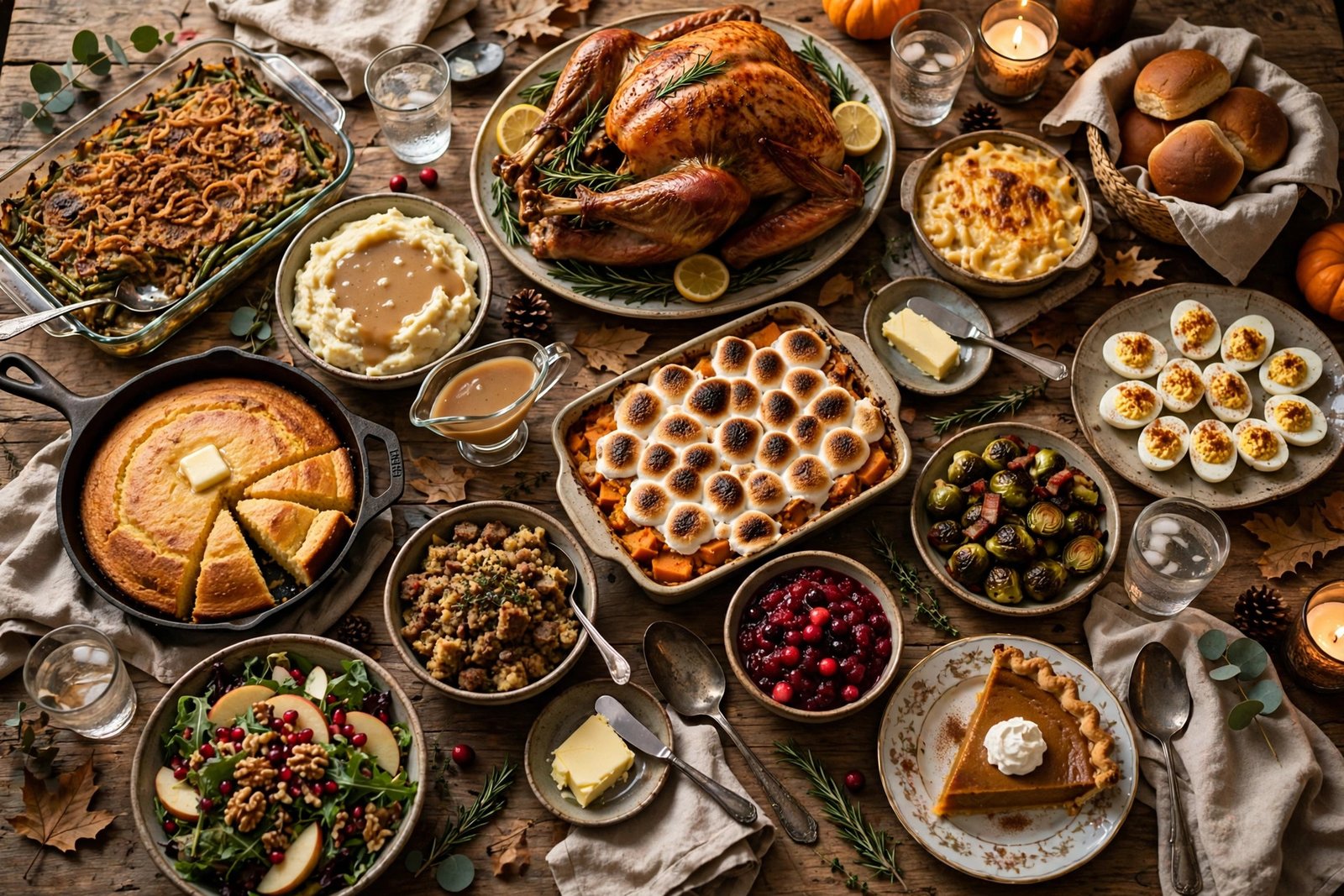
How to host a Friendsgiving: the complete plan
Pick a date and send the invites early
Send the invites at least two weeks ahead. A group chat works fine, but make it a real invitation with a date, a time, and an address — not a vague “we should do Friendsgiving sometime.” People need something they can put on a calendar. Ask for an RSVP within a week so you know how many to cook for.
Set the potluck rules clearly
The potluck is where Friendsgivings succeed or fail, and the difference is almost always communication. The moment someone RSVPs, assign them a category: a side dish, a dessert, a salad, or drinks. Be specific. “Bring a side” is an invitation to five bowls of mashed potatoes. “Bring the green beans” is a plan.
Keep a shared list — a group chat thread, a shared note, or a simple spreadsheet — where everyone can see what is already covered. The host should provide the turkey and the basics: plates, cutlery, napkins, and enough serving dishes. Guests bring the food. If someone cannot cook, assign them drinks, ice, or a store-bought pie. Nobody should be excluded because they cannot make a casserole from scratch.
Plan the menu like a host, not a chef
You do not need a ten-dish spread. A good Friendsgiving menu has a main, three or four sides, a dessert, and drinks. That is it. The turkey is traditional, but it is not mandatory — a roasted chicken, a ham, or even a big vegetarian main works just as well, especially for a smaller group. If you do cook a turkey, remember the basics: it is done at 165°F in the thigh, it needs 20 to 30 minutes of rest before carving, and leftovers must go in the fridge within two hours.
Balance the menu. If one person brings mashed potatoes, the next should bring something green, the next something sweet, and the next a salad. Ask about allergies and dietary needs when you send the invites, not on the night. A vegetarian guest should not discover at the table that every dish contains bacon.
Keep the drinks simple. A couple of bottles of wine, some beer, sparkling water, and one signature punch will cover the evening. If you want a festive drink, a simple Christmas punch — cranberry, ginger ale, and orange — takes five minutes and looks the part. You can find a full recipe in our guide to making Christmas punch, which works just as well in November as it does in December.
Set the table, then stop fussing
A Friendsgiving table does not need to look like a magazine spread. It needs enough seats, enough plates, and enough room for the food. Allow roughly 24 inches of table space per guest — the same rule that applies to a Thanksgiving table — so nobody is eating with their elbows tucked in. If you are short on chairs, borrow them. If you are short on table space, a folding table with a tablecloth does the job.
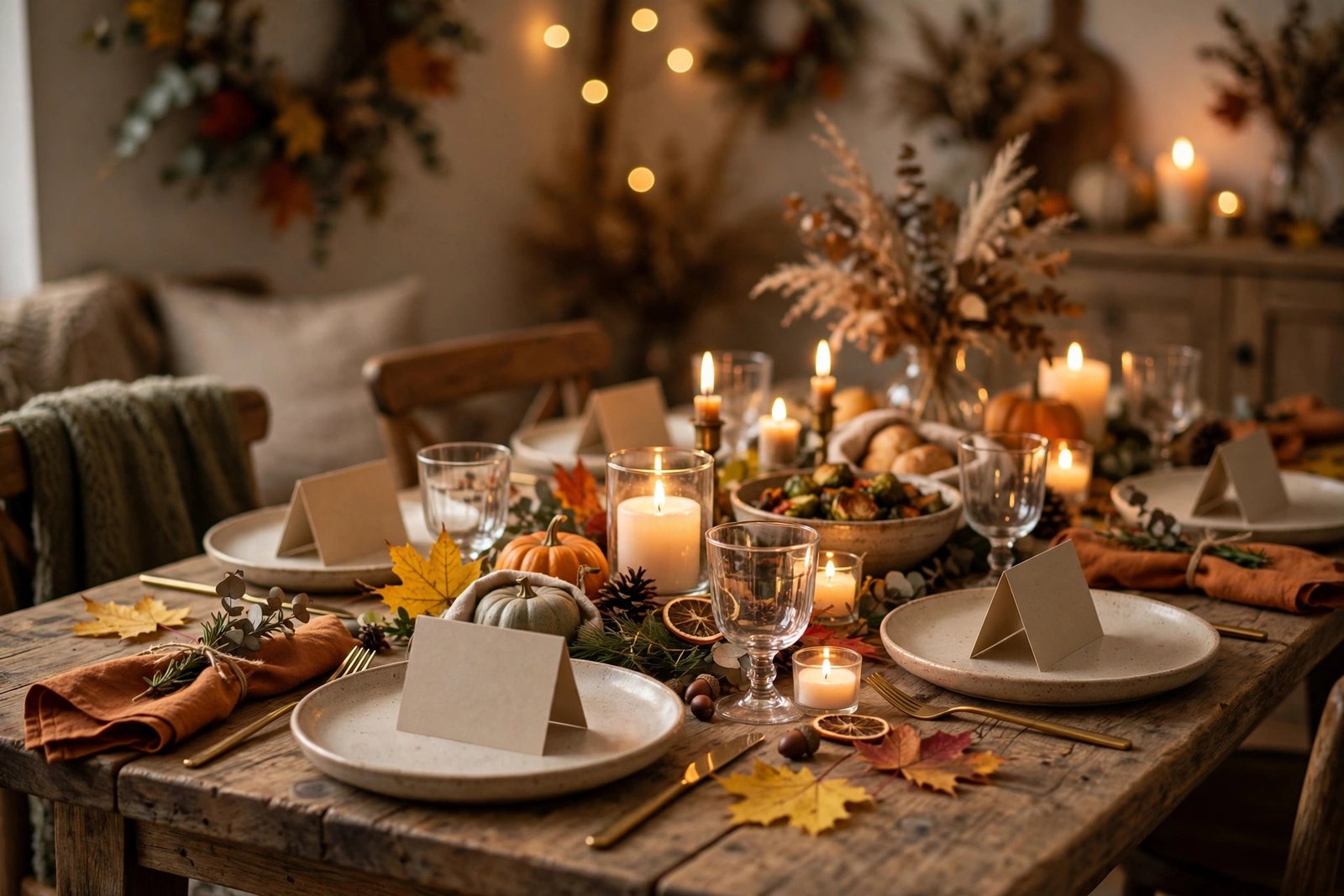
Place cards are a nice touch, and they solve the awkward “where do I sit?” shuffle. Autumn decor helps too: a few candles, some leaves, a pumpkin or two. Our guide to setting a Thanksgiving table covers the layout in detail, and almost all of it applies here — just skip the formal place settings and keep it relaxed.
Work out the budget before you shop
Still, agree on the split in advance. If the host is buying the turkey, say so. If guests are expected to bring drinks as well as food, say that too. A quick message in the group chat — “I’ll cover the turkey and plates, everyone brings one dish and a bottle” — prevents the awkward moment when someone shows up empty-handed because they thought everything was provided. Part of what is friendsgiving really about is that shared effort: everyone contributes, and everyone owns a piece of the evening.
If your group is hosting its first Friendsgiving, the planning habits from a proper dinner party still apply. Our guide on how to host Christmas dinner covers timelines, delegation, and the mistakes to skip — and nearly all of it transfers directly to a friends-only feast.
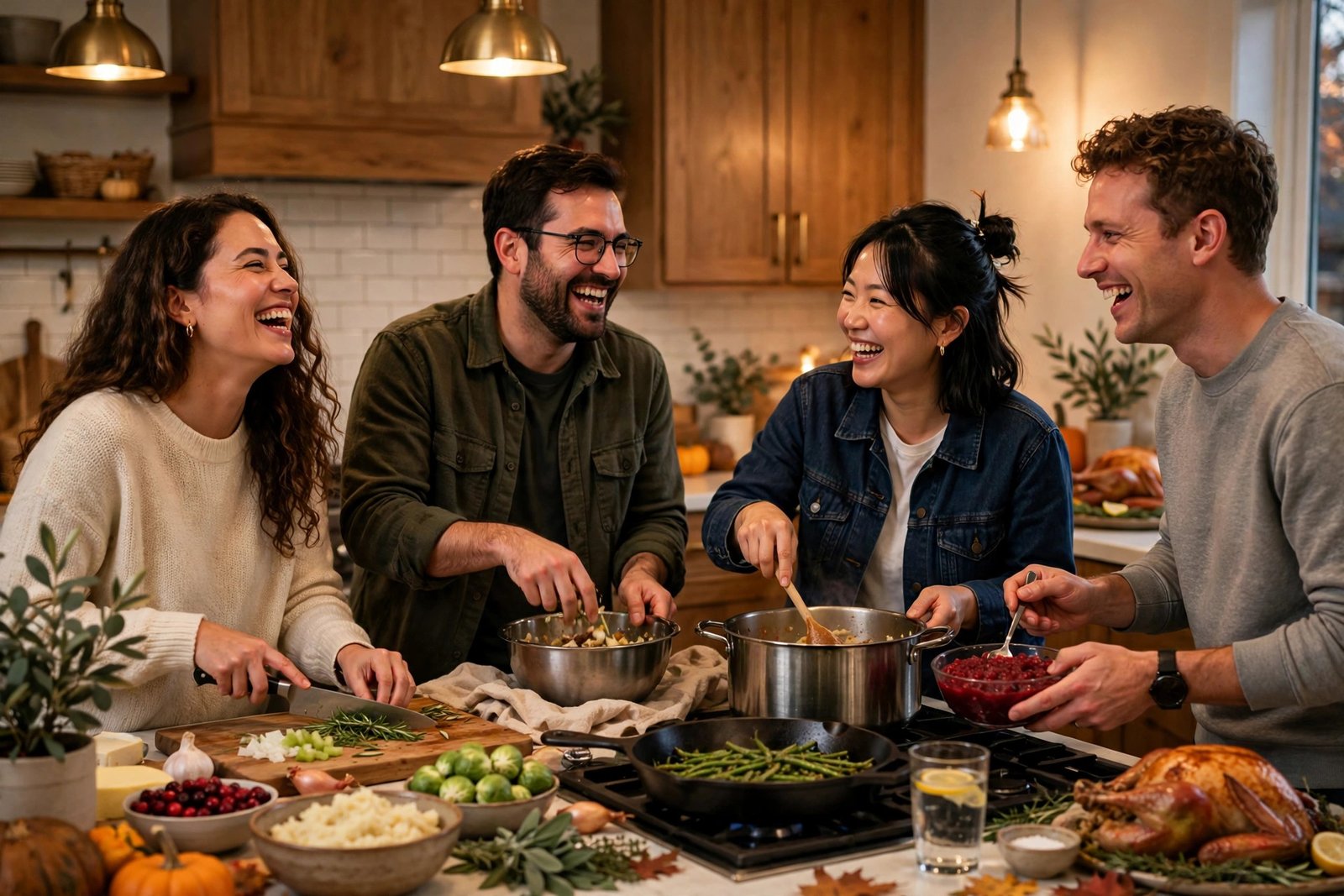
The potluck plan that actually works
A potluck sounds simple until five people bring dessert and nobody brings vegetables. The fix is a simple assignment table. Share it in the group chat, let people claim their slot, and fill the gaps yourself.
| Dish type | Who brings it | Serves | Notes |
|---|---|---|---|
| Main (turkey or ham) | Host | Whole group | Cook to 165°F; rest before carving |
| Mashed potatoes | Guest 1 | 8–10 | Keep warm in a slow cooker |
| Stuffing or dressing | Guest 2 | 8–10 | Bake at the guest’s home if possible |
| Green vegetables | Guest 3 | 8–10 | Green beans or Brussels sprouts |
| Cranberry sauce | Guest 4 | Whole group | Canned is fine — nobody will mind |
| Salad | Guest 5 | 8–10 | Something fresh to cut the richness |
| Dessert (pie) | Guest 6 | 8–10 | Pumpkin or apple; buy it if needed |
| Drinks and ice | Guest 7 | Whole group | Wine, beer, sparkling water |
There are no official rules, but there are unwritten ones, and breaking them is the fastest way to get quietly dropped from next year’s invite list.
First, bring what you promised. If you said green beans, bring green beans — not a bag of chips you grabbed on the way. If something goes wrong, tell the host early, not at the door. A text at noon saying the casserole burned gives the host time to adapt. A shrug at 7 p.m. does not.
Second, arrive on time, or close to it. The host has timed the turkey to your arrival. Showing up an hour late means cold food and a stressed host. If you are going to be late, say so.
Third, help without being asked. Clear plates, wash up, take out the trash. The host cooked the turkey and cleaned the house; the least the guests can do is help with the aftermath. The best Friendsgivings end with everyone in the kitchen, drying dishes and talking, long after the food is gone.
What to bring to someone else’s Friendsgiving
If you are a guest rather than the host, your job is simpler — but it still matters. Bring the dish you were assigned, arrive on time, and bring one extra thing: a bottle of wine, a small host gift, or a bag of ice. Ice is the most underrated contribution at any dinner party. Nobody ever remembers it, and everybody needs it.
If you cannot cook, be honest about it. Offer to bring drinks, dessert from a bakery, or the cheese plate. A good cheese plate takes ten minutes to assemble and looks like you tried very hard. Nobody will know the difference, and nobody will care.
One last note for guests: if the evening falls near Thanksgiving itself, the Macy’s Thanksgiving Day Parade makes a fine background for the afternoon. Put it on while people arrive, let the conversation take over, and turn it off when dinner is served.
Frequently asked questions
What is Friendsgiving?
What is Friendsgiving? It is a Thanksgiving-style meal shared with friends, usually potluck-style, held in the weeks around Thanksgiving. The host typically provides the turkey and the space, and each guest brings a dish. There is no fixed date, and the emphasis is on chosen family rather than formal tradition.
When should you hold a Friendsgiving?
Most Friendsgivings happen on a weekend in the weeks around Thanksgiving — the weekend before is the most popular, because it avoids clashing with family plans. The weekend after Thanksgiving works too, and it is a good way to use up leftover turkey. The only date to avoid is Thanksgiving Thursday itself, unless your whole group is skipping family dinner.
Do you have to serve turkey at a Friendsgiving?
No. Turkey is traditional, but it is not required. A ham, a roasted chicken, or a vegetarian main all work, especially for smaller groups. The point is a shared seasonal meal, not a specific bird. What matters is that there is enough food, that it is served warm, and that everyone has something they can eat.
How many people should you invite?
Eight to twelve is the sweet spot. Fewer than six, and the potluck feels thin. More than twelve, and the cooking, seating, and conversation all get harder. If your group is bigger, consider two smaller gatherings rather than one crowded one — or ask a co-host to share the space and the work.
Is Friendsgiving a replacement for Thanksgiving?
For some people, yes; for most, no. Many people celebrate both — Thanksgiving with family on the Thursday, Friendsgiving with friends on a nearby weekend. For people who cannot travel home, or whose families are far away, Friendsgiving can be the main event. Either way, it is a complement to Thanksgiving, not a competitor.
Ask ten people what is friendsgiving and you will get ten slightly different answers, but they will all mention the same thing: the people. Friendsgiving started as a word on the internet in 2007, got a boost from a sitcom and a drinks campaign, and earned a dictionary entry in 2020. But its real history is simpler than that. People have always wanted to share a good meal with the people they love, and sometimes the people they love most are not the ones they share a last name with.
That is what the holiday is for. A table, a turkey, a few dishes brought by friends, and an evening that stretches longer than anyone planned. It does not need to be perfect. It does not need to be traditional. It just needs to happen — and if you host one this year, your friends will remember it long after the plates are cleared.



