
What Is Kwanzaa? The 2026 Guide to Dates, Principles, and Traditions
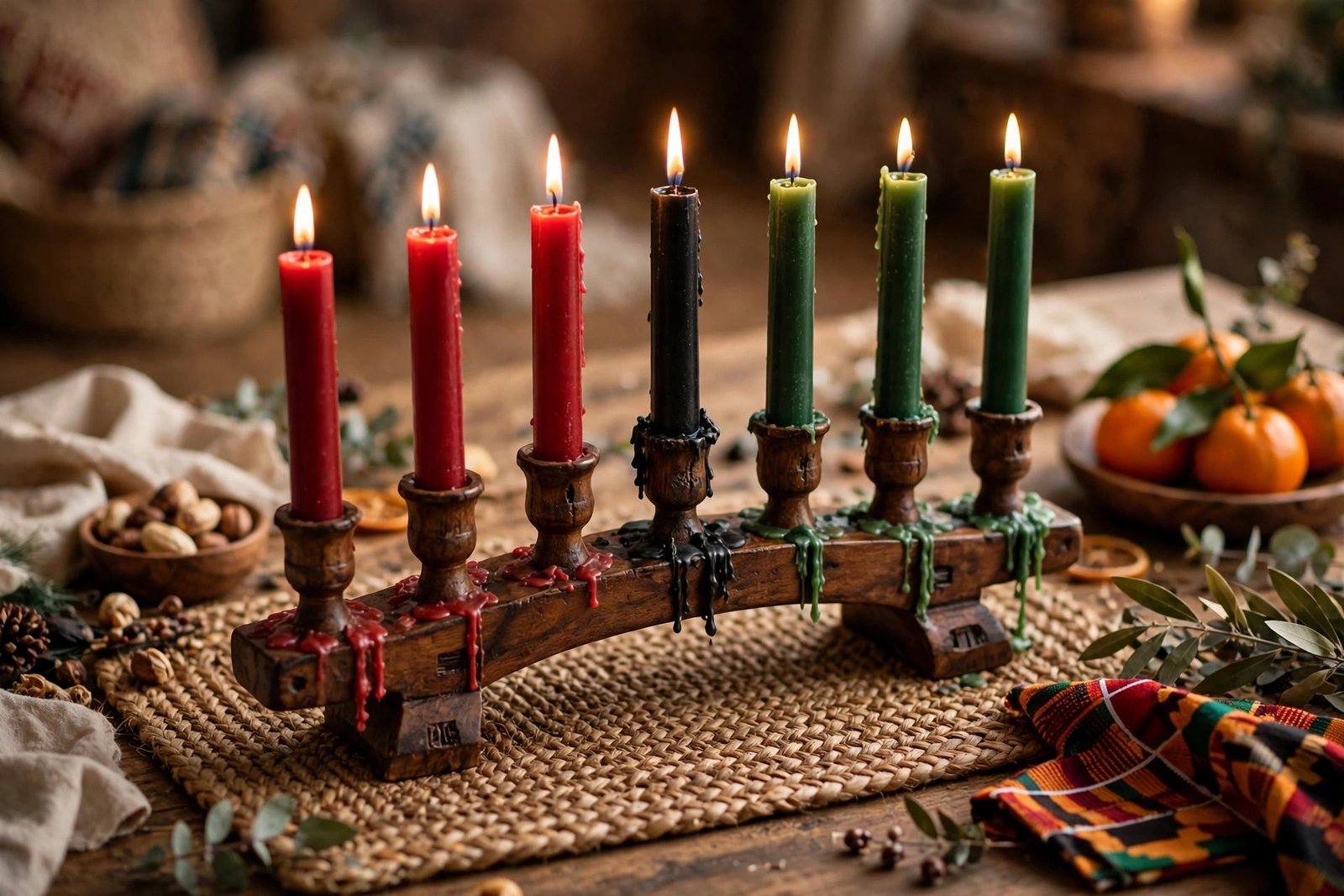
Every year, in the week after Christmas, a different kind of light appears in homes across the United States. Seven candles — three red, one black, three green — stand in a row on a wooden holder, and one more is lit each evening until all seven burn together. If you have ever seen that candle holder and wondered what is Kwanzaa, this guide has the answers.
Kwanzaa is a seven-day celebration of African heritage, family, and community. It runs from December 26 to January 1 every year, and each of its seven days honours a different principle — unity, self-determination, collective work, cooperative economics, purpose, creativity, and faith. This guide covers the 2026 dates, the history, the seven principles, the symbols, the feast, and how to take part respectfully.
What Is Kwanzaa? The Short Answer
Kwanzaa is a cultural celebration, not a religious holiday. It was created in 1966 by Dr. Maulana Karenga, a professor at California State University, Long Beach, as a way for Black Americans to honour their African roots and celebrate the values that hold a community together.
The name comes from the Swahili phrase “matunda ya kwanza,” meaning “first fruits.” The extra “a” at the end of Kwanzaa was added because seven children were present at the first celebrations, and the holiday has seven principles — one for each day. That detail says a lot about the holiday: it was built by a community, for a community, from the very first year.
Kwanzaa is observed by millions of people, mostly in the United States, and it is often celebrated alongside Christmas or Hanukkah rather than instead of them. There is no conflict in that — Kwanzaa is about heritage and values, and it fits naturally into a season that is already about family and togetherness. For a fuller account of the holiday’s background, Britannica’s Kwanzaa entry covers its origins and principles in detail.
Kwanzaa 2026: Dates and the Seven Days
Kwanzaa 2026 runs from Saturday, December 26, 2026, to Friday, January 1, 2027. Unlike Hanukkah, whose dates shift each year, Kwanzaa’s dates are fixed: it always begins on December 26 and always ends on January 1.
Each day of Kwanzaa is devoted to one of the seven principles, known as the Nguzo Saba. A candle is lit each evening, and families talk about the principle of the day — what it means, and how it shows up in their lives. Here is the full schedule for 2026.
| Day | Date (2026–27) | Principle | Meaning | How families observe it |
|---|---|---|---|---|
| Day 1 | Saturday, December 26 | Umoja | Unity | The black candle is lit; families gather and talk about togetherness |
| Day 2 | Sunday, December 27 | Kujichagulia | Self-determination | First red candle is lit; families reflect on defining themselves |
| Day 3 | Monday, December 28 | Ujima | Collective work and responsibility | First green candle is lit; families talk about helping each other |
| Day 4 | Tuesday, December 29 | Ujamaa | Cooperative economics | Second red candle is lit; families discuss supporting Black-owned businesses |
| Day 5 | Wednesday, December 30 | Nia | Purpose | Second green candle is lit; families talk about their goals |
| Day 6 | Thursday, December 31 | Kuumba | Creativity | Third red candle is lit; the karamu feast is shared |
| Day 7 | Friday, January 1 | Imani | Faith | Third green candle is lit; families reflect on faith in themselves and each other |
The candles are lit in a particular order. The black candle in the centre is always lit first, on December 26. After that, candles alternate: red on the left, green on the right, moving outward. By January 1, all seven candles are burning.
The greeting of the season is “Habari gani?” — Swahili for “What’s the news?” The answer is the principle of the day. So on December 26, you would answer “Umoja,” and on December 31, “Kuumba.” It is a small ritual, but it is the kind of thing that makes the holiday feel lived-in rather than just observed.
For a clear day-by-day reference, the Old Farmer’s Almanac lists the 2026 dates and principles, and History.com has a solid overview of how the week unfolds.
Where Kwanzaa Comes From
The question of what is Kwanzaa really asking is a question about history. Kwanzaa was born in the 1960s, in the middle of the American civil rights movement, when many Black Americans were looking for ways to reconnect with African heritage and build pride in their identity.
Dr. Maulana Karenga drew on African harvest festivals — the “first fruits” celebrations held across the continent — and wove them into a new American holiday. The seven principles, the Swahili words, the symbols, and the colours all come from that idea: a celebration rooted in African traditions but made for Black families living in America.
The holiday grew quickly. By the 1970s and 1980s, Kwanzaa was being celebrated in homes, schools, and community centres across the country, and today it is a familiar part of the American holiday season.
It is worth saying plainly: Kwanzaa is not an ancient African holiday, and it does not pretend to be one. It is a modern celebration, created in 1966, that draws on older traditions to say something about the present — about who you are, where you come from, and what your community stands for.
The Kinara and the Seven Candles
The kinara is the candle holder at the centre of Kwanzaa, and it is the holiday’s most recognisable symbol. It holds seven candles, called the mishumaa saba: three red on the left, one black in the centre, and three green on the right.
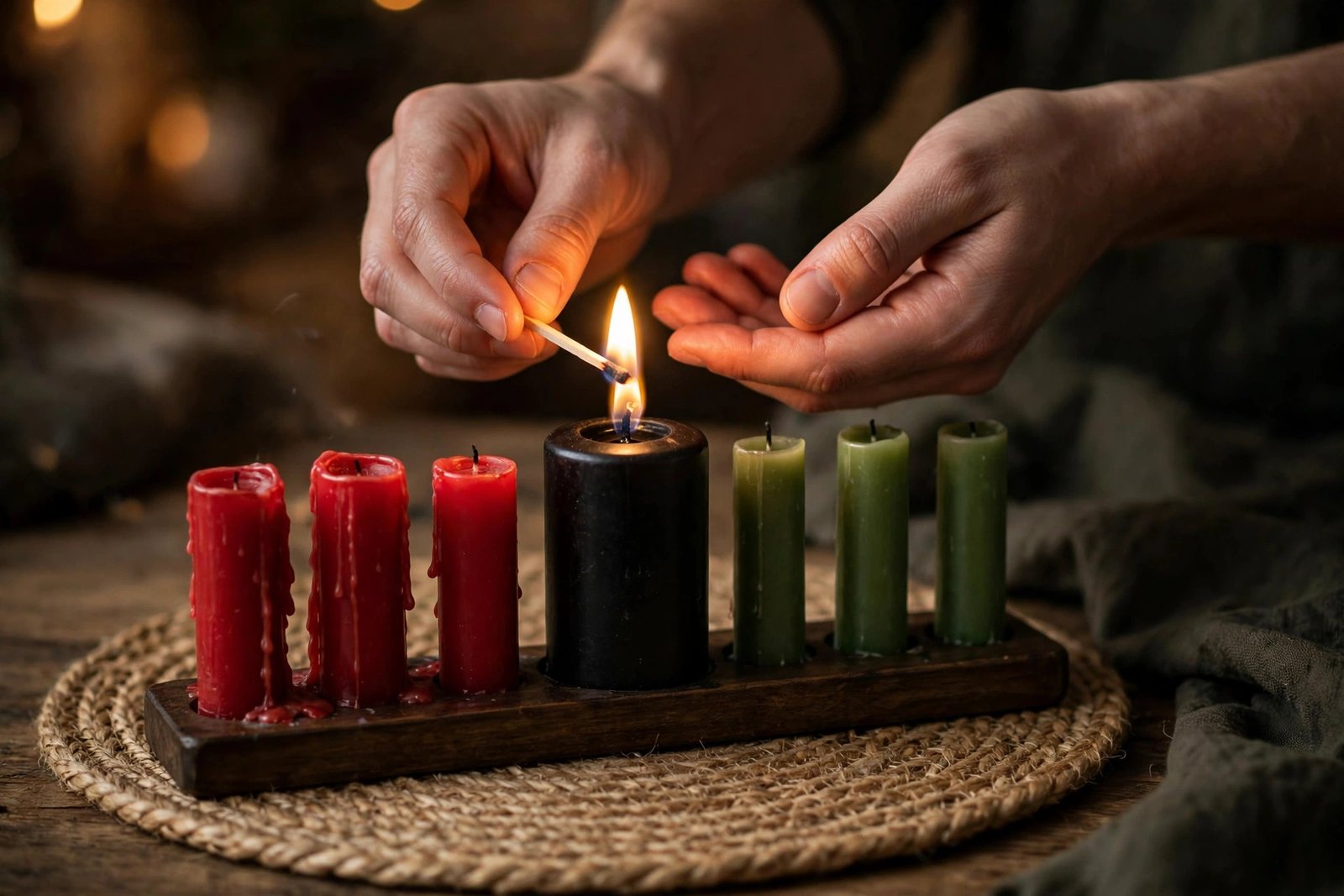
The colours carry meaning. Black stands for the people, red for their struggle, and green for the future and hope. The black candle is lit first, on the first night, because unity — Umoja — is the foundation everything else rests on.
The kinara sits on a woven mat called the mkeka, which represents the foundation of tradition and history that the family stands on. Around it, families place the other symbols of the holiday: fruit, corn, a cup, and gifts.
Lighting the candles is usually a family moment. Someone lights the candle for the day, the family says the principle aloud, and they talk about it — what it means to them, and how they will live it. Children are often given a part to play, lighting a candle or answering “Habari gani?” with the principle of the day.
If you are setting up a kinara for the first time, place it somewhere steady and visible — a dining table or a sideboard works well. Keep it away from anything flammable, and never leave the candles burning unattended. The light is the point; the safety is the job.
The Seven Symbols of Kwanzaa
Kwanzaa has seven symbols, and each one has a job to do on the holiday table. Together, they tell the story of the celebration: the harvest, the family, the community, and the future.
| Symbol | What it is | What it means |
|---|---|---|
| Mkeka | A woven straw mat | The foundation of tradition and history |
| Kinara | The seven-branched candle holder | The ancestors and the family line |
| Mishumaa Saba | The seven candles | The seven principles, one per day |
| Mazao | Crops, usually fruit | The harvest and the fruits of collective work |
| Muhindi | Ears of corn | The children, and the future of the community |
| Kikombe cha Umoja | The unity cup | Unity — shared by all at the table |
| Zawadi | Gifts | The rewards of labour and the love of parents |
The mazao, the crops, are usually shown as a bowl of fruit — oranges, apples, pomegranates, whatever is in season. They are a reminder that the holiday began as a harvest celebration, and that good work produces good things.
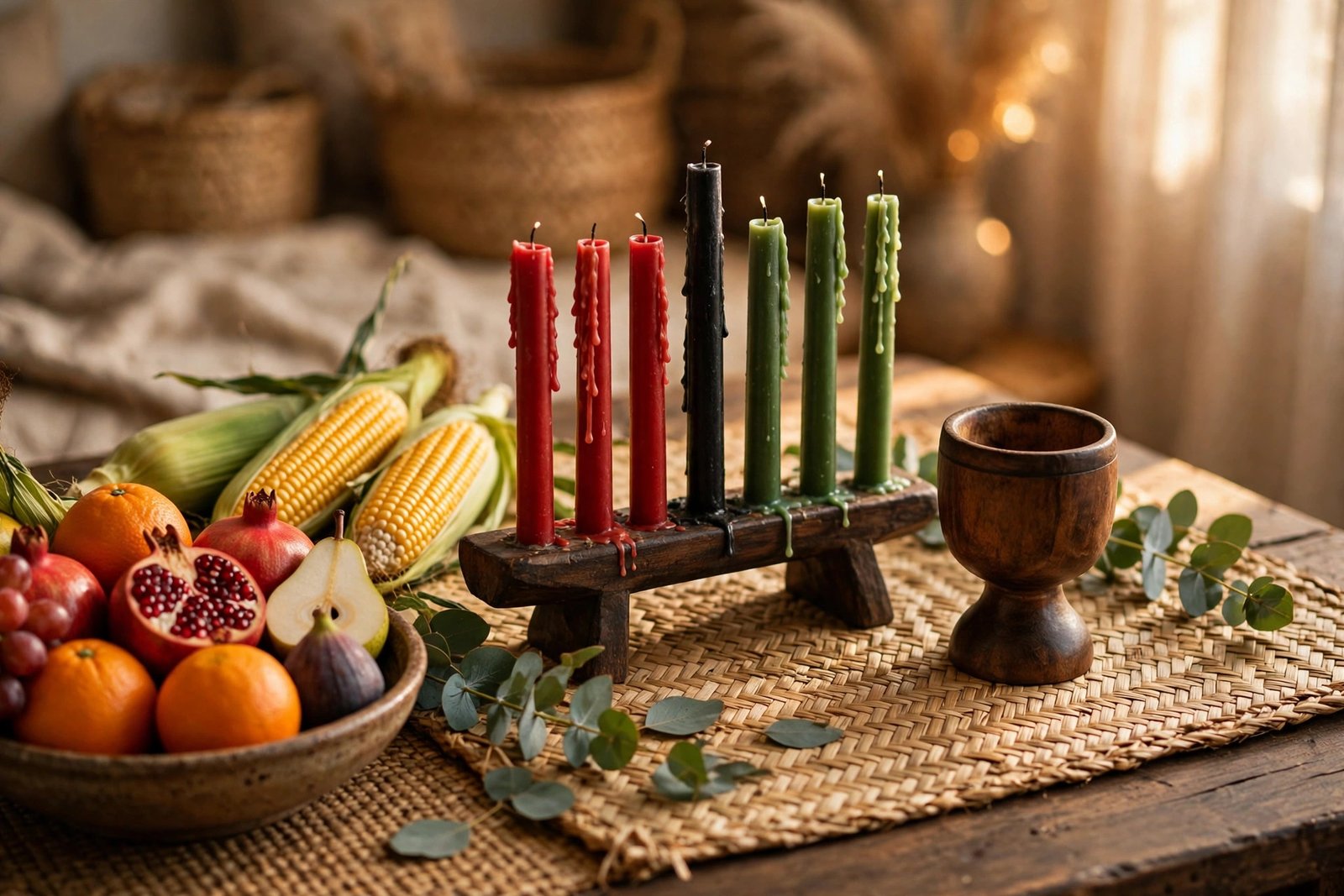
The muhindi, the ears of corn, are placed on the mat to represent the children of the family — one ear for each child. If a family has no children, a single ear is still placed to represent the children of the community. It is one of the holiday’s most touching details: the future is always at the table, even when it is not sitting in a chair.
The kikombe cha umoja, the unity cup, is used for the libation — a pouring of water or juice in honour of the ancestors. The cup is passed around the table, and each person takes a sip. It is a quiet, serious moment in the middle of a joyful week.
The Karamu Feast
The karamu is the great feast of Kwanzaa, held on the evening of December 31 — the sixth day, the day of Kuumba, creativity. It is the biggest gathering of the week, and it is where the holiday’s food, music, and community all come together.
The meal is a celebration of African and African-diaspora cooking. Typical dishes families serve include jollof rice, collard greens, black-eyed peas, sweet potatoes, fried plantains, and cornbread. There is no single official menu — every family cooks its own version, often with recipes passed down through generations.
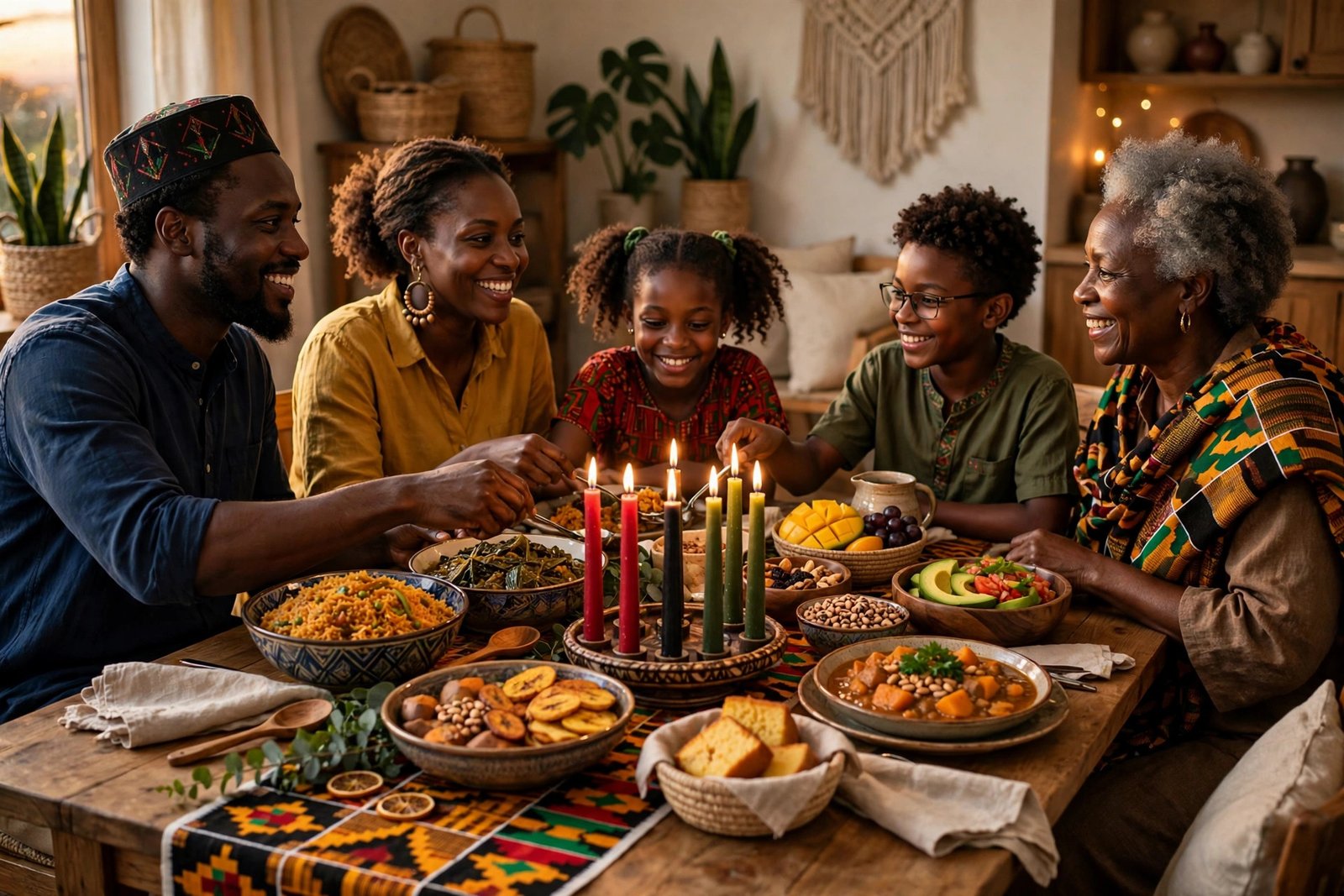
The feast usually begins with the libation and a moment of remembrance, then moves into the meal, music, and storytelling. Elders are honoured, children perform or speak, and the evening often runs long — as the best family dinners do.
If you are invited to a karamu, bring something to share and be ready to take part. The feast is not a performance for guests; it is a community meal, and guests are part of the community for the night. Ask questions, try the food, and listen to the stories. That is how the holiday is meant to be experienced.
Gifts, Greetings, and Zawadi
Gifts at Kwanzaa are called zawadi, and they are usually given on January 1, the last day of the holiday. The tradition is that gifts should be meaningful and handmade where possible — books, art, and things made by hand are valued more than expensive store-bought items.
Books are an especially popular Kwanzaa gift, particularly books about African history and culture for children. The idea is that a gift should teach something, or create something, or honour the person who receives it. A handmade gift carries more weight than a pricey one.
The greeting “Habari gani?” is the holiday’s other tradition, and it is worth learning even if you never celebrate Kwanzaa yourself. Answering with the principle of the day is a small way to show respect and join in, and it is the kind of detail people remember.
If you are sending a card, “Happy Kwanzaa” is the simplest greeting and always welcome. You may also see “Joyous Kwanzaa,” which is equally correct. Either one says that you know the holiday exists and that you respect it — and that is the whole point.
Kwanzaa and Christmas: Can You Celebrate Both?
Yes — and many families do. Because Kwanzaa is a cultural celebration rather than a religious one, it does not compete with Christmas or Hanukkah. A family can go to church on Christmas morning and light the kinara on December 26 without any contradiction.
This is one of the most common points of confusion about the holiday. People often ask what is Kwanzaa in relation to Christmas, as if the two are rivals. They are not. Christmas is a religious holiday; Kwanzaa is a cultural one. They answer different questions, and the season has room for both.
For families who celebrate both, the week after Christmas becomes a time to shift focus: from the religious observance of Christmas to the cultural reflection of Kwanzaa. The tree may still be up, the gifts may still be under it, and the kinara takes its place on the table beside them.
If you would like to understand how the season’s holidays fit together, our guide to what is Hanukkah covers the Festival of Lights, and our explainers on what is an advent calendar and what is Secret Santa cover two more December traditions. Our piece on what is Boxing Day explains the day after Christmas in the countries that mark it.
How to Celebrate Kwanzaa Respectfully as a Learner
Kwanzaa is a celebration of Black heritage, and if you are not Black, it is worth approaching it as a learner rather than an adopter. That does not mean you cannot take part — it means you take part with respect, and you let the people whose holiday it is lead the way.
The best way to learn what is Kwanzaa is to attend a community celebration, read about the principles, and listen to the people who grew up with the holiday. Many cities hold public Kwanzaa events in the week after Christmas, and they are open to everyone. Go, listen, and learn.
If you are a teacher or a parent, Kwanzaa is a natural subject for a classroom or a family discussion. The seven principles are values any child can understand — unity, purpose, creativity, faith — and the holiday gives you a week to talk about them, one at a time.
Frequently Asked Questions
When is Kwanzaa in 2026?
Kwanzaa 2026 runs from Saturday, December 26, 2026, to Friday, January 1, 2027. The dates are the same every year: December 26 to January 1.
Is Kwanzaa a religious holiday?
No. Kwanzaa is a cultural celebration of African heritage, family, and community. It is not tied to any religion, and it is often observed alongside Christmas or Hanukkah.
Who created Kwanzaa?
Kwanzaa was created in 1966 by Dr. Maulana Karenga, a professor at California State University, Long Beach. He drew on African harvest festivals and the Swahili language to build a holiday for Black Americans.
What are the seven principles of Kwanzaa?
The Nguzo Saba are Umoja (unity), Kujichagulia (self-determination), Ujima (collective work and responsibility), Ujamaa (cooperative economics), Nia (purpose), Kuumba (creativity), and Imani (faith). One principle is honoured on each day of the week.
What does “Habari gani” mean?
“Habari gani?” is Swahili for “What’s the news?” It is the greeting of Kwanzaa, and the answer is the principle of the day — for example, “Umoja” on December 26.
What is the karamu?
The karamu is the great feast of Kwanzaa, held on December 31, the sixth day. Families and friends gather for a meal of African and African-diaspora dishes, with music, storytelling, and a libation in honour of the ancestors.
Conclusion
Kwanzaa is a young holiday with deep roots. It was created in 1966, but it reaches back to harvest festivals that are far older, and it speaks to values that never go out of date: unity, purpose, creativity, and faith in the people around you.
So what is Kwanzaa, in the end? It is seven days, seven candles, and seven principles — a week to gather the family, light the kinara, share the karamu, and remember where you come from. Whether you celebrate it yourself or simply want to understand it, the dates are fixed and the welcome is open: December 26 to January 1, every year.



