
How much house can I afford? It’s the question every buyer asks first, and the answer matters more than almost any other financial decision you’ll make — because the gap between what a lender will approve you for and what you can actually live with comfortably can be hundreds of thousands of dollars. With the average 30-year mortgage rate sitting at 7.40% in October 2026 (per Freddie Mac’s weekly survey), borrowing power is tighter than it was a few years ago, and the old rules of thumb need a fresh look.
This guide gives you the honest math: the 28/36 rule explained in plain English, what different salaries actually buy at today’s rates, how down payments change the equation, and the costs buyers forget until they hurt.
A quick note before we start: this is educational information, not financial advice, and every worked example below assumes you are asking how much house can I afford in the 2026 rate environment. Everyone’s situation is different — talk to a licensed mortgage professional about your own numbers.
The 28/36 rule: the formula lenders actually use
Forget vibes and Zillow estimates for a minute. Lenders answer “how much house can I afford” with a specific formula called the 28/36 rule, and learning it is the single most useful thing you can do before house hunting.
- The 28% front-end ratio: your total monthly housing payment — principal, interest, property taxes, homeowners insurance, and PMI if you put down less than 20% — should not exceed 28% of your gross monthly income (before taxes).
- The 36% back-end ratio: your total monthly debt payments, housing included, should not exceed 36% of gross monthly income. This counts car loans, student loans, credit card minimums — everything.
Here’s the 28/36 rule in practice: a household earning $8,000 a month gross caps housing at $2,240 (28%) and total debt at $2,880 (36%). If they already pay $640 a month in car and student loan payments, only $2,240 remains for housing — the math is the same, but the debt eats the margin. That second ratio is why two households with identical salaries can afford very different houses. Whenever you ask how much house can I afford, run both ratios — the lower one is your real ceiling.
Important reality check from the Consumer Financial Protection Bureau: a lender’s pre-approval tells you what they’ll lend, not what you should spend. The CFPB’s guidance on figuring out what you want to spend stresses that lenders don’t know your expenses, your savings goals, or your plans — only you do. Treat the 28/36 result as a ceiling, not a target.
How much house can I afford at today’s rates? The income table
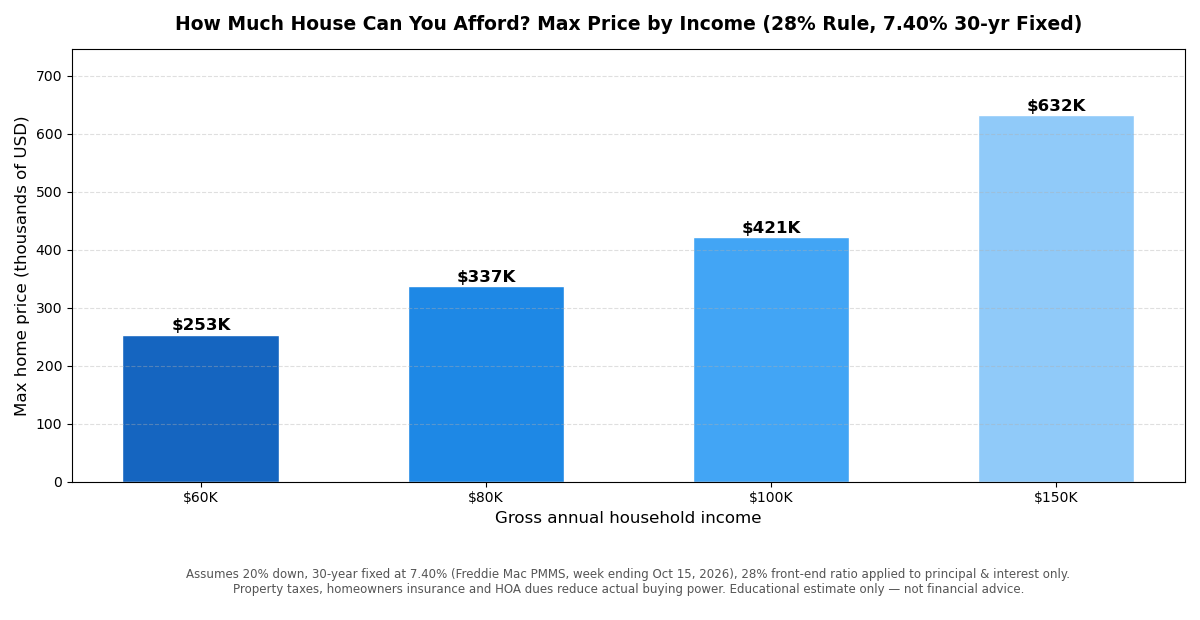
Mortgage rates are the silent partner in every affordability calculation. At 7.40% — the average 30-year fixed rate for the week ending October 15, 2026, according to Freddie Mac’s weekly survey — each $1,000 borrowed costs about $6.92 a month in principal and interest. That’s roughly 75% more expensive than the same loan at 4%. The chart above translates the 28% rule into maximum home prices at this rate, assuming 20% down. The table below shows the full math:
| Annual income | Gross monthly | Max P&I (28%) | Max loan @ 7.40% | 20% down payment | Max home price |
|---|---|---|---|---|---|
| $60,000 | $5,000 | $1,400 | $202,201 | $50,550 | ~$253,000 |
| $80,000 | $6,667 | $1,867 | $269,602 | $67,400 | ~$337,000 |
| $100,000 | $8,333 | $2,333 | $337,002 | $84,250 | ~$421,000 |
| $150,000 | $12,500 | $3,500 | $505,503 | $126,376 | ~$632,000 |
Two caveats keep this honest. First, these are principal-and-interest figures only — property taxes and homeowners insurance come on top and can easily add $200–$600 a month depending on your state, which shrinks the real ceiling. Second, if you carry other debts, the 36% back-end ratio may bind before the 28% front-end ratio does. Run both numbers and take the lower.

How much house can I afford on a $100,000 salary?
This is one of the most-searched versions of the question, so let’s work it fully. At $100,000 gross ($8,333/month), the 28% rule allows $2,333/month for principal and interest. At 7.40% over 30 years, that supports a loan of about $337,000 — and with 20% down ($84,250), a home price around $421,000. That is the headline answer for how much house can I afford on a $100,000 salary — before the real-world caveats below.
But the realistic version is more sobering. Add property taxes (nationally around 1% of home value per year, but over 2% in states like New Jersey and Illinois) and homeowners insurance ($150–$250/month in most markets), and the true monthly housing cost on that $421,000 home lands closer to $2,900–$3,100 — which is 35–37% of gross income, blowing past the 28% guideline. To stay within 28% on all-in housing costs, a $100K earner in a mid-tax state is realistically looking at homes in the $340,000–$380,000 range, not $421,000. This is the single most common mistake buyers make: budgeting on principal and interest alone.
If you have no other debt, some lenders will stretch the back-end ratio to 43% or even 50% on certain loan programs — meaning they’d approve you for more. Approval is not affordability. A good rule from the CFPB’s Mortgage Moves series: decide what you’re comfortable paying each month first, then work backward to a price. The lender works forward from your income; you should work backward from your life.
How much down payment do I need to buy a house?
The 20% figure is a benchmark, not a law. Here’s the real landscape:
- Conventional loans: as little as 3–5% down is allowed, but under 20% triggers private mortgage insurance (PMI) — typically $100–$200+ per month on a median-priced home — until you reach 20% equity.
- FHA loans: 3.5% down with a credit score of 580+, popular with first-time buyers. You pay mortgage insurance premiums for the life of the loan in most cases.
- VA loans: 0% down for eligible veterans and service members, with no monthly PMI.
- USDA loans: 0% down for qualifying rural and suburban properties.
The trade-off is straightforward: a smaller down payment gets you in sooner but costs more every month (PMI + a bigger loan at 7.40% adds up fast) and leaves you with less equity cushion if prices dip. On a $400,000 home, the difference between 5% and 20% down is $60,000 in cash — but the 5%-down buyer pays roughly $180/month in PMI plus interest on a $60,000-larger loan, around $415/month extra at current rates. That’s nearly $600 a month for the privilege of buying sooner. Sometimes it’s worth it — rents are high too — but go in with eyes open. That $600-a-month swing is a reminder that how much house can I afford depends as much on your cash and debts as on your income.
Whatever you put down, keep a separate emergency fund intact. Draining every dollar for the down payment and then facing a $9,000 roof repair in year one is how buyers end up in credit card debt. Speaking of which, tackling high-interest balances through paying off debt fast before you buy can improve both your ratios and your rate.
The hidden costs that break first-time budgets
The mortgage payment is the headline, but homeownership has a long tail of costs that renters never see. Budget for all of these before you finalize your answer to how much house can I afford:
- Closing costs: 2–5% of the purchase price, due at closing. On a $400,000 home, that’s $8,000–$20,000 on top of your down payment.
- Maintenance: the standard rule is 1–2% of the home’s value per year. On a $400,000 home, set aside $4,000–$8,000 annually — roofs, HVAC systems, and water heaters all have expiration dates.
- Property taxes: vary wildly by location and rise over time; verify the actual tax bill on any house you’re considering, not the listing’s estimate.
- Homeowners insurance: required by lenders, and rising fast in disaster-prone states — get quotes before you fall in love with a house.
- HOA dues: $200–$500/month is common in many developments, and special assessments can land without warning.
- Utilities jump: moving from a 900-square-foot apartment to a 2,000-square-foot house can double or triple heating, cooling, and water bills.
A practical test: for three months before buying, “pay” your projected all-in housing cost into savings each month (on top of rent). If your lifestyle survives it, the budget is real. If it doesn’t, you’ve learned something cheap — which is exactly the point of budgeting carefully before the biggest purchase of your life.
Five ways to afford more house (without lying to yourself)
If the math says you can’t afford the home you want, these are the legitimate levers — roughly in order of impact. Each one changes the answer when you ask how much house can I afford:
- Kill the other debts first. Every $500/month in car and student loan payments is roughly $70,000–$85,000 in lost borrowing power at current rates, because of the 36% back-end cap. Debt payoff is the highest-ROI move most buyers can make.
- Raise the down payment. More down means a smaller loan, no PMI at 20%, and sometimes a slightly better rate. Even going from 10% to 15% down trims the monthly bill meaningfully.
- Improve your credit score. The rate difference between fair and excellent credit can be half a point or more — on a $350,000 loan, that’s $100+/month. Building your credit from scratch (or repairing it) before you apply is free money. Our guide walks through the steps.
- Buy down the rate. Paying discount points (typically 1% of the loan per 0.25% rate reduction) makes sense if you’ll stay long enough to break even — usually 5–7 years at current pricing.
- Adjust the target, not the math. A smaller home, a different neighborhood, or a fixer-upper in a good location beats being house-poor in the dream zip code. Being house-poor — spending so much on housing that savings, travel, and emergencies all suffer — is the outcome the 28/36 rule exists to prevent.
What doesn’t work: stretching to a 50% back-end ratio because “the lender approved it,” counting on a raise that hasn’t happened, or assuming rates will fall soon enough to refinance. Rates might fall — they were 6.27% a year ago — but buying a house you can only afford if rates drop is speculation, not planning. A detailed walkthrough of the affordability calculation can help you model different rate scenarios before you commit.

Frequently asked questions
What is the 28/36 rule?
The 28/36 rule is the standard affordability guideline lenders use: spend no more than 28% of your gross monthly income on total housing costs (mortgage principal and interest, property taxes, homeowners insurance, and PMI), and no more than 36% on all monthly debt payments combined, including housing. Calculate both limits and use the lower one as your maximum. It’s a ceiling for safety, not a spending target.
How much house can I afford on a $100,000 salary?
Using the 28% rule at a 7.40% 30-year fixed rate with 20% down, a $100,000 salary supports roughly a $421,000 home on principal and interest alone ($2,333/month). Realistically, once property taxes and insurance are included, most buyers at this income stay comfortable in the $340,000–$380,000 range. If you carry significant other debts, the 36% back-end rule may lower that further.
How much down payment do I need to buy a house?
There’s no single requirement: conventional loans allow as little as 3–5% down, FHA loans need 3.5%, and VA and USDA loans can require 0% for eligible buyers. But putting down less than 20% means paying private mortgage insurance ($100–$200+/month) and carrying a larger loan. Aim for 20% if you can; if you can’t, make sure the all-in monthly payment still fits the 28% guideline.
Should I buy a house at 7.40% interest rates?
It depends on the math, not the rate alone. A high rate reduces what you can afford, but waiting has costs too — rents, price appreciation, and the life you’re postponing. The right question isn’t “is 7.40% good?” but “can I comfortably afford the all-in monthly payment at 7.40%, and would I still be okay if rates stay here for years?” If yes, buying can make sense; you can refinance later if rates fall, but never count on it.
What credit score do I need to buy a house?
Conventional loans typically want 620+, FHA loans accept 580+ (or 500+ with 10% down), and the best rates go to scores of 740+. But the score also affects your rate: even within the “approved” range, a higher score can save you tens of thousands over the life of the loan. If your score is borderline, six months of focused improvement before applying usually pays for itself many times over.
Is renting actually cheaper than buying right now?
Often, yes, on a pure monthly-cash-flow basis at current rates and prices — but the comparison isn’t apples to apples. Renting buys flexibility and zero maintenance risk; buying builds equity and locks in your housing cost (minus taxes and insurance). Run the numbers for your market with a rent-vs-buy calculator, and be honest about how long you’ll stay: buying rarely wins if you’ll move within 3–5 years once closing costs and selling fees are counted. If the rent-vs-buy math says renting wins, that is also a valid answer to how much house can I afford right now: nothing, until your situation changes.
Conclusion
So, how much house can I afford in 2026? Start with the 28/36 rule, price it at today’s 7.40% rates, budget on the all-in payment — not just principal and interest — and treat the lender’s pre-approval as a ceiling you’ll stay comfortably under. For most buyers, that means a home priced at roughly 3–4 times gross annual income, less if taxes are high or debts are heavy. The buyers who thrive aren’t the ones who max out their approval; they’re the ones who buy a house that leaves room for savings, emergencies, and an actual life. Run your numbers twice, keep your emergency fund intact, and remember: the goal was never the biggest house you can technically buy — it’s a home you can afford to enjoy. Revisit how much house can I afford every year — incomes, debts, and rates all change, and the right number moves with them.
Disclaimer: This article is for educational purposes only and is not financial, investment, or mortgage advice. Consult a licensed mortgage professional or financial advisor before making homebuying decisions.