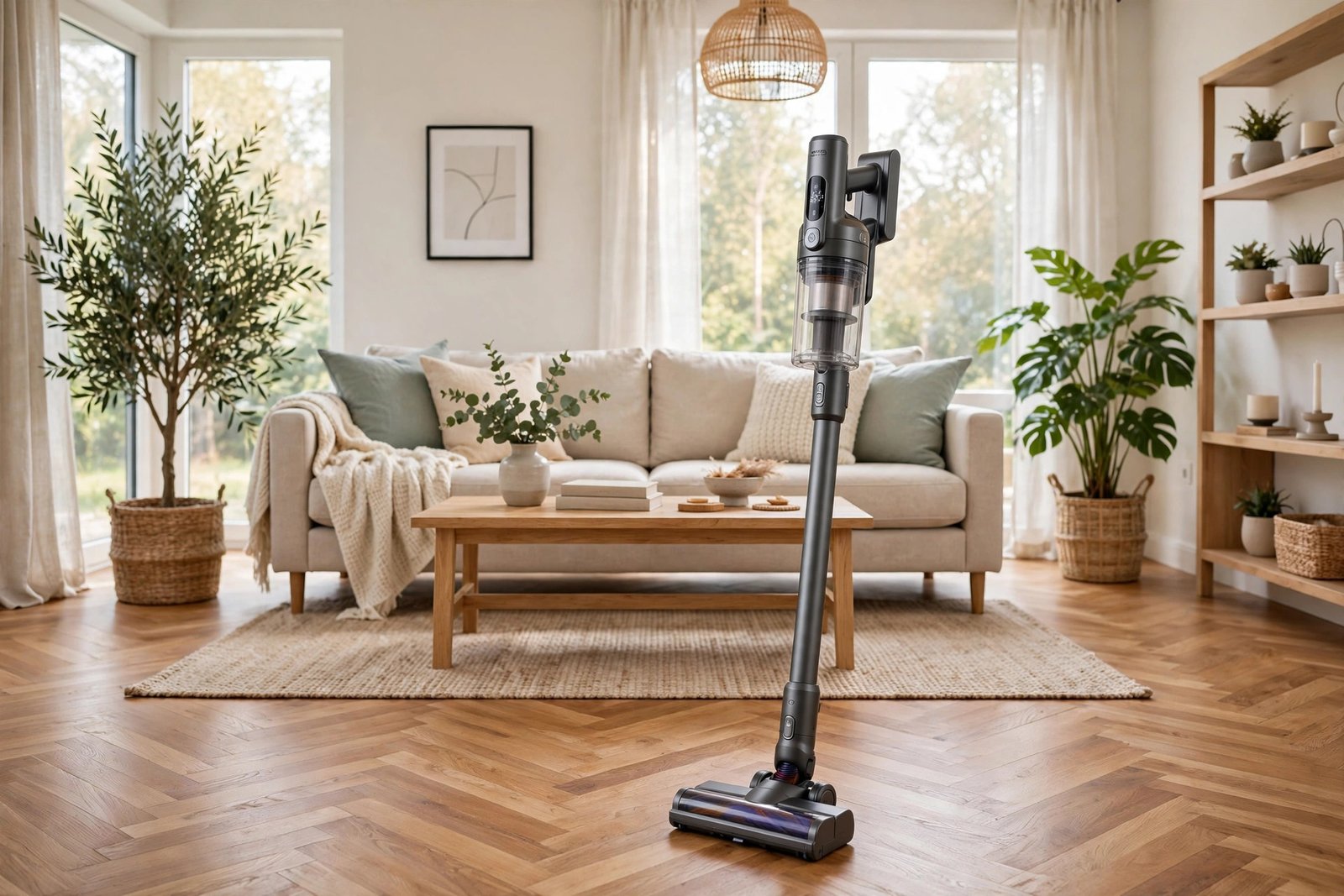

Dyson vs Shark Vacuum: Which Cordless Stick Vacuum Is Worth Your Money in 2026?
Shopping for a premium cordless vacuum usually comes down to one question: dyson vs shark vacuum — which brand actually deserves your money? Both make excellent machines, but they take very different approaches. Dyson sells cutting-edge engineering at a premium price, while Shark packs clever features and a longer warranty into a package that often costs hundreds less.
To settle it, this guide compares the two flagship cordless sticks head to head: the Dyson V15 Detect against the Shark Stratos Cordless (IZ862H). Every spec below is pulled from manufacturer and retailer listings, checked in October 2026 — no invented numbers, no guessed test results.
Dyson vs Shark Vacuum: The Short Answer
If you want the raw answer: the Dyson V15 Detect is the stronger performer on paper — 240 Air Watts of suction, a laser dust-revealing cleaner head, and a genuinely lighter body. But it costs $749.99, roughly $250 more than the Shark Stratos Cordless at its $499.99 list price (and the Shark is frequently discounted to around $400).
The Shark counters with a 5-year warranty (Dyson gives you two), a dirt-detecting Clean Sense IQ system, odor-neutralizing technology, and cleaning performance that gets remarkably close for everyday homes. For most buyers, the Shark is the smarter buy. For perfectionists and allergy sufferers who want the most powerful cordless machine available, the Dyson is worth the premium. The rest of this guide breaks down exactly where each one wins.
How We Compared Them
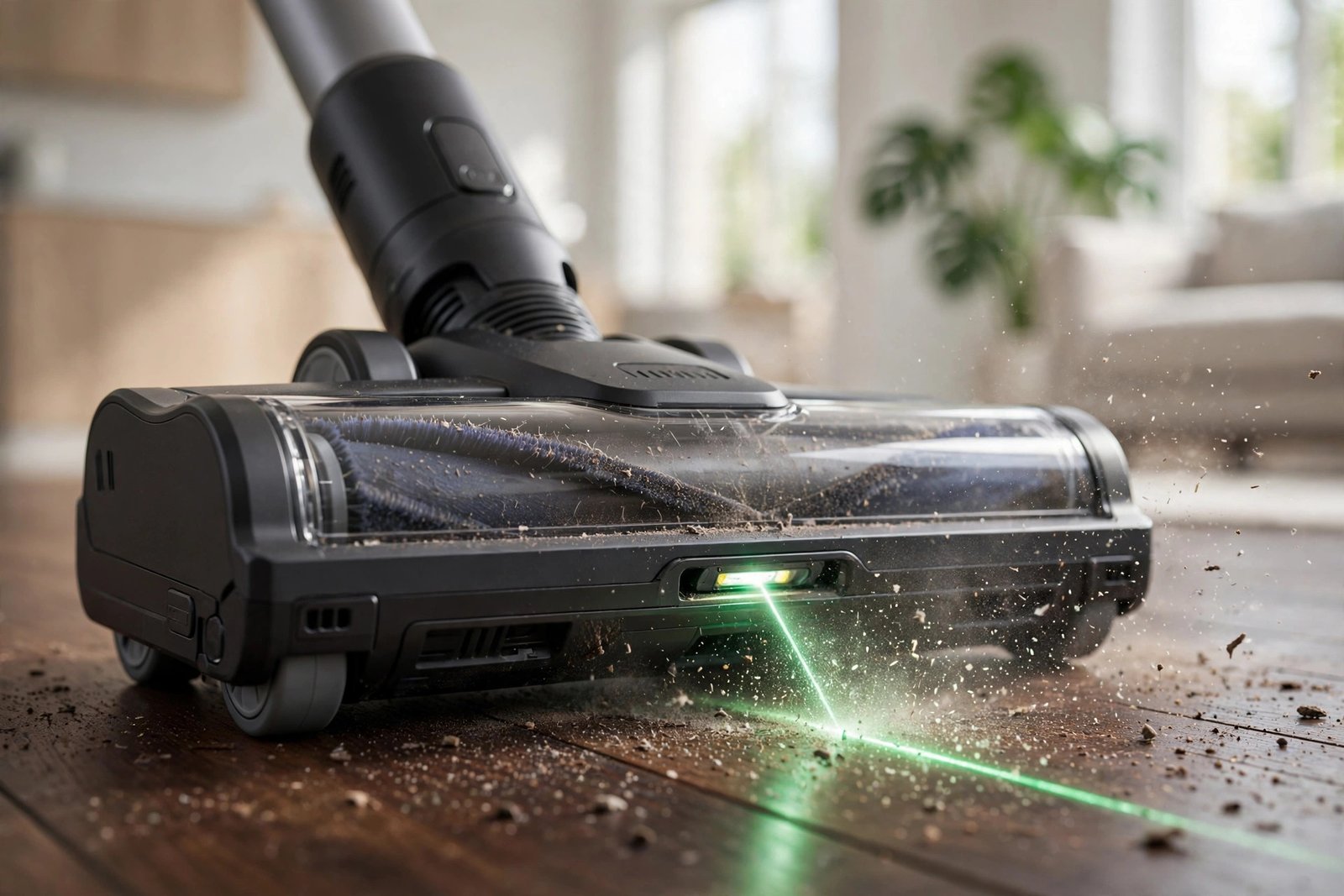
Like our Air Fryer vs Oven head-to-head, this comparison focuses on the things that actually change your daily cleaning experience: suction, battery life, bin capacity, weight, attachments, filtration, price, and warranty. Specs come from dyson.com, Shark’s official materials, and major retailer listings (Best Buy, TechGearLab’s lab measurements) — all checked October 2026. Prices may vary; treat them as current street prices, not permanent quotes.
Dyson vs Shark Vacuum: Head-to-Head on the Specs That Matter
Suction Power and Cleaning Performance
Dyson publishes hard numbers: the V15 Detect’s Hyperdymium motor delivers 240 Air Watts in Boost mode (tested at the inlet to ASTM F558), the highest suction rating Dyson has put in a cordless stick. In Auto mode, a piezo sensor counts dust particles up to 15,000 times per second and ramps suction up or down automatically. On deep-pile carpet and ground-in pet hair, that matters — more raw suction means fewer passes.
Shark takes a different approach and does not publish an Air Watts figure, instead marketing “HyperVelocity Plus” suction. Independent lab tests give us something concrete: TechGearLab’s independent lab tests measured the Stratos Cordless at 647 Pa of suction, with 97% hardwood and 83% low-pile carpet cleaning in their debris tests. Those are strong results — though Pa and Air Watts are different measurements, so don’t treat this as an apples-to-apples number. Shark’s Clean Sense IQ uses infrared sensors to detect hidden dirt and auto-boosts power, claiming up to 50% better dirt pickup than its own Eco mode.
Winner: Dyson. 240 AW is the benchmark in cordless vacuums right now, and the auto-adapting piezo system is genuinely smarter. But the gap on everyday messes — hard floors, low-pile rugs, kitchen crumbs — is narrower than the price gap suggests.
Battery Life and Runtime
Both machines advertise up to 60 minutes of runtime, but the fine print matters. Dyson’s 60 minutes is in Eco mode with a non-motorized tool; expect 30–40 minutes in Auto mode and around 8 minutes in Boost. Charge time is 4.5 hours, and the click-in battery is swappable, so a second battery (sold separately) effectively doubles your cleaning time.
Shark’s 60 minutes is also an Eco-mode figure measured at the hand vacuum. Real-world testing from review outlets lands around 46 minutes in Clean Sense IQ mode and roughly 14 minutes at maximum power. Charge time is shorter — about 3.5 hours — and the battery is also removable. One practical edge for Shark: the Stratos charges faster between cleanings.
Winner: Tie. Both give you an honest hour in low-power mode and drain fast at full power. If your home needs more than 40 minutes of powered cleaning, buy the spare battery for whichever brand you choose.
Cleaner Heads and Attachments
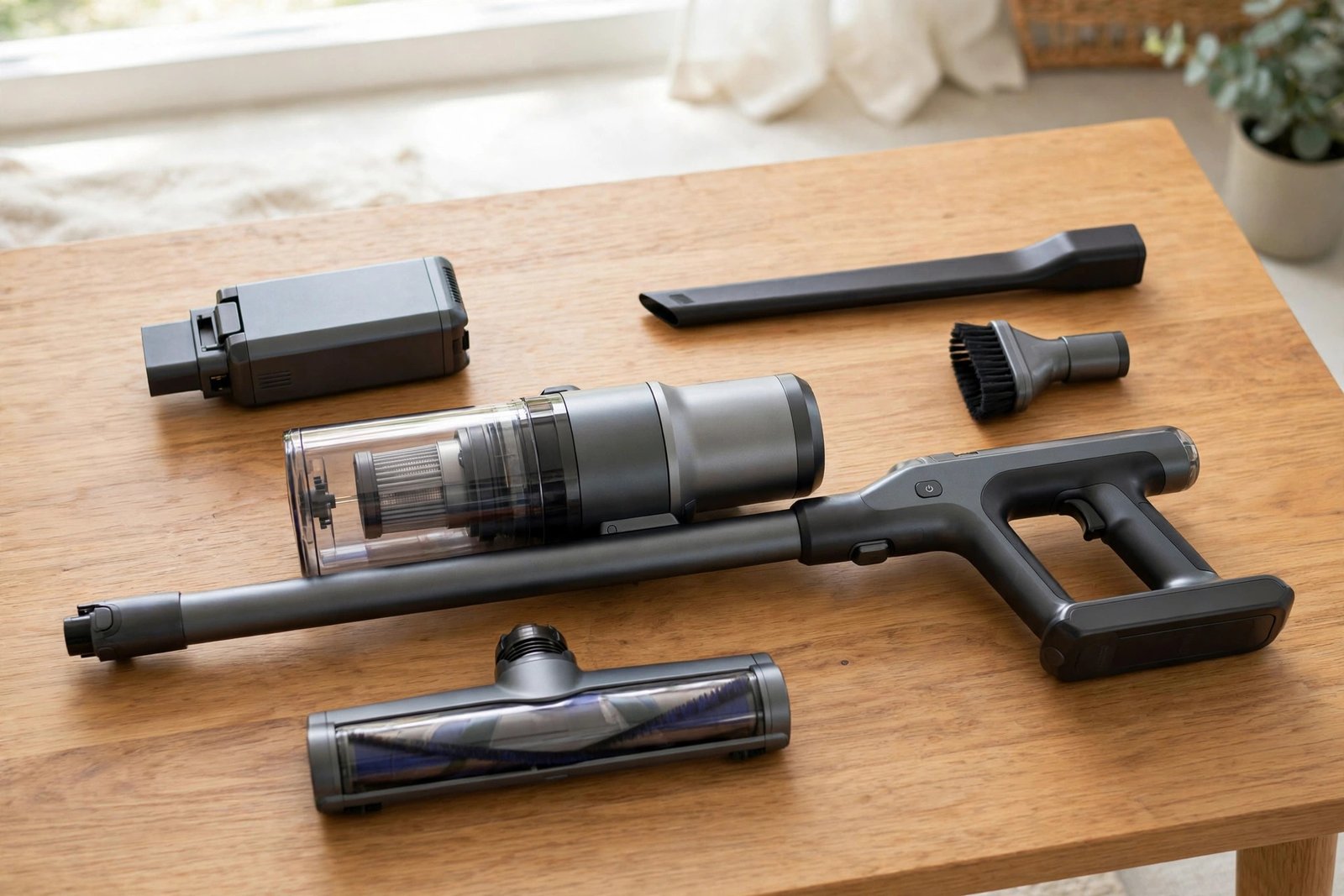
This is where the two brands’ philosophies diverge most. The V15 Detect ships with two standout heads: the Digital Motorbar, which de-tangles hair with polycarbonate vanes so pet hair spirals into the bin instead of wrapping the brush, and the Fluffy Optic head, whose precisely angled laser reveals microscopic dust on hard floors. Seeing the dust you missed is weirdly motivating. The box also includes a hair screw tool, combination tool, crevice tool, and docking station.
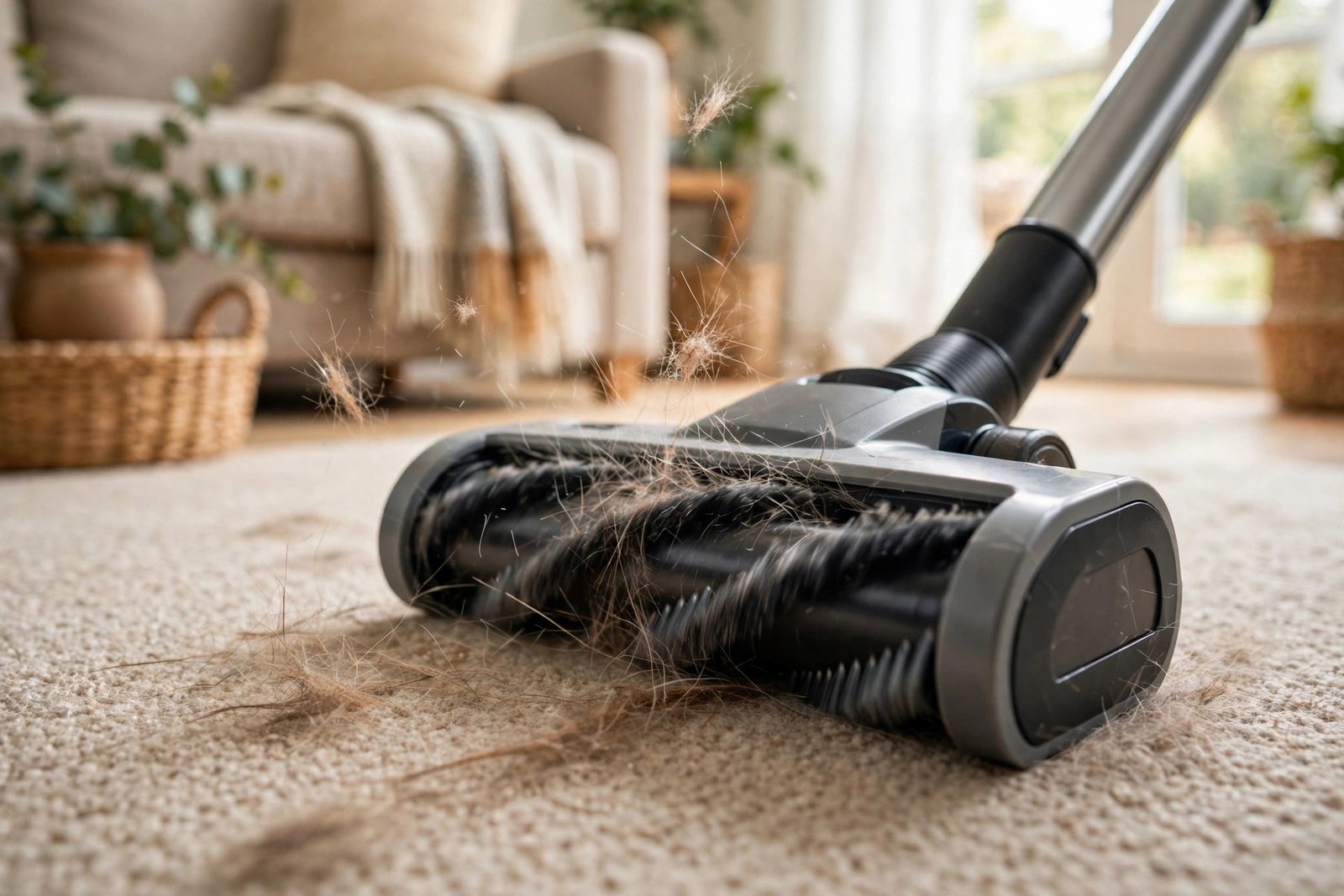
The Stratos answers with DuoClean PowerFins HairPro — a two-brushroll system that handles carpet and hard floors in a single pass, with a self-cleaning brushroll that resists hair wrap. Add Clean Sense IQ auto-boost, an LED smart display, and Odor Neutralizer Technology (a cartridge that guards against bad smells inside the vacuum), and you have a machine clearly designed around real homes with pets. The MultiFLEX wand folds so you can clean under furniture without bending, and the unit folds for compact storage.
Winner: Shark, for pet owners and practicality. The laser is Dyson’s party trick, but Shark’s anti-hair-wrap brushroll, folding wand, and odor control solve daily annoyances the Dyson doesn’t address.
Weight and Maneuverability
Weight is the spec your arms will notice every single cleaning session. The Dyson V15 Detect weighs 6.83 lb. The Shark Stratos Cordless weighs 8.9 lb — a full two pounds heavier. That difference is significant when you’re vacuuming stairs, ceilings, or doing a whole-house clean in one go.
The Shark earns back some goodwill with its flexible MultiFLEX wand, which bends to reach under sofas and beds without you crouching, and its pivoting floorhead. But if you have a multi-story home, wrist issues, or simply hate lugging a heavy stick around, Dyson’s weight advantage is real and daily.
Winner: Dyson. Two pounds lighter is two pounds lighter, every time you pick it up.
Filtration and Allergies
Both machines are strong here. Dyson’s whole-machine filtration is HEPA-grade, trapping 99.99% of particles as small as 0.3 microns, with a fully sealed system so dust doesn’t leak back out. For allergy and asthma sufferers, that sealed HEPA system is the gold standard.
Shark’s Stratos uses a HEPA filter plus an Anti-Allergen Complete Seal that captures 99.9% of dust and allergens inside the vacuum. Both brands’ filters are washable, so there are no recurring filter costs — rinse, air-dry for 24 hours, and you’re done. On tile and grout, where fine dust hides, pair good filtration with a proper grout routine — see our guide to regrouting tile if your bathroom floors need more than vacuuming.
Winner: Dyson, narrowly. 99.99% at 0.3 microns edges out Shark’s 99.9% claim, and the fully sealed whole-machine design is well documented. Allergy sufferers should lean Dyson.
Price and Value
Here’s the number that decides most purchases. The Dyson V15 Detect lists at $749.99 on dyson.com. The Shark Stratos Cordless lists at $499.99 — and it’s frequently on sale; Best Buy recently had it at $399.99, a full $350 under the Dyson. (Prices checked October 2026 and may vary; sales come and go.)
That $250–$350 gap buys you the laser head, the LCD particle counter, stronger peak suction, and two fewer pounds. It does not buy you a longer warranty or a bigger feature set — in fact, the Shark gives you odor neutralization and a folding wand the Dyson lacks. If you’re planning bigger home projects and watching the budget, check the real cost of building a deck or a roof replacement cost breakdown to see where a vacuum fits in your home improvement spending — then decide how much of that budget deserves to go to a stick vacuum.
Winner: Shark. The Stratos delivers roughly 85–90% of the real-world cleaning experience for about half the money.
Warranty and Support
This one isn’t close. Dyson covers cordless vacuums for 2 years (parts and labor, per Dyson’s warranty terms). Shark covers the Stratos for 5 years (limited warranty; the battery itself is covered separately for a shorter period on some models, so register your product and read the terms). More than double the coverage on the cheaper machine is a remarkable value proposition — and it’s one reason Shark has such loyal repeat buyers.
Winner: Shark, by a mile. Five years versus two, on a machine that costs less. Register either machine within 30 days of purchase and keep your receipt.
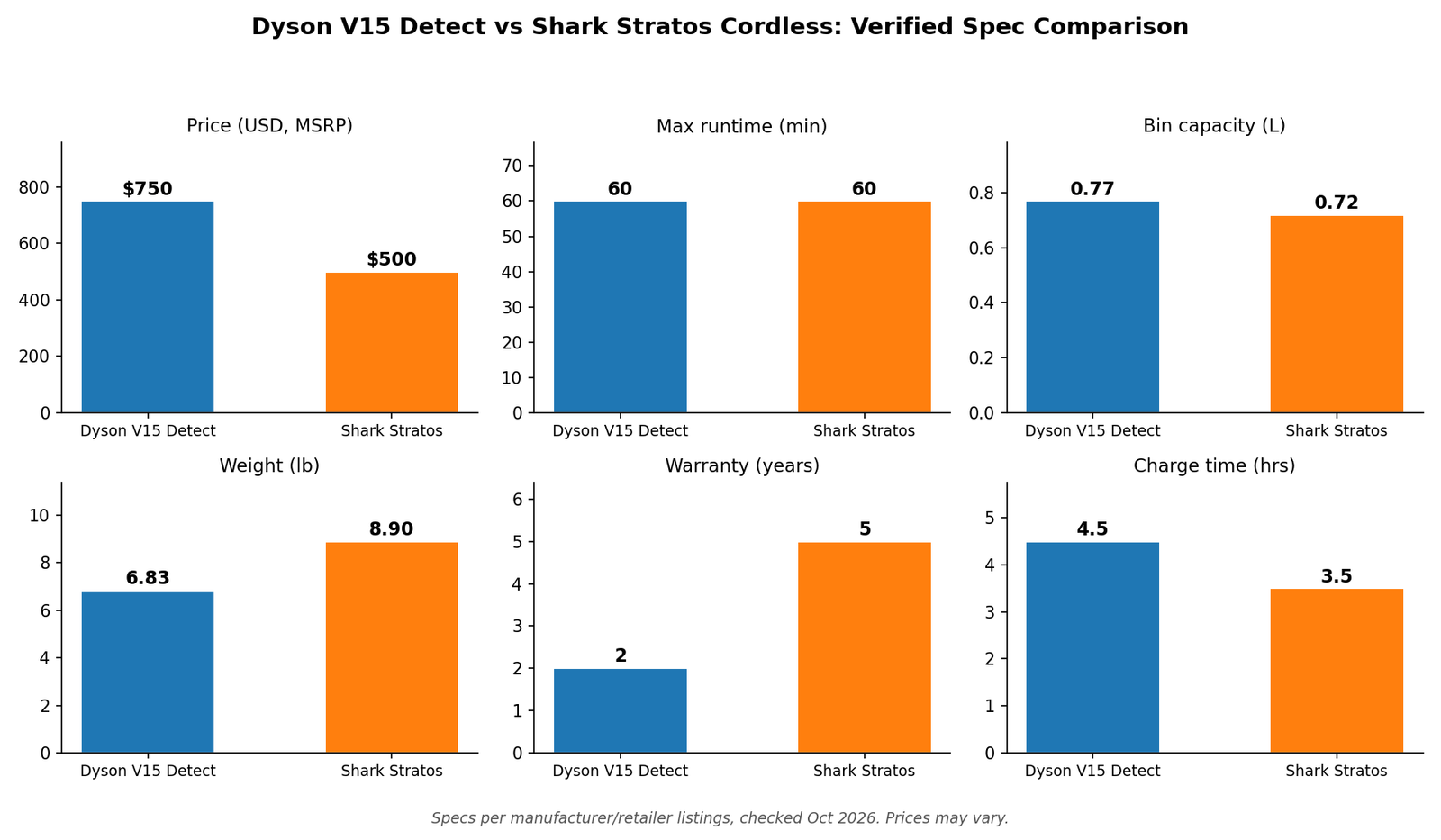
Dyson vs Shark Vacuum: Spec Comparison Table
| Spec | Dyson V15 Detect | Shark Stratos Cordless (IZ862H) |
|---|---|---|
| Price (MSRP, Oct 2026) | $749.99 | $499.99 (often on sale ~$400) |
| Suction | 240 AW (Boost) | HyperVelocity Plus (no published AW rating) |
| Max runtime | Up to 60 min (Eco) | Up to 60 min (Eco) |
| Bin capacity | 0.77 L | 0.72 L |
| Weight | 6.83 lb | 8.9 lb |
| Charge time | 4.5 hours | ~3.5 hours |
| HEPA filtration | Yes — whole-machine HEPA, 99.99% at 0.3 microns | Yes — HEPA + Anti-Allergen Complete Seal, 99.9% |
| Warranty | 2 years | 5 years (limited) |
| Standout feature | Laser dust detection + LCD particle counter | Clean Sense IQ + Odor Neutralizer + folding wand |
Specs from dyson.com, Shark official materials, and retailer listings; prices checked October 2026 and may vary.
The Verdict: Which Should You Buy?
Buy the Dyson V15 Detect if: budget isn’t the deciding factor and you want the most powerful cordless vacuum you can buy. The 240 AW suction, laser dust reveal, and 6.83-lb body make it the best choice for large homes, deep carpet, and allergy sufferers who need sealed HEPA filtration at the highest grade.
Buy the Shark Stratos Cordless if: you want the best value in the category. For $250–$350 less, you get strong everyday cleaning, a dirt-detecting auto-boost system, odor control, a folding under-furniture wand, and a 5-year warranty. It’s the right pick for apartments, busy family homes, and pet owners who’d rather spend the savings on something else. Check current pricing at major retailers like Best Buy, where it frequently drops to around $400.
Either way, you’re getting a genuinely good machine — this isn’t a category with a bad choice at the top end, just a question of how much the last 10% of performance is worth to you. For a deeper independent look at both machines side by side, see this detailed V15 vs Stratos head-to-head breakdown.
Frequently Asked Questions
Is Dyson really better than Shark?
On raw specs, yes — the Dyson V15 Detect has higher measured suction (240 AW), a lighter body (6.83 lb vs 8.9 lb), and finer HEPA filtration. But “better” depends on what you value: the Shark Stratos costs $250–$350 less, charges faster, and carries a 5-year warranty versus Dyson’s 2 years. For everyday cleaning, most homes won’t notice the performance gap.
Which lasts longer on a charge, Dyson or Shark?
Both advertise up to 60 minutes in Eco mode. In practice, expect 30–46 minutes of powered cleaning from either, with maximum-power modes draining both in under 15 minutes. The Shark recharges faster (about 3.5 hours vs Dyson’s 4.5), and both have swappable batteries for extended cleaning sessions.
Do Shark vacuums have HEPA filters?
Yes. The Shark Stratos Cordless uses a HEPA filter with an Anti-Allergen Complete Seal that traps 99.9% of dust and allergens. The filters are washable, so there are no ongoing replacement costs — rinse monthly and let them air-dry for 24 hours.
Is the Dyson V15 Detect worth the extra money over the Shark Stratos?
It’s worth it if you specifically want maximum suction, the laser dust-detection head, the lightest body in its class, and top-tier sealed HEPA filtration. If those don’t matter much to you, the Shark Stratos delivers comparable everyday cleaning for roughly half the price and backs it with a longer warranty.
Which vacuum is better for pet hair, Dyson or Shark?
Both handle pet hair well, but they solve it differently. Dyson’s Digital Motorbar uses polycarbonate vanes to de-tangle hair into the bin automatically. Shark’s DuoClean PowerFins HairPro uses a self-cleaning brushroll designed to resist hair wrap. Either is a strong choice for pet owners; the Shark adds odor-neutralizing technology, which pet households tend to appreciate.
Conclusion
The dyson vs shark vacuum debate doesn’t have a single winner — it has a winner for each budget. The Dyson V15 Detect is the performance king: more suction, less weight, smarter sensors, and elite filtration, all for $749.99. The Shark Stratos Cordless is the value king: genuinely strong cleaning, clever features Dyson doesn’t offer, and a 5-year warranty, for $499.99 or less on sale.
Our take: unless you have severe allergies, deep carpet throughout, or simply want the best money can buy, the Shark Stratos Cordless is the smarter purchase for most homes in 2026. Put the $300 you save toward something else on the home to-do list — your floors will still be clean.