
Air fryer vs oven — it’s the kitchen debate that refuses to die. One side swears the air fryer changed their life; the other insists nothing beats a real oven. The truth is less dramatic than either camp admits: both appliances cook with hot air, both can make excellent food, and the right choice depends almost entirely on what you cook, how many people you feed, and what your electricity bill looks like. This guide settles the air fryer vs oven question with real test data on energy use, cook times, running costs, and health — so you can stop guessing and pick the winner for your kitchen.
Here’s the short version up front: for small, everyday meals — a couple of chicken breasts, a tray of fries, reheating last night’s pizza — the air fryer wins on speed, energy, and cost. For big family cooking, batch baking, and anything that needs real capacity, the oven still rules. But the numbers behind that summary are more interesting than you’d expect, and a few of them might genuinely surprise you.
How They Actually Work (They’re More Similar Than You Think)
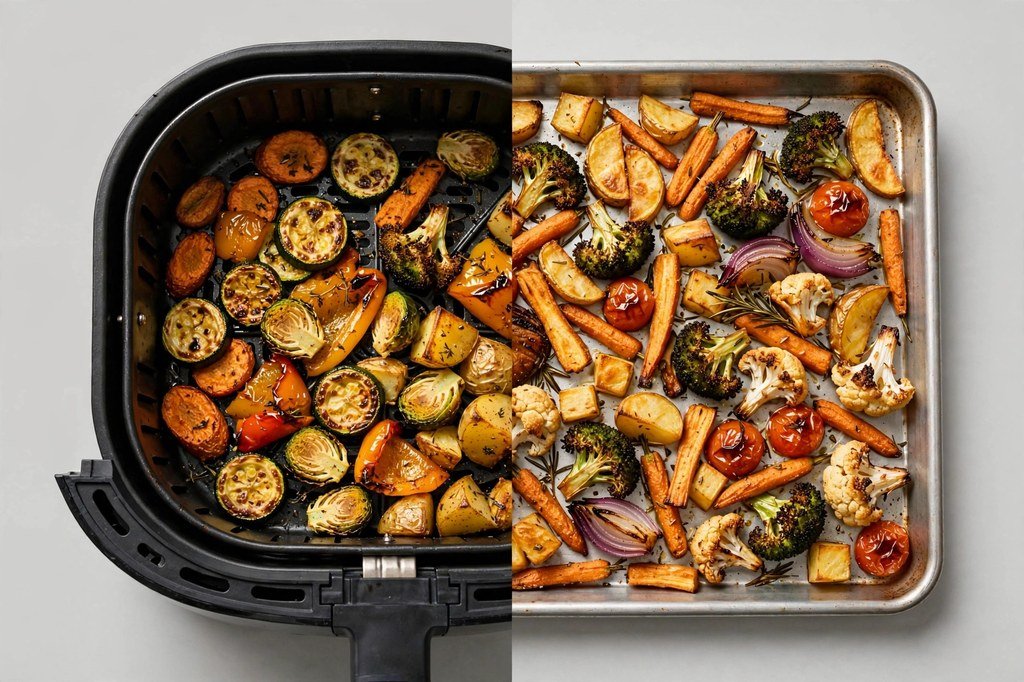
An air fryer is, technically, a small, high-powered convection oven. A heating element sits above the food while a fan blasts hot air around it at high speed. The basket has holes or a raised crisper plate so air reaches the underside too. That fast, dry, circulating heat browns the surface the way hot oil does — which is why a thin coat of oil is enough to get a crispy crust.
A conventional oven works on the same principle but at a much larger scale: heating elements warm a big metal box, and in convection ovens a fan circulates the air. The difference is physics, not magic. The air fryer’s tiny cavity heats up in minutes and the aggressive fan relative to that small space crisps food faster. The oven’s large cavity takes 10 to 15 minutes just to preheat, but it can hold a whole roast dinner, multiple trays, or a big batch of cookies at once. Same technology — wildly different trade-offs.
Air Fryer vs Oven: Which Costs Less to Run?
This is where the air fryer genuinely earns its reputation. Two factors decide running cost: how much power the appliance draws (wattage) and how long it runs. Air fryers typically draw 1,200–1,800 watts; full-size ovens draw 2,000–5,000 watts. But the bigger gap is time: air fryers need only 2–3 minutes of preheating and cook 20–30% faster, while ovens need 10–15 minutes of preheating alone — energy spent before food even goes in.
Real measured tests back this up. In independent Which? energy tests, cooking a roast chicken used 0.54 kWh in the air fryer versus 1.157 kWh in a built-in oven — the oven used more than twice the energy. A cake was even more dramatic: 0.223 kWh in the air fryer versus 0.71 kWh in the oven, over three times the energy. Separate independent energy measurements found a toad in the hole used 0.387 kWh in an air fryer against 1.575 kWh in an oven — roughly a quarter of the energy.
Translated to money: at typical electricity rates, a chicken that costs about 14p in the air fryer costs about 30p in the oven. Do that once a week and the air fryer saves roughly £8 a year on that one dish alone — modest, but it stacks up across daily cooking. The U.S. Department of Energy’s energy-saving guidance confirms the principle: smaller cooking appliances like toaster and convection ovens use one-third to one-half the energy of a full-sized oven for the same job.
One honest caveat: the air fryer’s advantage shrinks when you cook for a crowd. If you’re running three back-to-back batches to feed six people, the reheating between batches can erase the savings. For family-size cooking in one go, the oven’s big cavity wins — Which? notes that a full roast dinner is still cheaper in the oven because you can use all the surrounding space at once.
Energy Use Per Cooking Session: The Measured Numbers
Here’s the head-to-head data from published appliance tests, all measuring actual electricity consumed per cooking session:
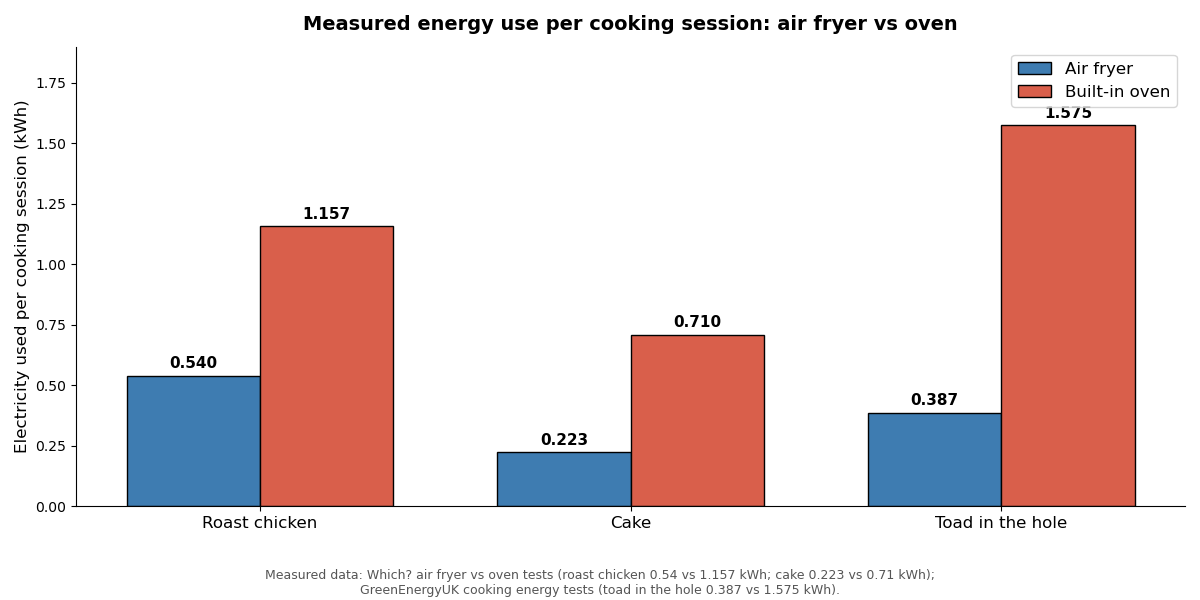
The pattern is consistent across every test and every dish: the air fryer uses roughly half to a quarter of the oven’s energy. Note the cake result in particular — for small baking tasks the gap is enormous, because the oven spends most of its energy just heating its own large cavity. These aren’t estimates; they’re smart-meter and lab measurements from independent testers.
Which Cooks Faster?
Speed is the air fryer’s second big win, and it’s directly tied to the energy numbers above. Less cavity to heat means 2–5 minutes to reach temperature instead of 10–20. The aggressive fan means food crisps faster once it’s in. In the Which? tests, roast chicken took 53 minutes in the air fryer versus 76 minutes in the oven, and the cake took 33 minutes versus 56 minutes — roughly a 30–40% time saving.
In everyday cooking the gap feels even bigger because of preheating. Reheating two slices of pizza takes about 5 minutes in an air fryer versus 15 minutes of cooking plus 10 minutes of preheating in an oven. Frozen fries: 14–15 minutes in the air fryer against 25–35 in the oven. When you’re cooking after a long workday, that difference is the gap between “I’ll just cook” and “I’ll order takeout.” Over a year of weeknight dinners, the time savings are genuinely significant — and less time cooking means less temptation to reach for expensive delivery, which is one more quiet way to save money on groceries.
Where the oven claws back time is volume. One oven tray holds what might take an air fryer three batches. If you’re cooking for four or more, the oven’s single big batch usually finishes before the air fryer’s third round starts.
Air Fryer vs Oven: Which Is Healthier?
Health is where marketing gets loudest — and where the honest answer needs the most nuance. The core fact: an air fryer is basically a small convection oven, so compared against an oven using the same amount of oil, the health difference is small. The air fryer’s real health advantage shows up in two specific situations.
First, against deep frying, air frying is dramatically lighter. According to Cleveland Clinic nutrition guidance, using an air fryer — which needs about a tablespoon of oil — can cut the calories you’d get from deep frying by up to 80%, because you’re not submerging food in a pot of fat. Since fats carry nine calories per gram, that oil reduction translates directly into a lighter plate. If your alternative to the air fryer is the deep fryer or the takeaway menu, the air fryer is unambiguously the healthier pick.
Second, air frying can reduce acrylamide — a chemical that forms when starchy foods like potatoes are cooked at high heat, and which animal studies link to cancer risk at high doses. Cleveland Clinic notes that one study found air frying reduced acrylamide by up to 90% compared to deep frying, thanks to shorter cooking times and less oil. That said, the comparison that matters for most buyers is air fryer vs oven, not air fryer vs deep fryer — and there, both use hot air and modest oil, so the acrylamide gap is far narrower.
The honest verdict: an air fryer is healthier than deep frying by a wide margin, and roughly on par with a conventional oven for the same recipe with the same oil. Where it can genuinely help your diet is behavioral — because it’s fast and makes crispy food with minimal oil, people tend to cook fresh vegetables and lean proteins at home instead of ordering fried takeout. The healthiest appliance is the one that gets you cooking real food.
The Full Comparison Table
| Factor | Air Fryer | Conventional Oven |
|---|---|---|
| Typical wattage | 1,200–1,800 W | 2,000–5,000 W |
| Preheat time | 2–5 minutes | 10–20 minutes |
| Cook time (typical small meal) | 12–20 minutes | 25–45 minutes |
| Energy per session | ~0.2–0.6 kWh (measured) | ~0.7–1.6 kWh (measured) |
| Running cost | Lower per session for small meals | Lower per serving for large batches |
| Oil needed | Minimal — about a tablespoon or a light spray | Same for roasting; more for tray bakes |
| Capacity | Small — typically 0.3–2.4 kg of food | Large — whole roasts, multiple trays |
| Best for | Quick weeknight meals, reheating, crispy snacks, 1–2 people | Family dinners, batch cooking, baking, roasts |
| Worst for | Feeding a crowd, large roasts, multi-tray baking | Single portions, quick reheats (wasteful preheating) |
| Upfront cost | £30–£285 for the appliance itself | Already in most kitchens; £300+ to replace |
| Kitchen heat | Minimal — small cavity, contained heat | Heats the whole kitchen in summer |
| Health edge | Big win vs deep frying; similar to oven with equal oil | Identical method — hot air; results depend on recipe |
When the Oven Still Wins
Let’s be fair to the oven, because there are plenty of kitchens where it’s the right tool. Feeding four or more people? The oven wins on both time and energy — one big batch beats three air fryer rounds. Baking? Full-size cakes, bread loaves, and multi-tray cookie batches need oven space; the air fryer can handle a small cake brilliantly (the Which? test cake scored 5 stars), but a celebration cake isn’t happening in a 4-quart basket. Roast dinners? A whole chicken plus roast potatoes plus vegetables, all cooking together in the surrounding oven space, is more efficient than juggling batches.
The oven also wins on versatility of technique: slow roasting, braising in a Dutch oven, broiling large cuts, and baking at precise low temperatures for hours. An air fryer is a sprinter; the oven is a marathon runner. Many serious home cooks end up using both — the air fryer for fast weeknight cooking and the oven for weekend projects. If you’re setting up a kitchen on a tight budget, a decent air fryer plus a basic oven covers nearly every cooking scenario, and planning your small kitchen organization around both keeps counters workable.
When the Air Fryer Is the Smarter Buy
The air fryer earns its counter space if any of these sound like you: you cook for one or two people most nights; you reheat leftovers constantly (it’s vastly better than a microwave for anything that should stay crispy); you want weeknight dinners in 15–20 minutes without preheating a cavernous oven; your electricity bill makes you wince; or your kitchen turns into a sauna every time the oven runs in summer. It’s also a genuine money-saver for renters and students — a £60–£80 air fryer can replace an oven you don’t have. Pair it with a weekly meal prep session and you’ve got fast, cheap, home-cooked food all week with minimal energy use. And if you’re refreshing the space around it, there are plenty of kitchen upgrades on a budget that make a small cooking corner feel intentional rather than improvised.
Frequently Asked Questions
Does an air fryer use less electricity than an oven?
Yes — for small to medium meals, significantly less. Measured tests show an air fryer uses roughly half to a quarter of the energy of a full-size oven for the same dish: 0.54 kWh vs 1.157 kWh for a roast chicken, and 0.223 kWh vs 0.71 kWh for a cake in independent Which? testing. The savings come from lower wattage, minimal preheating, and faster cooking. For large family batches cooked all at once, the oven can be more efficient overall.
Which cooks faster, air fryer or oven?
The air fryer, by roughly 20–40% for typical meals. It preheats in 2–5 minutes (vs 10–20 for an oven) and its powerful fan crisps food faster. A roast chicken took 53 minutes in an air fryer versus 76 in an oven in Which? tests. The exception is large quantities: an oven cooking one big batch for six people usually beats an air fryer doing three consecutive batches.
Is an air fryer healthier than a conventional oven?
It’s healthier than deep frying by a wide margin — Cleveland Clinic notes air frying can cut deep-frying calories by up to 80% since it uses about a tablespoon of oil instead of a pot of it. Compared to a conventional oven with the same recipe and oil, the difference is small: both cook with circulating hot air. The air fryer’s health advantage is mostly behavioral — its speed and crispiness make it easier to cook fresh food at home instead of ordering fried takeout.
Can an air fryer replace my oven completely?
For one or two people who mostly cook simple meals, nearly — many small households do exactly this. But it can’t match an oven’s capacity for big roasts, multi-tray baking, large casseroles, or cooking several dishes at once. Most cooks who own both use the air fryer for fast weeknight meals and the oven for bigger weekend cooking.
Do air fryers really save money?
On running costs, yes, modestly. Each session costs roughly half to a third of an oven session, which adds up with daily use — Which? estimated about £8 a year saved on a weekly roast chicken alone. But factor in the purchase price (£30–£285): a cheap model pays for itself quickly with regular use, while a premium one takes much longer. The biggest savings come from cooking at home instead of ordering takeout.
Is air-fried food actually crispy without much oil?
Yes — that’s the whole trick. The high-speed fan drives hot air around the food so aggressively that the surface browns and crisps much like it would in hot oil, using only a light spray or tablespoon of oil. For the crispiest results, don’t overcrowd the basket, shake or flip halfway through, and pat moist foods dry before cooking.
Conclusion
So, air fryer vs oven — who wins? For speed, energy use, and running cost on everyday small meals, the air fryer takes it, and the measured data isn’t close: half to a quarter of the energy, 20–40% faster, at a fraction of the per-session cost. For capacity, big family cooking, serious baking, and all-at-once roast dinners, the oven remains unbeatable. On health, the air fryer crushes deep frying but is roughly even with the oven for the same recipe. The smartest kitchen isn’t air fryer or oven — it’s knowing which one to reach for, and now you do.