
Kindle vs Paper Books: Which Is Better for Readers in 2026?
The book world has been arguing about this for nearly two decades, and it still comes up at every dinner party: Kindle vs paper books — which is actually better? I’ve read hundreds of books on both, from beach paperbacks to a battered e-reader that’s survived three continents. The honest answer is that neither wins outright. The right choice depends on how you read, where you read, and what you value most. Let’s settle it category by category.
Kindle vs Paper Books at a Glance
Here’s the quick comparison, then we’ll dig into each factor:
| Factor | Kindle / E-reader | Paper Books |
|---|---|---|
| Upfront cost | $100–200 for the device | $0 — start with one book |
| Cost per book | Ebooks often cheaper; many classics free | New paperbacks typically $12–20 |
| Portability | Thousands of books, ~7 oz | One book at a time, real weight |
| Eye strain | E-ink mimics paper; front light for night | Zero screen time; needs a lamp |
| Battery | Weeks per charge | Never needs charging |
| Reading retention | Slight edge to print in some studies | Physical pages aid spatial memory |
| Library access | Instant downloads, huge stores | Bookstores, libraries, lending |
| Durability | Fragile screen; waterproof models exist | Survives drops, sand, and bathtubs |
| Sharing & resale | Locked to your account | Lend, gift, resell freely |
Cost: Which One Saves You Money?
This is where the math gets interesting. A Kindle costs real money upfront — budget roughly $100–150 for a current e-reader — while a paperback costs nothing to start. But ebooks are usually a few dollars cheaper than their print editions, and thousands of classics are completely free through sources like Project Gutenberg. So the e-reader pays for itself eventually; the question is how fast.
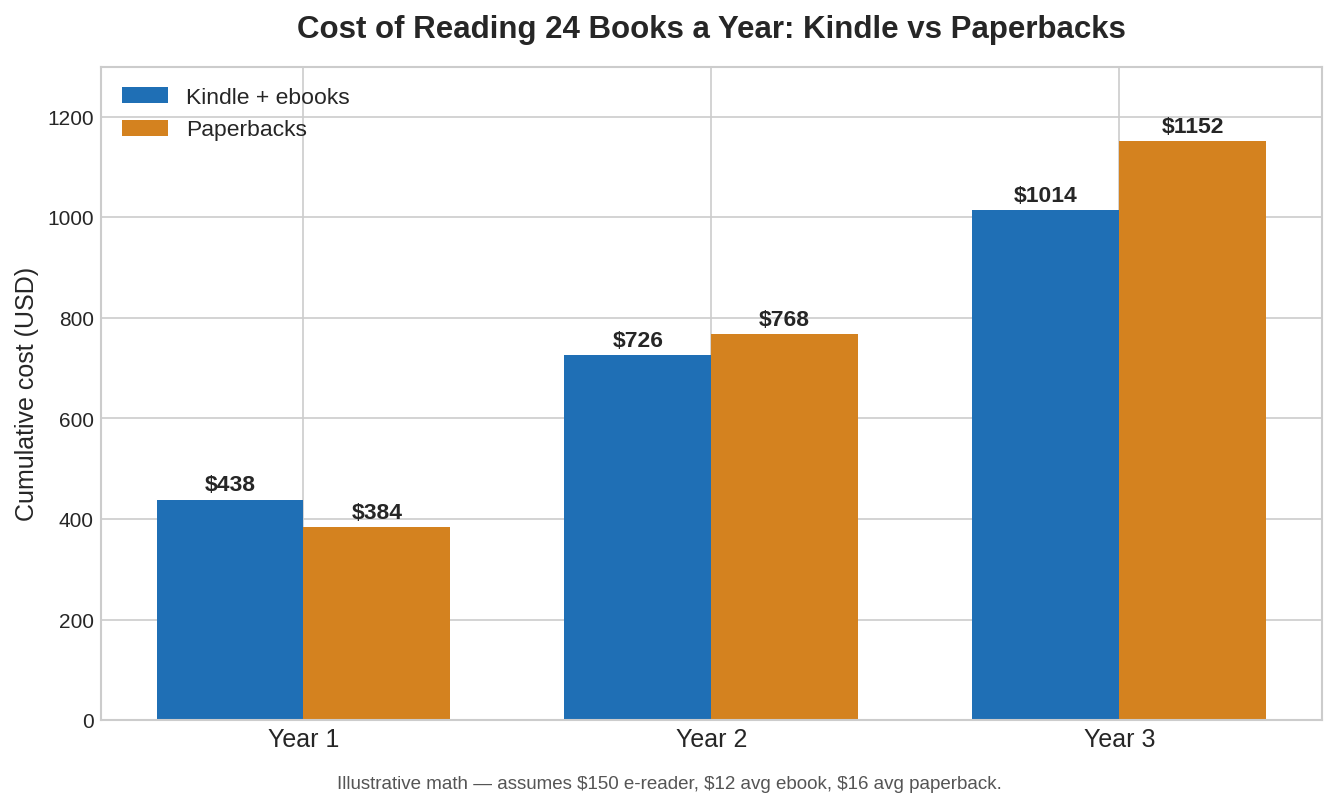
The chart above runs the numbers for someone who reads 24 books a year (two a month) — illustrative math with stated assumptions: a $150 e-reader, a $12 average ebook price, and a $16 average paperback price. In year one, paper wins ($384 vs $438). By year two, the e-reader pulls ahead, and by year three the Kindle reader has saved roughly $140. Read more than two books a month and the crossover happens even faster. Read six books a year and the device may never pay for itself.
One caveat: heavy readers can also borrow ebooks from public libraries for free, which changes the equation entirely — and paperback fans can buy used, which is often cheaper than any ebook.

Eye Strain and Reading Comfort
This is the most misunderstood part of the Kindle vs paper books debate. A modern e-reader doesn’t have a glowing screen like your phone — it uses e-ink, a technology that reflects ambient light much like paper does. The Kindle Paperwhite uses a 300 ppi glare-free display that reads comfortably even in bright sunlight, with an adjustable warm front light for night reading.
That said, paper still has one unbeatable advantage: it emits no light at all. If you’re doing a serious digital detox or you’re sensitive to any screen time before bed, a physical book is the purest option. But for most people, e-ink causes no more eye fatigue than print — the real culprits are tiny font sizes and poor lighting, and e-readers actually let you fix both by enlarging text.
One genuine comfort win for e-readers: weight. A 600-page fantasy epic weighs the same as a novella on a Kindle — about 7 ounces. Anyone who’s held a hardcover one-handed in bed knows the difference.
Portability: The Travel Test
Ask any frequent traveler and this category isn’t close. An e-reader holds thousands of books in less space than a single paperback. For flights, commutes, and vacations, it’s transformative — you never finish a book mid-trip with nothing to read next.
Paper fights back on durability. Books survive drops, sand, poolside splashes, and being shoved into an overstuffed bag. E-readers have gotten tougher — current models are waterproof enough for the bath or beach — but a cracked e-ink screen is a $100+ problem, while a bent paperback cover is character.
Reading Retention and Focus
Here’s where paper books quietly win. Multiple reading studies over the past decade have found a small but consistent edge for print when it comes to remembering what you read — especially the order of events and where information appeared. Researchers think physical pages give your brain spatial landmarks (“that was on the left side, about two-thirds through”) that scrolling or tapping doesn’t replicate.
The difference is modest for casual fiction, but if you’re studying, learning a skill, or reading dense nonfiction, print has a real advantage. Researchers also note that the tactile feedback of turning pages helps readers gauge their progress through a book intuitively — a sense of place that’s harder to replicate with a percentage counter. Focus is the other factor: a Kindle is a single-purpose device with no notifications, which beats reading on a phone or tablet — but a paper book can’t tempt you to check the news between chapters either. For deep work reading, paper remains the gold standard.
That said, e-readers offer focus tools of their own. Built-in dictionaries let you look up unfamiliar words without breaking your flow, and features that sync your progress between devices mean you can pick up where you left off whether you’re on your e-reader, phone, or tablet. For commuters who read in short bursts, that continuity is genuinely useful.
Library Access and Ownership
Kindle’s superpower is instant gratification. Finish a book at midnight, buy the sequel in ten seconds, start reading immediately. The ecosystem is enormous, and ebook adoption has made digital the default format for a huge share of new releases.
Paper’s superpower is freedom. You truly own a physical book: lend it, gift it, scribble in the margins, resell it, leave it on a park bench. Ebooks are licenses tied to your account — you can’t lend most of them freely or pass them to your kids. Book lovers who build personal libraries, browse used bookstores, or treasure signed copies will never give that up, and they shouldn’t have to.

So Which Should You Choose?
Get a Kindle (or other e-reader) if: you read more than a book a month, you travel, you read in bed at night, you like big books but hate carrying them, or you want adjustable text size. It’s the practical workhorse.
Stick with paper books if: you read slowly and savor, you study or annotate heavily, you love bookstores and physical libraries, you share books with friends, or you’re cutting screen time. It’s the richer experience.
Plenty of serious readers — myself included — use both: Kindle for travel, late-night reading, and doorstopper novels; paper for the bookshelf keepers, gifts, and anything worth underlining. The format war only matters if you let it. What matters is that you’re reading, whether that’s on a device you track or a stack of paperbacks on your nightstand.
Frequently Asked Questions
Is reading on a Kindle bad for your eyes?
No more than reading print. E-ink displays reflect light like paper rather than emitting it like a phone or tablet screen, so they don’t cause the same kind of eye fatigue. Adjustable text size and warm lighting actually reduce strain for many readers.
Do ebooks cost less than paper books?
Usually, yes — new-release ebooks are typically a few dollars cheaper than paperbacks, and thousands of classics are free. But used paperbacks can undercut ebooks, and library borrowing is free in both formats.
Can you share Kindle books with others?
Only in limited ways. Most Kindle ebooks are licensed to your account and can’t be freely lent like a physical book, though Amazon’s household sharing lets family members on the same account access your library.
How long does a Kindle battery last?
Weeks, not hours. Current e-readers advertise up to 10 weeks of battery life on a single charge with typical use (about 30 minutes of reading per day with the light at moderate brightness). Heavy readers will charge more often, but still far less than a phone.
Do people remember less of what they read on screens?
Studies suggest a small retention edge for print, particularly for recalling the sequence of events and locating information. The effect is modest for pleasure reading but more noticeable for studying — one reason students often prefer physical textbooks.
Is it worth buying a Kindle if I read only a few books a year?
Probably not for cost reasons — at a few books a year, the device may never pay for itself versus paperbacks. But if you value portability, night reading, or adjustable text, the convenience alone can justify it.
Conclusion
Kindle vs paper books isn’t a war with a winner — it’s a toolbox with two excellent tools. The Kindle wins on portability, cost-per-book for heavy readers, night reading, and instant access. Paper wins on retention, ownership, sharing, and the simple sensory pleasure of a real book. Match the format to the moment: e-reader for the red-eye flight, paperback for the Sunday afternoon. And if you’re trying to build a calmer reading life overall, pairing your format of choice with a habit like journaling will do more for you than any device ever could.



